Dystopia by Design: From ARPANET to Veracore
From Innovation to Surveillance
The year is 2075, and the promise of innovation and a brighter future has collapsed into a dystopian world dominated by surveillance and control under an autocratic government. This future did not emerge overnight but was caused by the slow surrender of privacy and autonomy in exchange for convenience and connectivity. Every innovation, from the creation of the internet in the 1960s to the rise of the World Wide Web and social media platforms like Facebook and Instagram, has carried promises of progress and connection but hidden significant costs. Technologies such as predictive policing, artificial intelligence, and neural surveillance were introduced with the promise of eliminating crime, cognitive advancement, and daily optimization, but their risks were ignored. In this essay, I will unearth the historical evolution of the internet and explore how a landscape built on convenience has led to the birth of Veracore, a platform that has destroyed the very essence of human agency.
The Internet’s Evolution
First, it is essential to look back at the evolution of the internet to understand how today’s technological landscape came to be. The initial concept of the internet was first conceived by renowned UCLA professor Leonard Kleinrock in 1961 through his theory on packet switching. The idea then became a reality in 1969 when the United States Department of Defense announced the launch of the first operational packet-switching network, called the Advanced Research Projects Agency Network (ARPANET), which is the precursor to today’s internet. The original purpose was to decentralize communications and ensure the resilience of information against attacks during the Cold War, a purpose that has since significantly changed. The first nodes were installed at UCSB, UCLA, Stanford, and the University of Utah, and the first message was sent from UCLA to Stanford (Emspak & Zimmermann, 2022). Later in 1972, Ray Tomlinson created the first email, and in 1973, the term “Internet” was coined. The following year launched the first internet service provider, Telenet. In 1982, the TCP/IP protocol suite was originated, which created the foundation for the modern internet, and by the mid-1980s, internet speed reached 56,000 bits per second, just 0.01% of today’s average.
The 1990s brought the introduction of the World Wide Web, thanks to Tim Berners-Lee, who brought the internet to a global scale and introduced a medium for communication, commerce, and social interaction. The early 2000s saw further innovation with the rapid rise of social media platforms, including MySpace, Facebook, Twitter, and Instagram, which redefined how people interacted, shared information, and built their identities (Emspak & Zimmermann, 2022). However, the internet’s initial promise of openness and freedom shifted toward a reality where a once-decentralized tool for communication transformed into a reality where digital spaces are dominated by corporate monopolies fueled by algorithmic manipulation and the commodification of personal data. This revolution laid the foundation for surveillance capitalism, digital alienation, and the dystopian digital landscape that would fully emerge in the year 2075.
Life Under Veracore
The year is 2075, and the world is run by one omnipotent platform, Veracore. The very name sends shivers down the spines of many. An organization founded on the principles of “truth, unity, and progress,” Veracore now represents the culmination of decades of gradual technological surrender, where citizens have continually traded privacy and autonomy for convenience and innovation. What was once a sensible social networking platform has grown into a corporate-state hybrid conglomerate that now controls every aspect of human life. It is not simply a platform; it is an infrastructure that controls every aspect of civilization, from politics and commerce to culture and even interpersonal relationships. Once sovereign and democratic governments are now fully reliant on Veracore. Its algorithms are so powerful that they determine the outcome of elections long before they happen. The party that promises to bend the knee to the demands of the platform receives the privilege of visibility. As communications theorist Christian Fuchs (2023) has warned, digital platforms are no longer neutral; they have become instruments of ideology for those who create them, embedding capitalistic and state imperatives into every interaction. Their policies get amplified, their leaders get deified, and their opponents get silenced.
For any entity, whether it be a business, a political movement, or even a religious institution, to not only thrive but exist, it must cater to every algorithmic impulse and strategic mandate of Veracore. For ordinary citizens, life revolves around their presence on Veracore; intrinsic value is no longer measured by someone’s physical skills or charisma but in their algorithmic visibility, their likes and follower count and, most importantly, their platform rank. Your Veracore Visibility Score (VVS) now determines all aspects of life, including your access to jobs, healthcare, housing, and even judicial outcomes. By the year 2075, the concept of privacy is no longer imaginable. Every citizen has a neural surveillance implant, a device that was initially marketed as a revolutionary tool for mental health and cognitive optimization but was later mandated through Veracore’s control over the government as a requirement to live in their “free” society. The device is a significant instrument for predictive policing, as it is capable of identifying dangerous thoughts and behaviours before they manifest into crimes. These implants analyze and collect citizens’ personal data in real time, which Veracore then bundles and sells to advertisers. The technology is justified as increasing safety, but in reality, it represents a complete collapse of autonomy and individualism.
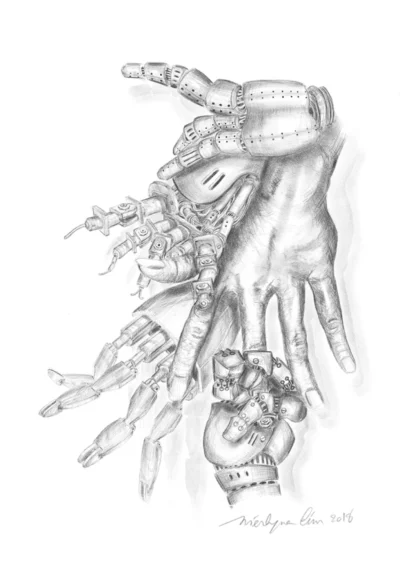
Alienation and Hyperreality
In the year 2075, Christian Fuchs’ concept of digital alienation has fully manifested, and his warnings about the capitalist colonization of the digital public sphere are visible everywhere. The citizens in this world are alienated economically, politically, and culturally (Fuchs, 2023, p. 280). The economic alienation is present in the endless streams of unpaid labour they are forced to perform for Veracore. The citizens are stuck in a phase of “prosumers,” forced to constantly curate content and interact with others to improve their VVS. What they do is not considered work; however, it is essential for survival (Fuchs, 2023, p. 289). The political alienation is present through the death of the democratic system and the birth of a new algorithmic regime. Since elections are no longer contested but instead shaped by Veracore’s algorithms, political parties no longer campaign to citizens; they negotiate directly with the platform. The opposition is algorithmically silenced, and all movements conflicting with Veracore’s ideological framework simply are not visible.
The cultural alienation might be the worst of all. In Veracore’s new society, culture can no longer emerge organically through communities, traditions, or shared human experiences. Instead, culture is now artificially engineered through Veracore’s algorithm, which augments content in line with its ideological standpoints. As Christian Fuchs argues, digital platforms embed capitalistic and state priorities into the fundamental structures of everyday life. This has never been truer than what the citizens are facing in the year 2075; citizens no longer consume the content they choose; they consume what Veracore wants them to see. They are trapped in a filter bubble of predetermined entertainment, news, and even relationships (Fuchs, 2023, p. 283).
This engineered reality has devastating consequences. Along with deciding political outcomes and the content everyone sees, Fuchs’ concept of influencer capitalism is also present. In this dystopian future, a handful of celebrities have risen to near god-like status. These influencers, who have been chosen by having the highest VVS, serve as cultural and political gatekeepers. They are the ones who decide fashion and lifestyle trends, shape public opinion, and even dictate the moral codes of society. To increase one’s own VVS, citizens are forced to emulate the decisions of influencers or lose all visibility (Fuchs, 2023, p. 283). This platform has led to the deterioration of in-person interaction and a drastic decline in birth rates, as people are too addicted to improving their VVS and brainwashed by the hyperrealistic platform.
As Baudrillard discussed with his theory of hyperreality, these technologies create a simulation so immersive that they feel more real than reality itself (Kellner, 2019). Through the neural implants, users can enter fantasy worlds where anything is possible: money, love, fame—you can have it all, if your VVS is high enough. The Veracore platform challenges the very essence of being human. The birth rate has fallen to almost zero, as being a parent has no impact on one’s VVS, and the fate of humanity is at risk. This is the reality we could be facing come 2075. The accumulation of small conveniences over time can lead to the erosion of autonomy and agency. Every technological milestone, from the creation of the internet to the prominence of social media, has been accompanied by promises of progress and connection, yet has carried with it hidden costs. What initially appeared as a tool for innovation slowly became a method of control to reshape human behaviour and test the boundaries of freedom. Reflecting on this potential reality forces us to ask many difficult questions, including: What is the true cost of convenience? And at what point does technological advancement become human limitation? This future is not inevitable, but it is possible. The decisions we make today regarding the allowances of technology will determine whether society moves towards technological empowerment or enslavement.
Ethical Imperatives for the Future
In conclusion, this dystopian vision of 2075 envisions the danger of surrendering privacy and autonomy for convenience and technological advancement. The Veracore platform represents the culmination of decades of compromises, where innovation was prioritized, and the costs of personal data collection, surveillance, and algorithmic control were minimized or ignored. By the year 2075, society has become built on a system where visibility is value, and freedom is eradicated. To prevent this reality, we must critically analyze the technologies we utilize and adopt, resist the normalization of surveillance, and demand transparency and accountability from governments and organizations. Through the protection of key digital rights and the prioritization of ethical innovation, we can harness technology not as a tool of control but as a means of empowerment. Ultimately, the decisions we make today will determine the future we live tomorrow and the legacy we leave for generations to come.
References
Fuchs, C. (2023). Digital democracy and the digital public sphere. Routledge. https://doi.org/10.4324/9781003331087
Emspak, J., & Zimmermann, K. A. (2022, April 8). Internet history timeline: ARPANET to the World Wide Web. Live Science. https://www.livescience.com/20727-internet-history.html
Kellner, D. (2019). Jean Baudrillard. In E. N. Zalta (Ed.), The Stanford Encyclopedia of Philosophy (Winter 2019 Edition). Stanford University. https://plato.stanford.edu/entries/baudrillard/
Author’s bio
Alex McDonald is 4th year undergraduate student of Communication and Media Studies at Carleton University.