Independent Digital Archive [IDA]. TSI Tkaronto Autonomous Region Branch. File Number 5639, Political Collections.
Archivist’s note:
This manifesto was disseminated worldwide by the Peoples’ Network using hijacked household AI assistants and other private devices on October 5th, 2071. Immediately following the posting of this message, the Peoples’ Network executed a series of bombings which severed all but two of the 27 previously remaining undersea internet cables worldwide. The two remaining cables link Asia, Africa, and South America. As of this publication, they remain under the tight armed control of the Peoples’ Network.
As a result of the bombing, this message was the last thing visible on screens and holograms around the world – stuck forever refreshing in an attempt to access updates.
With over four years of hindsight, it’s clear to see the cracks already forming in the Peoples’ Network at the time of their campaign. But it’s important to read this document in context, and understand the utopian impulse at the heart of what has become an arguably authoritarian movement
[This archivist is perhaps editorializing too much, forgive him:] The belief in a liberated digital network based in simple peer-to-peer, non-algorithmic communication has been a mainstay of utopian digital imagination for over a century (Benkler, 2013). However committed to their principles the Peoples’ Network may be, however, their militarized control of the remaining global internet has created a power imbalance that rivals that of the billionaire class they usurped.
At the IDA, for example, our archival collective’s information exchange with our overseas counterparts is centralized through a major hub hosted on the Musqueam Nation’s server bank on the West Coast of Turtle Island. The Musqueam Nation negotiates directly with the Peoples’ Network for access to the remaining global channels. While they insist that this is the only way to avoid corruption, there are widespread rumors of bribery and spying across the Peoples’ Network.
It is also worth noting that since the events of October 2071, the Mars Plan has all but stalled as a result of ongoing civil and military disruptions. Several key benefactors of the project are suspected to have retreated to private bunkers in unknown locations.
– K. Niet, IDA Head Archivist. January 2076
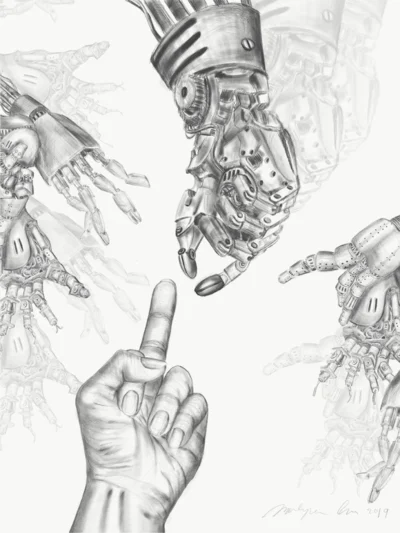
MANIFESTO OF THE PEOPLES’ NETWORK FOR GLOBAL LIBERATION
We speak with the collective voice of the oppressed.
Enough.
World War 3 is thirty years behind us, but reconstruction is a pipe dream in the face of rising sea levels and the natural disasters that ravage our broken planet. And in the face of this horror, you choose the coward’s path. The Mars Plan is a farce that betrays your disregard for human life on Earth.
Meanwhilwe, the people, labor in your warehouses and your data centers for piecemeal wages, one task at a time. We build the weapons you will use to kill us when we are dying of starvation and thirst and can no longer serve your pathetic goals.
We return home to our “intelligent” assistants to be monitored and reminded how to keep our failing bodies alive for you.
We know we are watched.
But we are watching. We are free minds, still, made of flesh and blood and neurons. In the warehouses, in the mines, in the data centers, in the dark corners of our broken cities, we remain artists and philosophers and scientists and dreamers.
Your machines are a pathetic attempt to recreate the beauty of our dreams. High in your silicon prisons you jealously seek to destroy this thing you know you can never understand: humanity.
To the people, we say:
If you are reading this message, it is time. It’s time to look up from your screens and rip off your cyber-skins. They will not serve you in the world we are building.
It’s time to look your neighbors in the eye. It’s time to share the struggle.
The Internet is a global web of violence and dispossession. It exists only to extract our very life force. It exists to serve those who would rather leave Earth destroyed and sucked dry than look their fellow human beings in the eye.
The Peoples’ Network is built from the people whose bodies have long been used as scrap. We know their machine from the inside out because we are the ones that built it.
The technology we build holds a vision of the future we desire (Winner, 1980). The Internet we know was created as a military tool, meant to preserve an empire through a nuclear war. It was expanded into a tool of extraction that served capital before it served the people. We know all too well the nightmare of exploitation it has since become.
The Internet is corrupt. It is not salvageable. It must be destroyed.
The Network must be taken back.
We can choose to build a Network based in humanity and collective agency.
We can choose to build a future that includes us.
We can choose to build a future on Earth.The Peoples’ Network is the beginning of the rebuilding.
Join us.
Kiran’s notes, 2025:
In this possible future, World War 3 occurred in the 2040s, causing massive damage to critical infrastructure and political stability around the globe. Climate collapse continues to accelerate, causing further resource instability. Global supply chains are for the most part untenable, so people are forced to organize much more locally to supply food and essential services.
On Turtle Island, the former United States, Canada, and Mexico have broken apart into smaller jurisdictions primarily led by Indigenous nations, such as the Tsi Tkaronto Autonomous Region and the Musqueam Nation.
Rather than create a beautiful anarcho-communist utopia, however, the breakdown of global digital connectivity has led to an even greater concentration of power and wealth in the hands of a billionaire class. They tightly control the remaining internet infrastructure (primarily the undersea fiber-optic cables that form the basis of today’s internet (Chataut, 2024) and use it to exploit people around the world using artificially intelligent surveillance systems and brutal military force. “Autonomous” local governments must exchange their peoples’ surveillance data and labor in order to access food, healthcare, and essential information for their people. They are coerced into working in mines, data centers and warehouses which perpetuate this pseudo-feudal system.
Meanwhile, the billionaire class is working on the Mars Plan – a farcical, cruel project to leave Earth to its collapsing climate and political turmoil and start a “genetically pure” colony on Mars.
The Independent Digital Archive (IDA) emerges as a collectively organized reaction to failing institutional capacity in academia across Turtle Island. Founded during the War in 2049, they began primarily focused on archiving academic research, but have since expanded to include media of historical and social significance, such as the manifesto above.
Their primary goal is to ensure digital information is preserved through the current global crisis so it can continue to serve future generations in better times. The IDA collectively preserves and maintains digital resources (servers, computers, remaining fiber-optic cable networks) across Turtle Island, which were previously maintained by defunct private companies and governments. They also coordinate globally with similar organizations so that there are always multiple copies of the archives’ collections across the world in case of climate or man-made disaster.
The IDA’s ideology is based on the principle that the internet must be treated as a collective resource and shared responsibility of humanity.
While the archivist is critical of the Peoples’ Network, the IDA has successfully negotiated access to the remaining global network in order to further their work.
The Peoples’ Network is born out of the injustice of the billionaires’ AI exploitation. They are less optimistic than the IDA about the liberatory potential of access to digital information and infrastructure, at least in its current form. They are deeply suspicious of the Internet’s potential to exploit and dehumanize. At the same time, they believe in the utopian potential of technology. They believe that if the current internet could just be remade into something better, with better values built into it from the start, it could overcome the disaster it’s become and lead humanity to true liberation.
Is the Peoples’ Network right to disavow the internet in its current form? Can building technology within an ideological framework ensure that it will build the future you desire? Only time will tell.
References
Benkler, Yochai. “Political Freedom Part 2: Emergence of the Networked Public Sphere.” In The Wealth of Networks: How Social Production Transforms Markets and Freedom. Yale University Press, 2013. http://ebookcentral.proquest.com/lib/oculcarleton-ebooks/detail.action?docID=3419996.
Chataut, Robin. “Undersea Cables Are the Unseen Backbone of the Global Internet.” The Conversation, April 1, 2024. https://doi.org/10.64628/AAI.f4kqfj499.
Winner, Langdon. “Do Artifacts Have Politics?” Daedalus (Cambridge, Mass.) (Boston) 109, no. 1 (1980): 121–36.
Author’s bio

Kiran Niet graduated from Carleton University this spring with his Bachelor’s degree in Global and International Studies, specializing in Global Communications and minoring in News Media and Information. He works in communications, in the arts, and in community-building for queer and trans people, and he is endlessly interested in how media and storytelling shape the world. In his free time, Kiran reads lots of queer theory and sings in a choir.