[Post/Millennials’ Voices] Issue 12 – The Lucid Prisoner: Essays on Digital Dystopia
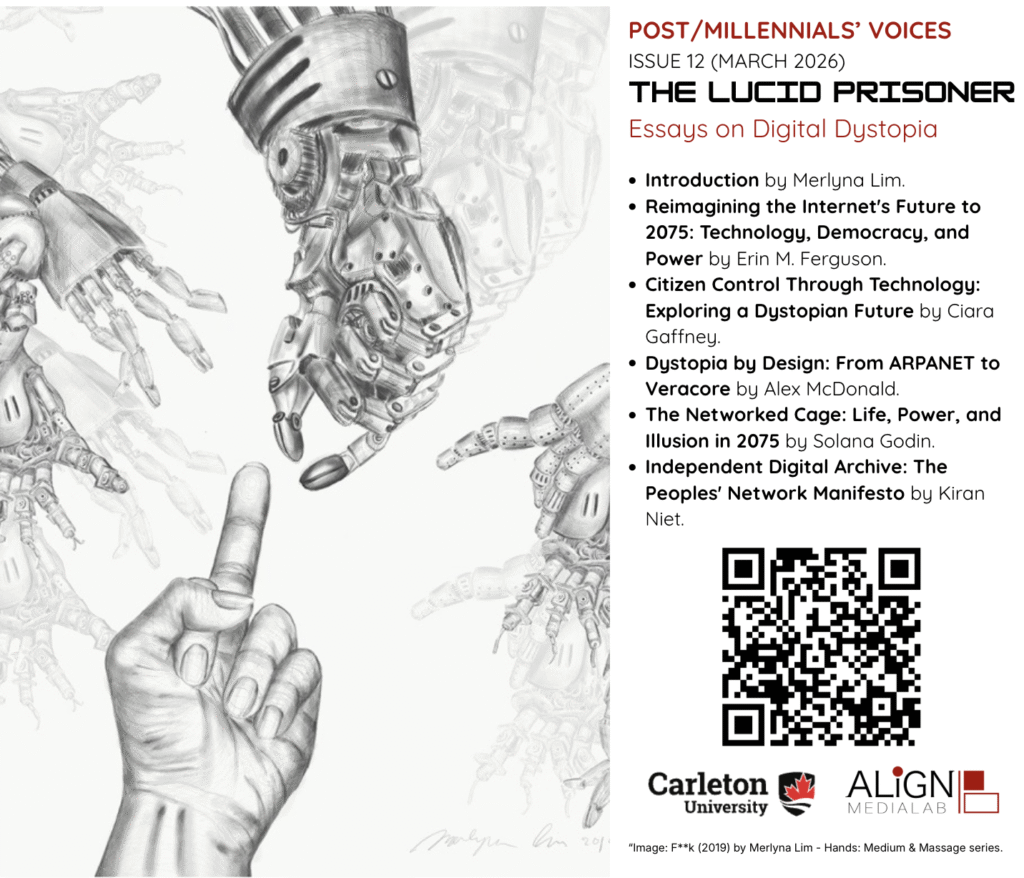
Introduction
Prisoner and dystopia. Yes, you read the words correctly. What a combo! Some of you will quickly comment, “What a gloomy collection!” And you would be right. These are not happy utopian essays. They were written in a moment that to some of us, notably these five Gen-Z authors, feels like the pre-dawn of a world we saw in apocalyptic movies.
In the fall term of 2025, I taught a COMS4317 undergraduate seminar on Digital Media and Global Network Society, in which we spent 13 weeks tracing the arc of the internet from its utopian origins to its present entanglements. We read the histories and the theories, the warnings and the justifications, the empirical and the analytical. Then, for one of the assignments, I asked students to do something challenging: to look at the trajectory we had mapped and follow it to its logical, if unsettling, conclusion to envision the digital world of 2075.
The result was thirty utopian/dystopian essays, each a distinct attempt to confront that future. The five essays in this special issue—though they are, understandably, dystopian—were not selected because they’re the darkest, but because they’re among the most incisive. In an era where algorithmic manipulation, platform consolidation, and extreme datafication are normalized, a hopeful scenario of the future would not feel like foresight but like willful naivete. Yet as you will see, the gloominess within these essays is not a product of cynicism. It is the fruit of deep engagement with histories and critical understanding. These student-authors have done more than simply imagine a dark future; they have diagnosed the mechanisms—economic, political, social, cultural, and technological—by which such a future would be built from the materials of our present.
Erin M. Ferguson’s “Reimagining the Internet’s Future to 2075: Technology, Democracy, and Power” offers a fitting starting point. It traces the internet’s evolution from a utopian vision of decentralized freedom and networked democracy to a dystopian system of control, surveillance, and inequality. By 2075, the essay envisions the emergence of the Grid, an integrated, algorithm-driven network that structures social, economic, and political life. It concentrates power around dominant hubs by reinforcing ideological enclaves, emotional manipulation, and behavioral regulation. This trajectory illustrates how technologies are never neutral, embedding the values and priorities of their creators, and shows that today’s design choices shape whether the digital future empowers or oppresses.
Ciara Gaffney’s “Citizen Control Through Technology: Exploring a Dystopian Future” charts the gradual erosion of independent thought as generative AI and digital capitalism transformed freedom into voluntary submission. Gaffney traces a world where citizens eagerly paid to be manipulated, where AI tutors replaced critical thinking, where cosmetic surgery and avatar customization enforced sameness, and where The SmartNet emerged not through force but through the seduction of comfort. Her essay captures the haunting irony at the heart of the collection: that we did not have to be conquered—we subscribed.
Alex McDonald’s “Dystopia by Design: From ARPANET to Veracore” gives this paradox its fullest form. Beginning with the promise of ARPANET, it traces the long consolidation of surveillance capitalism into Veracore, a corporate-state behemoth where citizens are governed by neural implants and a pervasive Visibility Score. Social life is hollowed out, authentic connection erased, and yet the machinery of control is presented not as tyranny but as the natural evolution of the digital ecosystems we once embraced.
Solana Godin’s “The Networked Cage: Life, Power, and Illusion in 2075” deepens this diagnosis by arguing that the dystopia of 2075 is not a rupture but a logical outcome: the cumulative result of ideological tensions left unresolved, of digital capitalism’s steady commodification of communication, of networks that centralized power even as they promised connection. Her essay expands the critique across AI consciousness, identity construction, and total surveillance, portraying a world where individuals are fully integrated yet profoundly isolated.
Kiran Niet’s “Independent Digital Archive: The Peoples’ Network Manifesto” offers a meditation on the possibility of escape and, eventually, its limits. Through the framing of a recovered manifesto from the Peoples’ Network, a revolutionary movement that destroys global internet infrastructure to overthrow billionaire-controlled exploitation, the essay asks whether any rebellion can truly escape the logics it opposes. The archivist’s perspective reveals that even in destruction, new forms of centralized power emerge. It is a sobering conclusion, suggesting that the task ahead is not merely to tear down but to imagine anew.
Taken together, these essays are not five separate warnings but five angles on the same slow-motion collapse. Each begins with a flicker of hope, tracking a gradual drift toward enclosure, and ending in a world where freedom has been optimized out of existence.
To read them in sequence is to feel the weight of that trajectory. But I want to suggest that this very act of clear-sightedness is, itself, an antidote to despair. A student once joked that I am so gloomy that the classroom dims when I enter. There is some truth to this. Yes, I do have dark humour and an aversion to feel-good, motivational culture. But, moreover, intellectually, this gloominess stems from a commitment to empirical realism: grounding theories and concepts in the real-world problems of power, hegemony, control, and resistance that digital technologies lay bare. I bring these narratives into the classroom because I believe that hope does not come from positive or utopian thinking, but from a thorough understanding of complex problems and the recognition of agency that such understanding makes possible.
There is a clear divide between a happy prisoner and a lucid one. Gloom that comes from understanding is not a surrender. Instead, it is the prerequisite of resistance. Understanding gives us agency. And agency, even in the face of overwhelming odds, is the seed of hope.
These five student-authors, like their peers in the seminar, have done the hard work of looking unflinchingly at the world we are making. It is my hope that by reading their work, you will not only see that potential future more clearly but will also recognize your agency, your responsibility, and your moral obligation to help build a different one.
Editor’s bio
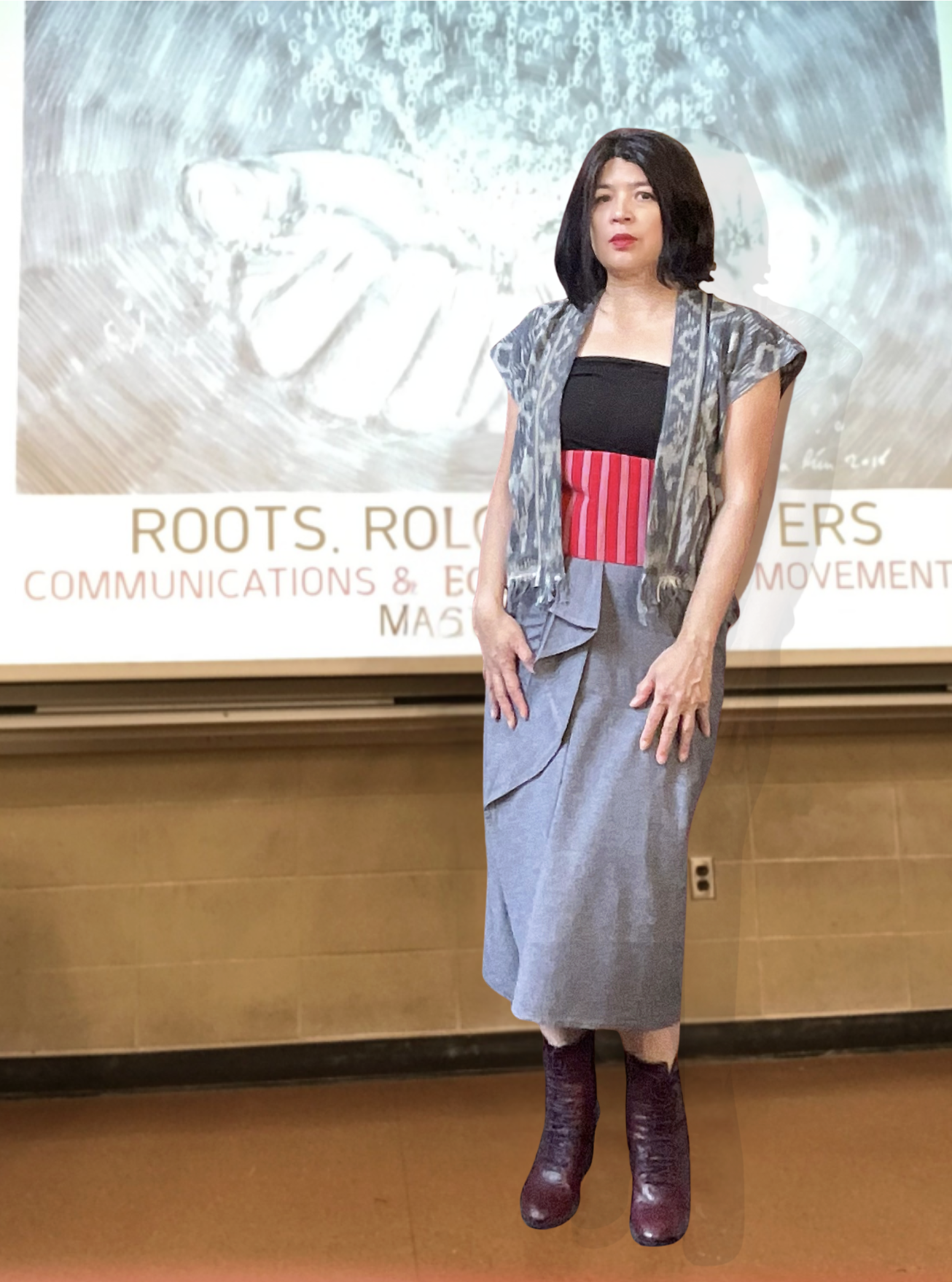
Merlyna Lim is a Canada Research Professor, founder of the ALiGN Media Lab, and Full Professor in Communication and Media Studies at Carleton University. Born and raised in Dayeuhkolot, an industrial slum on the outskirts of Bandung, Indonesia—which clearly taught her that if you can thrive amid urban chaos, you can definitely handle the algorithmic kind—her research explores how digital media, algorithms, and AI shape and are shaped by human connection and collective life. She has held a Canada Research Chair in Digital Media and Global Network Society, been inducted into the Royal Society of Canada, and been named one of Indonesia’s 100 Most Inspiring Women. When not researching or teaching, she can be found sketching, singing, and arranging music. Carleton University students have also voted her the funniest and best-dressed professor—proof, perhaps, that intellectual rigour, a bit of tailoring, and the occasional punchline can coexist, or more likely, that she’s simply a bit weird.