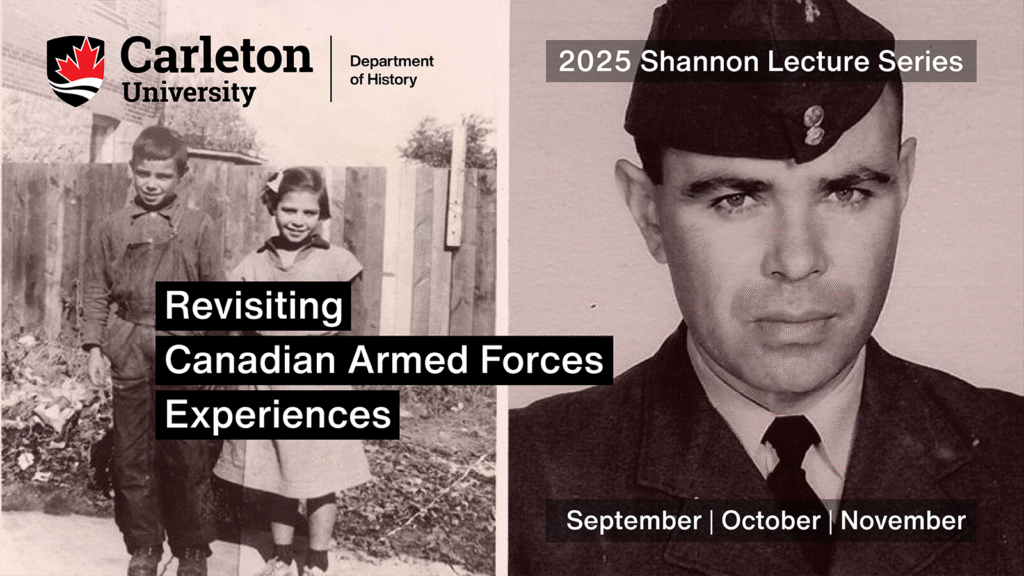
Shannon Lectures, Fall 2025: Revisiting Canadian Armed Forces Experiences
Join us this Fall (Sept-Nov 2025) starting Monday Sept 22nd for the Shannon Lectures in History The Shannons are a series of thematically linked public lectures offered at Carleton University each autumn and made possible through the Shannon Donation, a major gift from a long-time friend of the Department of History.
Lecture 1: September 22, 7:00-8:30pm, Dominion-Chalmers Centre
Fighting for Their Place and Recognition: Canadian Servicewomen and Women Veterans in Post-Second World War Canada
Lecture 2: October 6, 7:00-8:30pm, Dominion-Chalmers Centre
Cold War Consent? Military Experimentation and Research Ethics in Mid-Century Canada
Lecture 3: October 20, 7:00-8:30pm, Dominion-Chalmers Centre
The Transnational Making of United Nations Peacekeeping
Lecture 4: November 3, 7:00-8:30pm, Dominion-Chalmers Centre
This is not my story, but yours: The Russ Moses residential school memoir
Bonus Shannon Lecture: November 19, 3:00-5:30 pm, Mayfair Theatre (1074 Bank Street)
Ottawa Premiere, The Nest (2025)
Lecture 5: November 24, 7:00-8:30pm, Dominion-Chalmers Centre
Purging the Canadian military of “sexual deviants”: The war on 2SLGBTQIA+ members and their partners from the 1960s to present.
The objectives of the Shannon Lecture series are four-fold:
- to explore and illuminate the social dimensions of the past, particularly with reference to the social history of Canada;
- to demonstrate the linkages between approaches to Canadian history and the wider body of international scholarship;
- to encourage cooperation and a sense of collegiality between the different communities of historians in Canada, whether in universities, public institutions, or private agencies;
- to popularize innovative historical methods, practices, or genres, and to convey them in lectures intended to engage a general audience in an informative and accessible manner
- More information: https://carleton.ca/history/shannon-lectures-history/
The Shannon Funds were donated by Lois M. Long in memory of her parents James Buchanan Long and Ida May (Davidson).
Convenor: Jean-Michel Turcotte, historian at the Department of National Defense and Adjunct Professor in the Department of History
Description: Post-1945 Canadian military history is rich and complex as it is shaped by thousands of members of the Canadian Armed Forces (CAF), but also by their families, civilian workers, researchers and communities, who remain largely “unknown” in scholarship. In partnership with the Directorate of History and Heritage, the 2025 edition of the Shannon series, “Revisiting CAF Experiences,” examines those “unknown voices” and proposes to explore various and entangled trajectories related to the CAF after 1945. As such, invited speakers will address aspects of the militarization of Canadian lives beyond the traditional narratives of soldiers “serving” in the Cold War and deployed in various peacekeeping missions. While Canadian military social history has mainly focused on the 1914–1945 period, the lecture series aims to deepen our understanding of how the Cold War transformed the Canadian military and the Canadian people’s lives in profound ways.
The 2025 Shannon series extends the discussion raised in the recent book, Cold War Worker: Labour, Family, and Community in a Nuclear State, edited by Isabel Campbell (McGill-Queens University Press, 2025). As the volume shows, the Cold War created global and Canadian demands for new technological, scientific, construction, and other labour. The experiences of those workers raise questions about the influence of settler-colonial masculine institutional values developed in the Cold War state and society. In line with those questions, our objective is to examine how the development of CAF in the context of the Cold War affected diverse Canadians, their families, and their communities in ways that were both predictable and surprising, and both beneficial and harmful. By doing so, speakers will reveal contrasting experiences of marginalized peoples (Indigenous peoples, women, LGBTQUIA+ and northerners) and elite white men (scientists and psychiatrists). By comparing the experiences of different types of workers, families, and communities having contact with the military, this series will highlight how race, gender, and privilege affected people in varied and sometimes unexpected ways.
Unless otherwise indicated, lectures will take place at Woodside Hall in the Carleton Dominion-Chalmers Centre. The lectures are expected to run from 7:00-8:30pm and will be streamed as well. More details to be posted as they become available.