The Burden of Reporting – Has Accountability Gone Too Far?
Accountability is essential in the charitable sector—reporting ensures that funds are used effectively and transparently. However, when reporting requirements become excessive, they can divert time and resources away from service delivery.
Recent findings from the Charity Insights Canada Project (CICP) reveal that only 8% of charities can easily manage their reporting requirements, while 65% describe the burden as moderate to overwhelming. As one respondent put it:
“We have actually stopped applying for small grants (<$10k) because the reporting requirements often outweigh the financial benefit.”
A closer look at the data reveals notable differences across sectors and organizational sizes. So, who is facing this burden—and why?
Who Are the Charities Carrying the Burden?
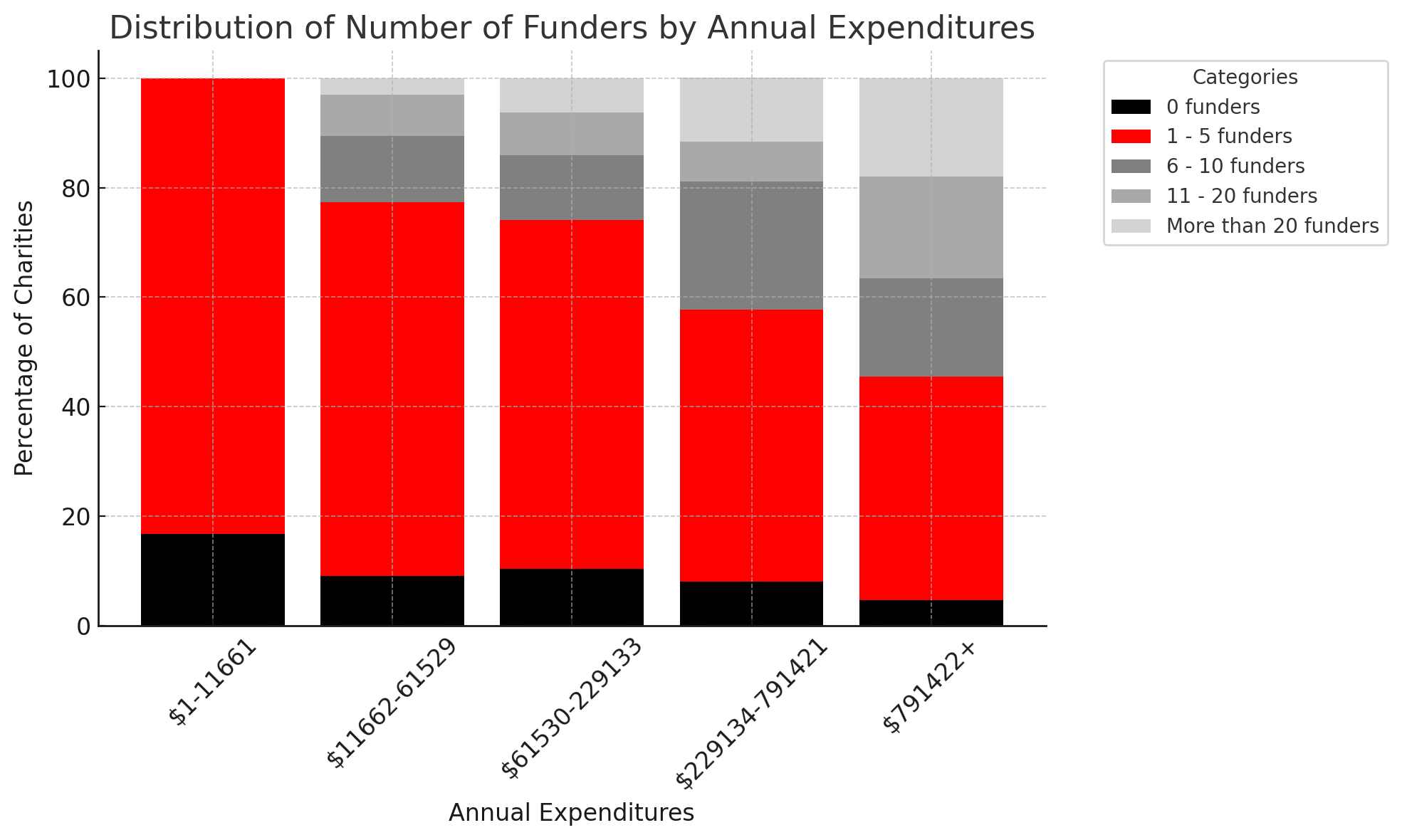
Our survey captured a diverse sample of primarily small- to mid-sized charities, many of whom rely on a limited number of funders:
- 8% have no funders
- 53% have 1–5 funders
- 28% have 6–20 funders
- Only 11% have more than 20 funders
(730 responses | ±4% margin of error | excludes “Not sure” responses)
Larger charities (with annual expenditures over $791,422) are more likely to have diversified funding (21+ funders), while smaller organizations (under $229,134) tend to rely on a narrower pool of funders.
How the Number of Funders Shapes the Reporting Load
Across the sector, most charities report a moderate reporting burden that consumes considerable time and staff resources. Interestingly, organizations with 1–5 funders and those with more than 20 funders tend to face lower administrative burdens overall.
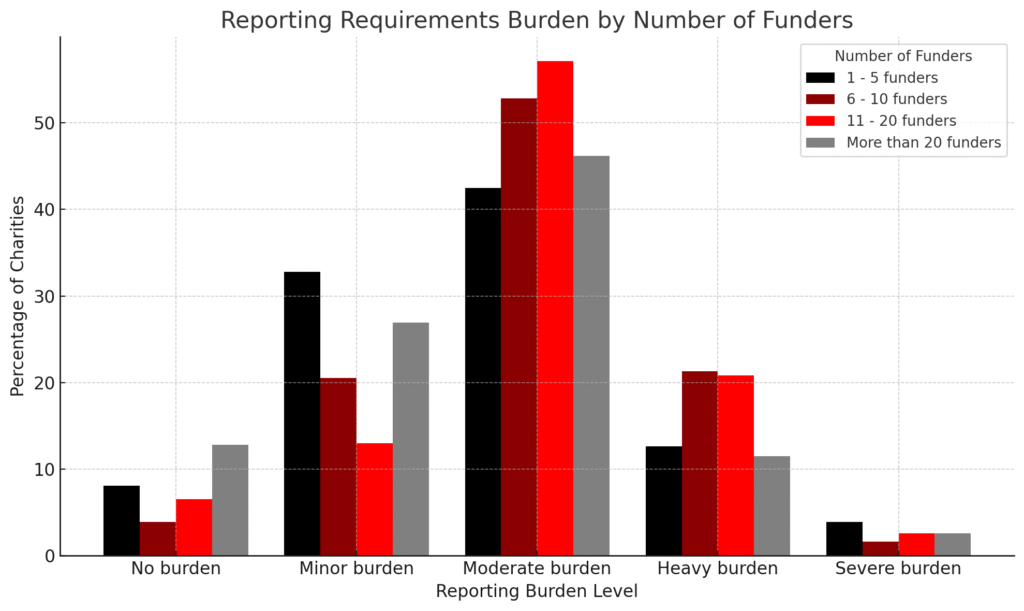
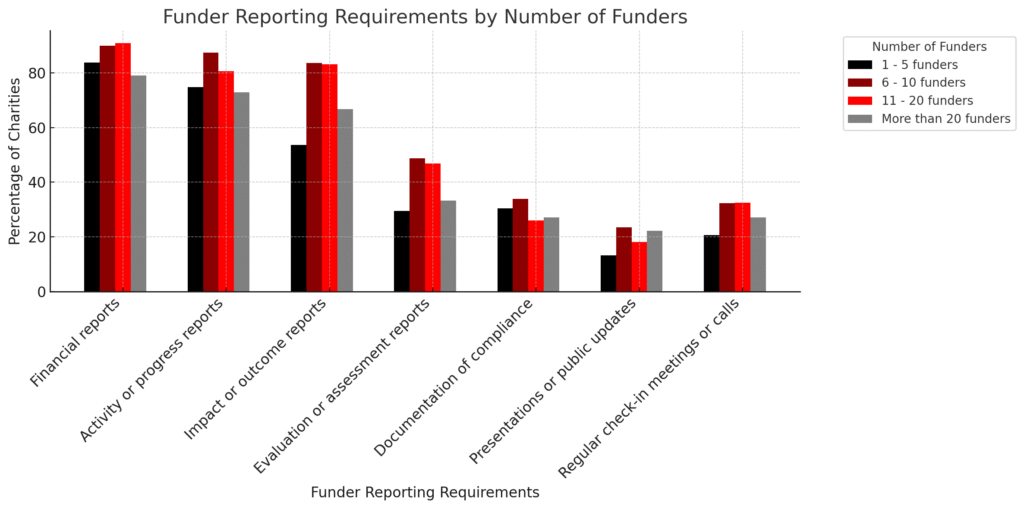
Why does this trend occur? Some larger charities may have implemented more efficient systems for tracking and reporting data and smaller charities with few funders may have simpler funding deliverables. But a key factor that CICP data reveals is that organizations with more than 20 funders and those with five or less, on average, have fewer types of deliverables requested by funders, especially in the case of impact/outcome and evaluation/assessment reports (See chart below)
The Big Three Reporting Challenges
Across all surveyed charities, three major challenges stand out:
- Increased Staff Time – Significant resources are allocated to fulfill reporting requirements, diverting staff from service delivery.
- Complex Financial Tracking – Funders often require financial data in different formats, making consistent record-keeping difficult.
- Duplicative Reporting – Multiple funders require similar – but not identical – reports, forcing charities to customize deliverables repeatedly.
Once again, we see that charities with 1-5 or more than 20 funders tend to report fewer of these burdens on average (See chart below).

Differences in Reporting Burdens Across Sectors
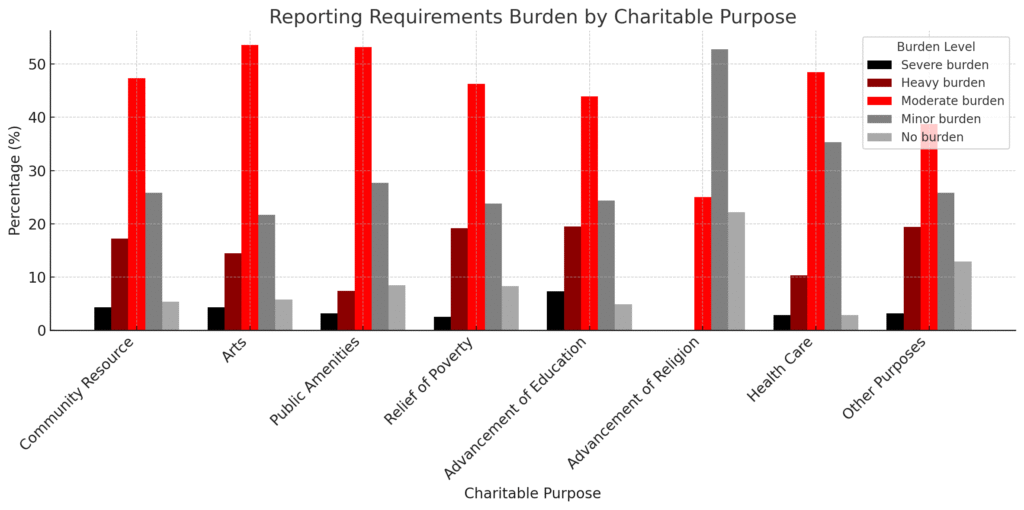
Religious organizations reported the lowest administrative burden, with over 50% indicating only a minor burden and 22% stating they had no burden at all. This is likely due to their heavier reliance on individual charitable donations rather than external funding. Almost half (42%) of religious charities surveyed had no external funding, and a further 35% had five or fewer funders. On the other hand, charities focused on education, poverty relief, and community services were the most likely to report heavy to severe administrative challenges (See chart below).
Five Concerns Moving Forward
Beyond the numbers, charities have shared firsthand experiences regarding reporting challenges:
- Lack of Standardization: “In a lot of cases we have multiple funders for each program, all with different reporting requirements. It would be great if we could use a standardized reporting template for all funders of a program!”
- Complex Government Compliance: “Government funders require reports every few months and often change the way they want the reports submitted.”
- Technology and Accessibility Issues: Online reporting platforms can be difficult to use. “Most small, ordinary Not for Profits serving ordinary people do not have the capacity to meet the demands of highly centralized, internet dependent funding sources.”
- Focus on Output Over Impact: “Our funders… are mostly focused on output numbers instead of impact…At the same time, funders don’t provide the means to establish an outcomes measurement process.”
- Burnout and Sustainability Concerns: “We have actually stopped applying for small grants (<$10k) because the reporting requirements often outweigh the financial benefit.”
Data points to the Need for Trust-Based Philanthropy
In light of the burdens, charities are identifying potential solutions. They advocate for trust-based philanthropy, where funders emphasize long-term relationships rather than extensive reporting. This approach fosters a more collaborative funding environment and can help to reduce administrative strain. Others suggest that multi-year and core funding would help charities plan for the long term and reduce the burden of frequent re-applications. If organizations with credible track records were given multi-year commitments, they could focus more on delivering programs and services rather than continuously applying for new funding and managing multiple reporting requirements.
As one respondent shared: “Trust based philanthropy is the future! We work with a funder who has adapted to this model, and it makes the process actually enjoyable to connect and relationship build.”
Author

Want to receive our blog posts directly to your email? Sign-up for our newsletter at the following link, and follow us on social-media for regular project updates:
- Newsletter sign up: https://confirmsubscription.com/h/t/3D0A2E268835E2F4
- LinkedIn: https://www.linkedin.com/company/cicp-pcpob/
- Socials: @CICP_PCPOB

Measuring What Matters: Rethinking Impact Evaluation
In Canada’s charitable sector, “impact” has become a buzzword. It is embedded in grant applications, strategic plans, and funder conversations as a signal of seriousness …

Setting Priorities, Building Strength: How Charities Are Entering 2026
The CICP’s analysis of its first survey of 2025 captured a charitable sector caught in the cross-currents of economic instability, political uncertainty, and escalating community …

From Crisis to Caution? Tracking Turnover
In a recent blog, we explored the deepening HR crisis in Canada’s charitable sector, drawing on data from the Charity Insights Canada Project (CICP). Between …