Unpaid Labour in Canadian Charities: The Elephant in the Room
In the charitable sector, going “above and beyond” isn’t just a figure of speech, it’s a workplace reality. Across Canada, many paid staff in charities are putting in extra hours without compensation or time off in return. The latest data from the Charity Insights Canada Project (CICP) shows how deeply this unpaid labour is embedded in the sector, and how its impacts vary depending on the size and type of charity.
Last year, we published a blog on this issue based on our March 2024 survey. At the time, 53% of responding charities told us their paid staff were regularly working unpaid hours. This year’s data builds on that story – offering more detail on where and why this is happening.
How Common is Uncompensated Labour?
We asked charities – which departments or functions most often require staff to work overtime without pay or time in lieu. The top three: fundraising, communications, and program or service delivery.
Just over one-third (38%) of responding organizations said their staff don’t work unpaid hours. Another 5% reported they have no paid staff, and 2% were unsure. When we exclude those two groups, the numbers are striking: 60% of charities with paid employees say their staff are working unpaid hours in one or more areas of their organization.
While a few respondents appeared to conflate unpaid labour with time-in-lieu arrangements, the core pattern remains clear: unpaid overtime is widespread and part of the work culture.
Who’s Most Affected? Size and Type of Charity Matter
Unpaid labour doesn’t affect all charities equally. Our findings show that smaller organizations are far more likely to rely on it.
Charities with annual expenditures under $61,500 reported the highest rates of unpaid labour, while those with expenditures over $229,000 reported the lowest. This relationship between organizational size and unpaid labour is statistically significant X2 (2, N = 779) = 9.47, p = .0009.
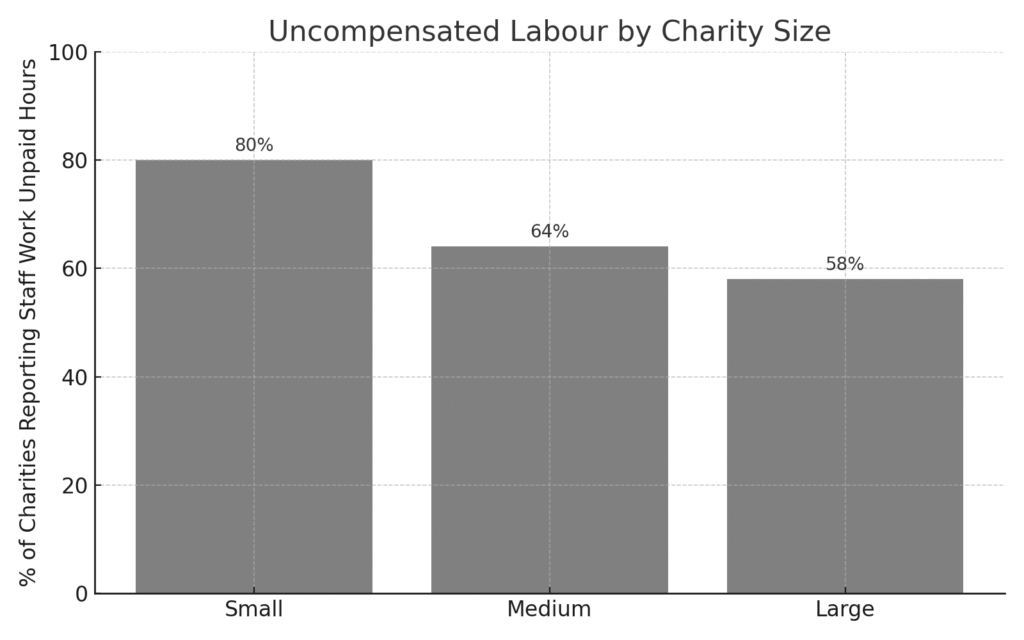
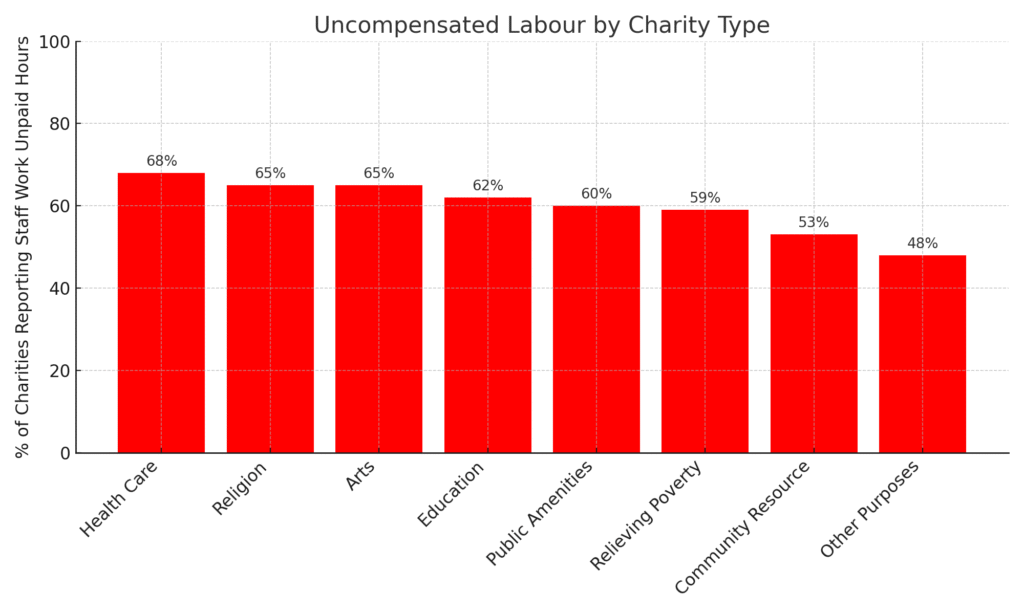
Differences also emerge across types of charities. Although these differences are not statistically significant, X2 (7, N = 779) = 8.7, p = .275, unpaid staff hours were reported slightly more in charities focused on health care, religion, and the arts.
Why are Staff Working Without Pay?
We also asked why staff are putting in unpaid time. The top three reasons:
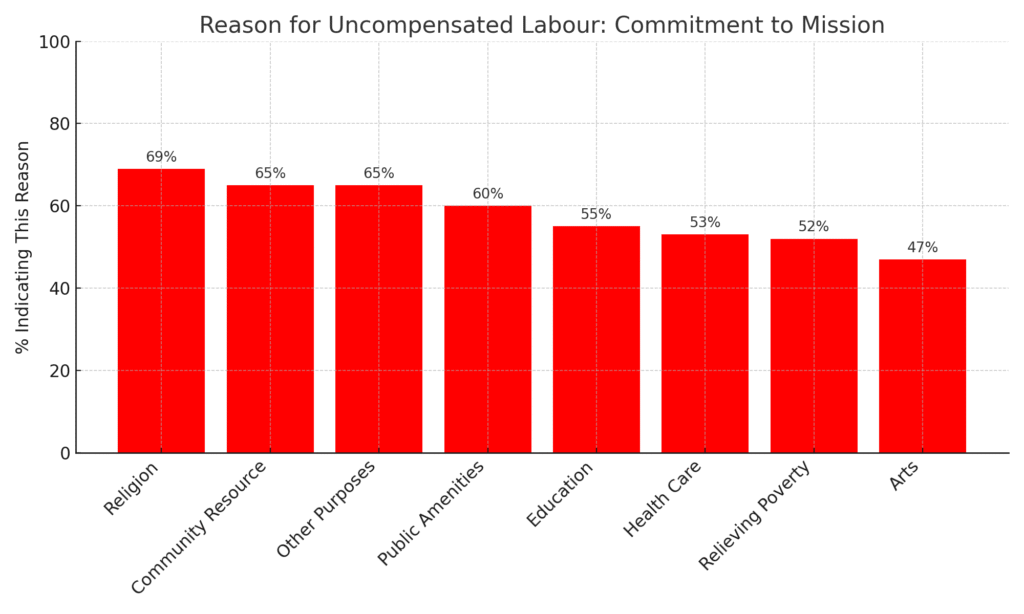
- Commitment to mission and beneficiaries (58%)
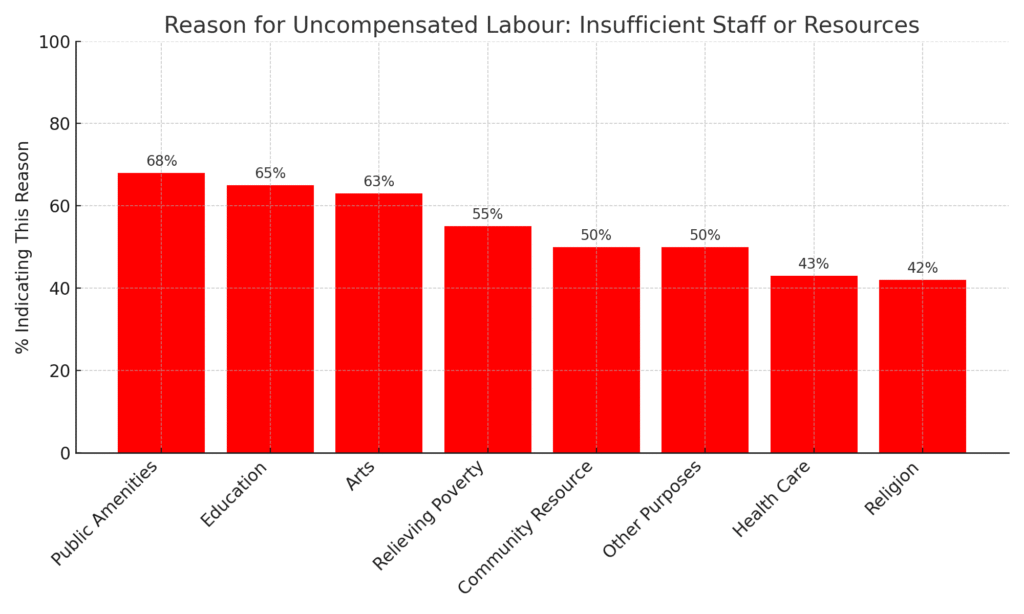
- Not enough staff or resources (54%)
- Budget constraints (50%)
That first reason ‘dedication to the cause’ is especially high in religious and community resource organizations and lowest in the arts. But these variations are not statistically significant, X2 (7, N = 477) = 10.1, p = .182.
Still, the structural pressures can’t be ignored. Among the 54% of charities citing insufficient staffing as a reason for staff providing unpaid labour, this was most common in public amenities, the arts, and educational organizations, with marginal statistical significance X2 (7, N = 477) = 14.1, p = .005.
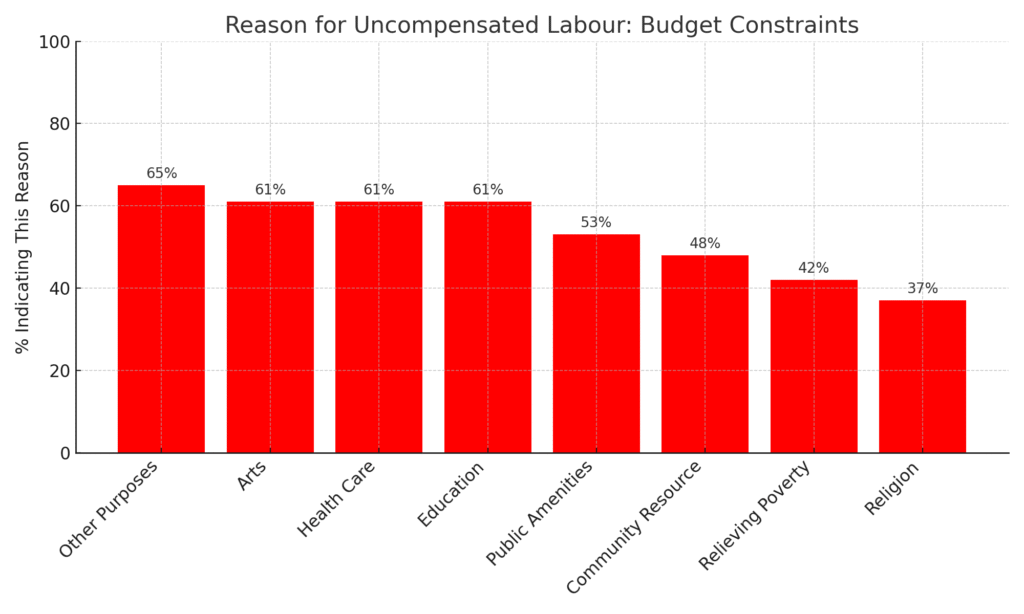
And when it comes to financial constraints, the arts, health care and education sectors stand out. Budget constraints leading to staff providing unpaid labour was lowest in religious organizations. This variation between charities with different purposes is statistically significant X2 (7, N = 477) = 17.3, p = .016.
Why It Matters
Unpaid labour in charities isn’t a new issue but it’s one that continues to be under acknowledged. Our 2024 survey results showed that executive staff were working an average of 35 unpaid hours a month which is equivalent to roughly 60 extra workdays per year. That’s not just a strain on individuals; it’s a sustainability problem for the whole sector.
This year’s data builds on that story. Staff aren’t just overworked. They’re filling the gaps created by funding shortfalls, gaps in staffing, and systemic expectations that charitable work comes with personal sacrifice.
This capacity issue is gendered. It is estimated that around 80% of Canada’s nonprofit workforce is made up of women, many of them racialized, immigrant, or working in lower-paid roles. The Ontario Nonprofit Network’s decent work movement is calling attention to this dynamic and pushing for a sector where fair wages, benefits, job security, and healthy workplaces allow all workers to thrive. Decent work isn’t just about pay. It’s about changing expectations, addressing systemic inequities, and building a sector that values its people as much as its mission.
It’s time to take this problem seriously.
Charities need structural support to address unpaid labour. That includes more sustainable funding models, realistic workloads, and fair compensation. Boards and management need to rethink what they expect from paid staff. Passion shouldn’t be a prerequisite for overwork.
Author

Want to receive our blog posts directly to your email? Sign-up for our newsletter at the following link, and follow us on social-media for regular project updates:
- Newsletter sign up: https://confirmsubscription.com/h/t/3D0A2E268835E2F4
- LinkedIn: https://www.linkedin.com/company/cicp-pcpob/
- Socials: @CICP_PCPOB

Measuring What Matters: Rethinking Impact Evaluation
In Canada’s charitable sector, “impact” has become a buzzword. It is embedded in grant applications, strategic plans, and funder conversations as a signal of seriousness …

Setting Priorities, Building Strength: How Charities Are Entering 2026
The CICP’s analysis of its first survey of 2025 captured a charitable sector caught in the cross-currents of economic instability, political uncertainty, and escalating community …

From Crisis to Caution? Tracking Turnover
In a recent blog, we explored the deepening HR crisis in Canada’s charitable sector, drawing on data from the Charity Insights Canada Project (CICP). Between …