Setting Priorities, Building Strength: How Charities Are Entering 2026
The CICP’s analysis of its first survey of 2025 captured a charitable sector caught in the cross-currents of economic instability, political uncertainty, and escalating community need. Financial anxiety was widespread, optimism had softened, and leaders described the moment bluntly: “It’s just madness.” Yet even amid this turbulence, charities remained steadfast in their commitment to supporting communities.
With the release of the CICP’s final survey of 2025, which focused on charities’ planning for 2026, we are now able to examine how priorities and expectations have shifted over time. This analysis draws on three survey points: early 2024 (CICP 2.01.01, January 2024), early 2025 (CICP 3.02.1, February 2025), and late 2025 (CICP 3.11.40, November 2025). Across these data, three emerging trends stand out: renewed optimism, a strengthening focus on services and engagement, and persistent workforce instability. Together, they point to a notable shift in how Canadian charities are entering 2026.
Optimism Is Making a Comeback
Against a backdrop of economic uncertainty, a combined 77% of organizations report feeling “very optimistic” (21%) or “somewhat optimistic” (56%) about their prospects for 2026. This marks the highest level of optimism in three years, surpassing the 71% reported in early 2025 and 76% in early 2024. The most striking shift was the increase in those identifying as “very optimistic,” which nearly doubled from 11% in early 2025 to 21% for 2026.
| Outlook Category | 2024 (%) | Early 2025 (%) | Late 2025 (for 2026) (%) |
|---|---|---|---|
| Positive (Optimistic + Very Optimistic) | 76% | 71% | 77% |
| Negative (Pessimistic + Very pessimistic) | 5% | 10% | 8% |
The rebound in optimism suggests that although charities expect 2026 to bring continued economic challenges, they are entering the year with greater confidence in their capacity to navigate uncertainty.
Strengthening Services and Community Engagement
While financial health remains the undisputed top priority for 66% of participating charities, other leading priorities indicate a notable shift in operations towards what charities can control. The importance of delivering programs & services has risen to its highest point in three years, cited by 55% of organizations, up from 50% in 2025 and 48% in 2024. Similarly, “community outreach/engagement” was reported as a significantly higher priority for 2026 (38%) than it was in 2024 (29%).
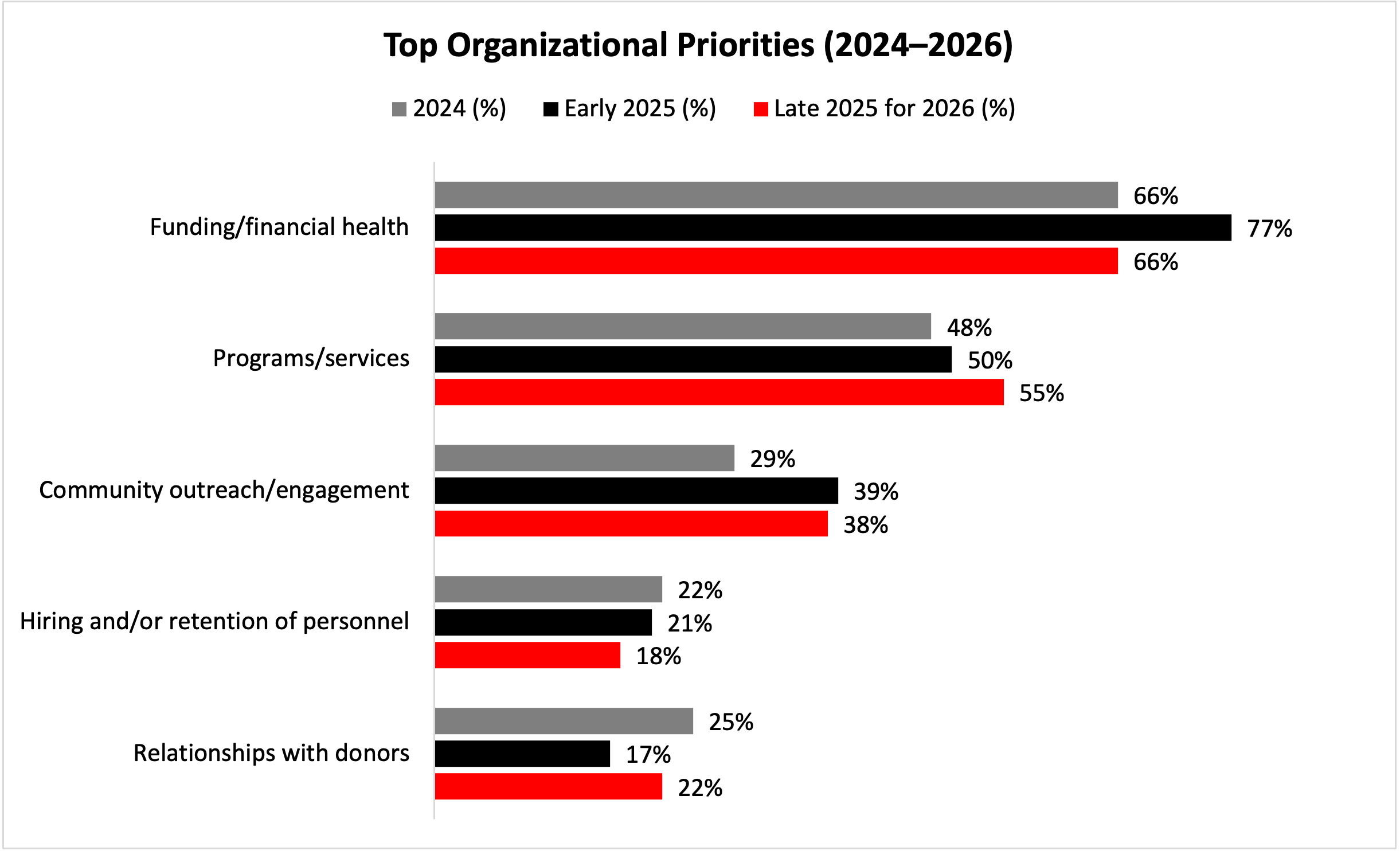
In an environment of uncertainty, this is a calculated choice: charities are focusing on the assets they can control and strengthen. The renewed emphasis on essential programs/services and community engagement reflects organizations’ core strategy for building stability.
Focus on the Sustainability of the Workforce
While financial instability remains a top challenge for 65% of organizations, workforce sustainability has emerged as a defining pressure point for the sector. Charities report persistent challenges related to increasing demand for services (36%), staff or volunteer burnout (34%), recruitment and retention of staff (31%), and recruitment and retention of volunteers (25%).
“We learned that supporting staff well-being and communication is vital to quality care. In 2026, we’ll focus on stronger internal supports and connection to reduce burnout and strengthen our teams.”
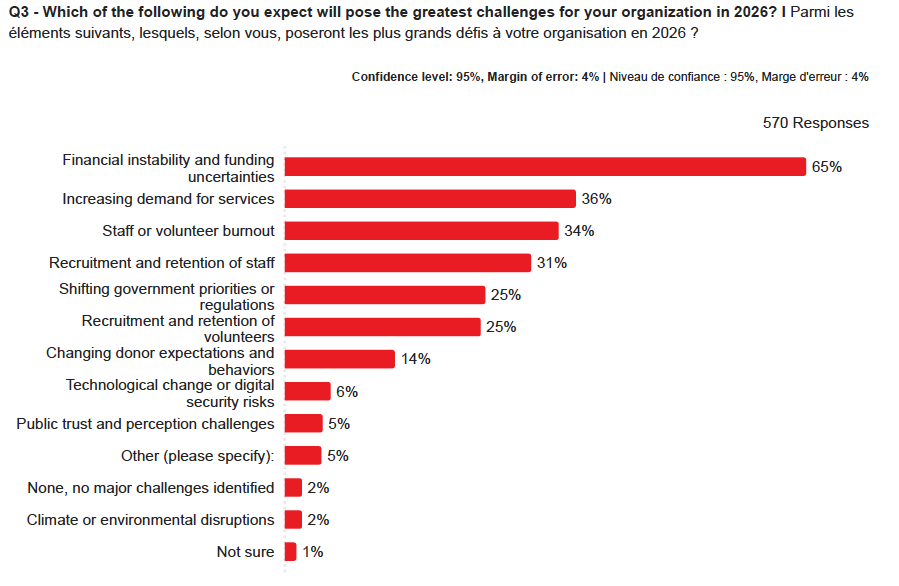
The greatest risk facing charities is no longer solely a volatile funding environment, but the long-term sustainability of the sector’s workforce. Efforts to strengthen internal supports, such as extended health benefits, flexible work arrangements, and improved communication, are increasingly viewed as essential to maintaining service quality and organizational resilience.
Tracking Priorities
As charities enter 2026, many are prioritizing the assets they can most directly influence: programs and services, community engagement, and workforce support. While funding uncertainty remains a constant backdrop, the sector’s rebounding optimism reflects a deep well of resilience.
As one respondent observed:
“We are very resilient, partly because in case of severe funding shortage many of us are willing to work for free… not so great for the people doing the unpaid work.”
The CICP will continue to track these trends closely as charities navigate 2026, monitoring how optimism, priorities, and pressures evolve across the Canadian charitable sector.
Author

Want to receive our blog posts directly to your email? Sign-up for our newsletter at the following link, and follow us on social-media for regular project updates:
- Newsletter sign up: https://confirmsubscription.com/h/t/3D0A2E268835E2F4
- LinkedIn: https://www.linkedin.com/company/cicp-pcpob/
- Socials: @CICP_PCPOB

Why Data Literacy Matters More Than Ever for Canada’s Charitable Sector
Data literacy has become a necessary skill across the charitable sector because organizations are being asked to make decisions more quickly, demonstrate impact more clearly, …

Measuring What Matters: Rethinking Impact Evaluation
In Canada’s charitable sector, “impact” has become a buzzword. It is embedded in grant applications, strategic plans, and funder conversations as a signal of seriousness …

Setting Priorities, Building Strength: How Charities Are Entering 2026
The CICP’s analysis of its first survey of 2025 captured a charitable sector caught in the cross-currents of economic instability, political uncertainty, and escalating community …