Why History Matters & Informs the Future
By John Mania, NC-CIPSeR
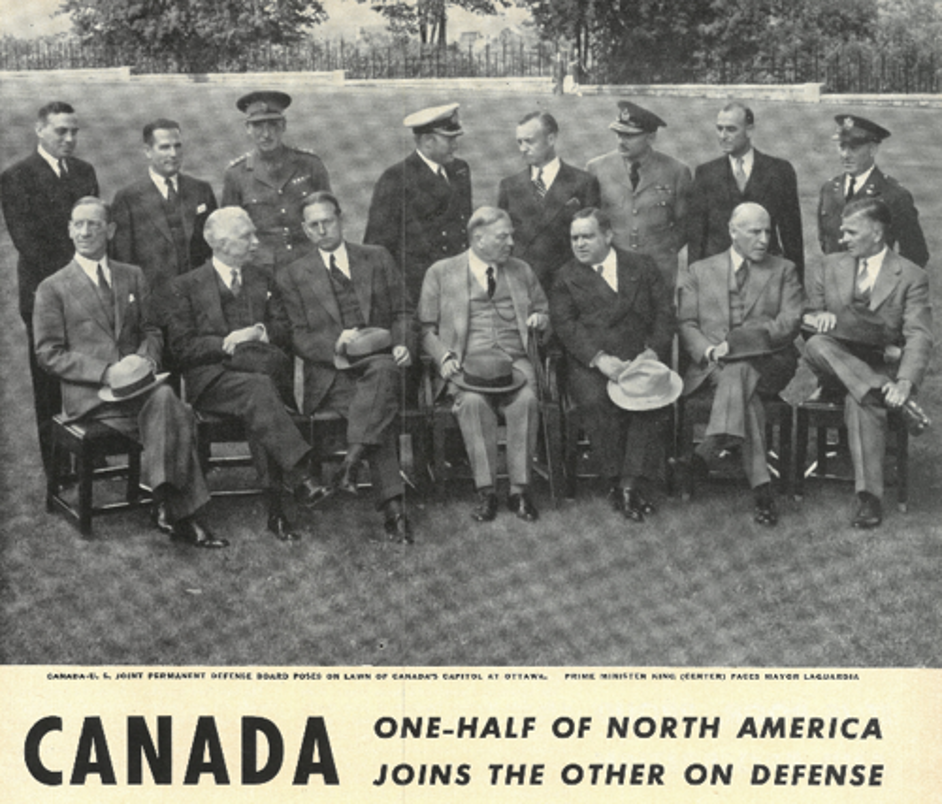
“North America is largely Canada”. Although it may seem obvious to most who can find countries on a map, this realization was noted 86 years ago in the September 9th, 1940 edition of LIFE magazine. Given the historical context, the primary threat to North America was the rise of Nazi Germany. The U.S., at the time, perceived Canada as an easy point of access for an invasion.
Late August 1940 saw the first meeting of the Permanent Joint Defense Board (PJDB), chaired by famed New York City Mayor Fiorello LaGuardia. The original intent of the board was to coordinate defenses between Canada and the U.S. “…if the Nazis start hopping from Iceland to Greenland to Newfoundland” (Ibid).
Ironically, today Canada is no longer worried about threats from Europe, but rather from its erratic trading partner and current defence partner, the United States. Through a stream of tweets alternately reference Canada as being the 51st state, called our Prime Minister ‘Governor’ and displayed State Department maps covering Canada, Cuba, Greenland and Venezuela in the stars and stripes. President Trump and his closest advisors have made it clear that they do not recognize or respect Canadian sovereignty. U.S. Undersecretary of War Elbridge Colby “…lay(s) some blame for the U.S. move on Prime Minister Mark Carney’s frequent statements about making alliances with countries other than the U.S.”[1] Our American counterparts frustrated at a change in national policy they precipitated can’t or choose not to understand why we don’t just accept their aggressive overtures.
While geopolitics have evolved considerably since WWII, Canada’s view on American annexation remains remarkably stable. Even in the 1940s, Canadians rejected American dreams of manifest destiny. “[Canada] is free and sovereign…it objects to any suggestion to being swallowed up by the U.S.” (Ibid). With the United States abandoning their place in international order they built in the wake of World War 2 in favour of an imperialistic one with shades of 19th century power-politics, many Canadians are rightfully concerned. What began as a “joke” has deteriorated into threats and ultimately into a trade war designed to cripple the nasty Canadian economy. Set against US policy in Iran and ongoing threats against NATO ally Denmark over Greenland, the unlikely spectre of a US invasion of Canada is no longer entirely dismissible. With the rising possibility of conflict across the world’s largest undefended border Canadians everywhere are discussing how we ended here.
Let’s be clear-eyed about this: the U.S. has Canada exactly where it has wanted it since the 1950s; economically dependent, compliant and militarily diminished. At the end of WWII Canada had the fourth largest military in the world. Yet our domestic defence industry has since been undermined wherever possible by the US who weren’t particularly pleased with a potentially fortified, educated northern neighbour capable of producing advanced technology. Clear evidence of this is includes the forced abandonment of the Avro Arrow project in exchange for obsolete-before-they-were-installed Bomarc missiles in 1959. Like a younger sibling tolerated and tagging along, for decades Canada largely deferred to U.S. direction and over-relied on economic and military integration at the expense of self-sufficiency.
We don’t know what we don’t know, yet
Economic and military integration, became overreliance which further became complacency. With this new political crisis upon us, we are forced to consider our sovereignty and what underpins it. Critical Infrastructure (CI) systems such as the power grid, water distribution, transportation and, increasingly, data and infrastructure sovereignty are all prerequisites to a modern, functioning state and are therefore preconditions for meaningful sovereignty. Sadly, our exposure here is obvious.
CI failures can have wide-ranging, cascading impacts including:
- “…interruption of essential services, such as electricity, water and natural gas
- disruption in the production and supply of food and medical supplies
- loss of public trust and confidence in the economy, national security and defence, and the democratic processes
- damage to environment and risk to public health from chemical spills, toxic waste discharges or hazardous air emissions
- lost revenue, reputational risks, job losses or legal consequences for companies and employees
- disruption to hospital operations, or even compromised medical devices, that could lead to loss of life
- damage to CI components that could disrupt, destroy or degrade processes and operations”[2]
Complicating the discussion of CI is the fact that privatization has created a complex landscape of interdependencies which often tie into U.S.-dependent supply chains.
Consider the following examples affecting Canadian CI:
- Data sovereignty: “American companies own 84 of Canada’s 283 data centres, making the U.S. the largest foreign player in the sector…”[3] equaling 30% of capacity
- Oil & Gas: “Large American energy companies…maintain huge ownership stakes in Canadian production… U.S. investors own roughly 60 per cent of the four largest oil-sands producers, which collectively account for the vast bulk of Canada’s oil-sands output.”[4]
- CI ownership: “nearly 85 per cent of Canada’s [CI] is owned and operated by the private sector…”[5]
To protect ourselves, not just from external threats but from increasing levels of environmental crises such as fires and floods, we must develop a comprehensive understanding of our CI vulnerabilities. Not only must we know where these risks lie, we must also determine what resources and regulations are required to ensure their ongoing stability during moments of national duress.
What we’re starting to understand
CI resiliency is more complex than ever, including the Canadian Armed Forces’ reliance on civilian, often privately owned infrastructure. How well does Canada understand the interdependencies and potential cascading effects should one CI sector fail? If the energy grid drops, what are the impacts on Canadian Health, Finance and Security?
Digital payment system Moneris “…services more than 325,000 points of commerce and processes more than five billion transactions every year…”[6] was recently sold to U.S. private equity raising critical, complex questions about data sovereignty, including:
- Canadians’ data could be available, not only to foreign governments, but foreign law enforcement agencies.[7]
- U.S. border agents potentially checking an individual’s transaction history before allowing them to enter the country[8]
- Rich data that comes from millions of Canadians’ purchases could easily be leveraged to inform trade negotiations[9]
Regarding fuel availability, it’s easy to take diesel for granted until its distribution is disrupted, highlighting its criticality to the Canadian economy and CI resiliency. It underpins consumer goods distribution while also serving as the primary fuel of the Arctic and dually supporting many back-up generators essential to CI redundancy systems.
“In 2025, diesel consumption reached over 80 million litres per day in Canada.”[10] Diesel reliance is pervasive and “…essential for facilities that cannot afford energy interruptions… supporting industrial sites, utilities, remote operations, municipal assets, and critical infrastructure power.”[11]
As Canada affirms its Arctic sovereignty, it is important to understand the current reality diesel plays “…power[ing] every off-grid community in Nunavut, Nunavik, the Northwest Territories, Yukon and Labrador without exception — and most northern communities are off-grid.”[12]
Canadians should strive to understand how important CI is to their busy daily lives and demand CI inter-dependencies are standardized, catalogued and protected
Going forward
As Canada continues to build new trading partnerships abroad, we remain a victim of our geography. While Canada/US relations have been generally positive and collaborative, recent changes to American domestic political arena have shown that this history cannot be taken for granted. If we value our sovereignty and seek to move beyond the American shadow, we must hope for the best but plan for the worst. The anti-Canadian sentiment emanating from south of the border came as a shock to many here. Let’s capture Canadians’ newfound awareness and harness it, so that we mitigate finding ourselves in this position again.
[1] Pentagon walks away from Canada-U.S. defence board | CBC News https://www.cbc.ca/news/politics/trump-canada-us-joint-defence-board-9.7203211
[2] Security considerations for critical infrastructure (ITSAP.10.100) – Canadian Centre for Cyber Security https://www.cyber.gc.ca/en/guidance/security-considerations-critical-infrastructure-itsap10100
[3] American firms own nearly a third of Canada’s data centres https://theijf.org/article/american-firms-own-canadas-data-centres
[4] American ownership and Canadian sovereignty – Winnipeg Free Press https://www.winnipegfreepress.com/opinion/analysis/2026/05/26/american-ownership-and-canadian-sovereignty
[5] Protecting Canada’s critical infrastructure: the road ahead https://www.ipolitics.ca/2021/08/10/protecting-canadas-critical-infrastructure-the-road-ahead/
[6] A Canadian payment giant is being sold to U.S. private equity. Is your digital privacy at risk? | CBC News https://www.cbc.ca/news/politics/moneris-deal-canadian-digital-sovereignty-9.7304962
[7] ibid
[8] ibid
[9] ibid
[10] Conventional Fuels – Canadian Fuels Association https://www.canadianfuels.ca/industry-facts/conventional-fuels/
[11] Diesel And Natural Gas Systems In Canada | Energy Tech Review CANADA https://www.energytechreview.com/a/diesel-and-natural-gas-systems-in-canada
[12] Canada’s dependence on diesel | The Narwhal https://thenarwhal.ca/how-canadas-north-get-off-diesel/