Carleton Screens Film on 1970s Push for Equality on Campus
By
Joseph Mathieu
Photo Credit:
Chris Roussakis
It only took two years for support staff, librarians and faculty at Carleton University to become some of the first unionized white-collar university employees in Canada in the 1970s.
Women were leaders in this push for legal collective bargaining because they believed that a union contract would help them gain equal pay for work of equal value.
A new documentary film, Women at the bargaining table. White-collar unionization at Carleton University, shares the stories of five of the women who were instrumental in gaining the rule of law for their groups.
“There was no concept that we would want to be anything other than a clerk or a secretary,” says Pat Finn, a Carleton University Support Staff Association (CUSSA) organizer. “Because after all, we were only looking around for a husband. We were interchangeable, we didn’t know anything, we had no expertise.”
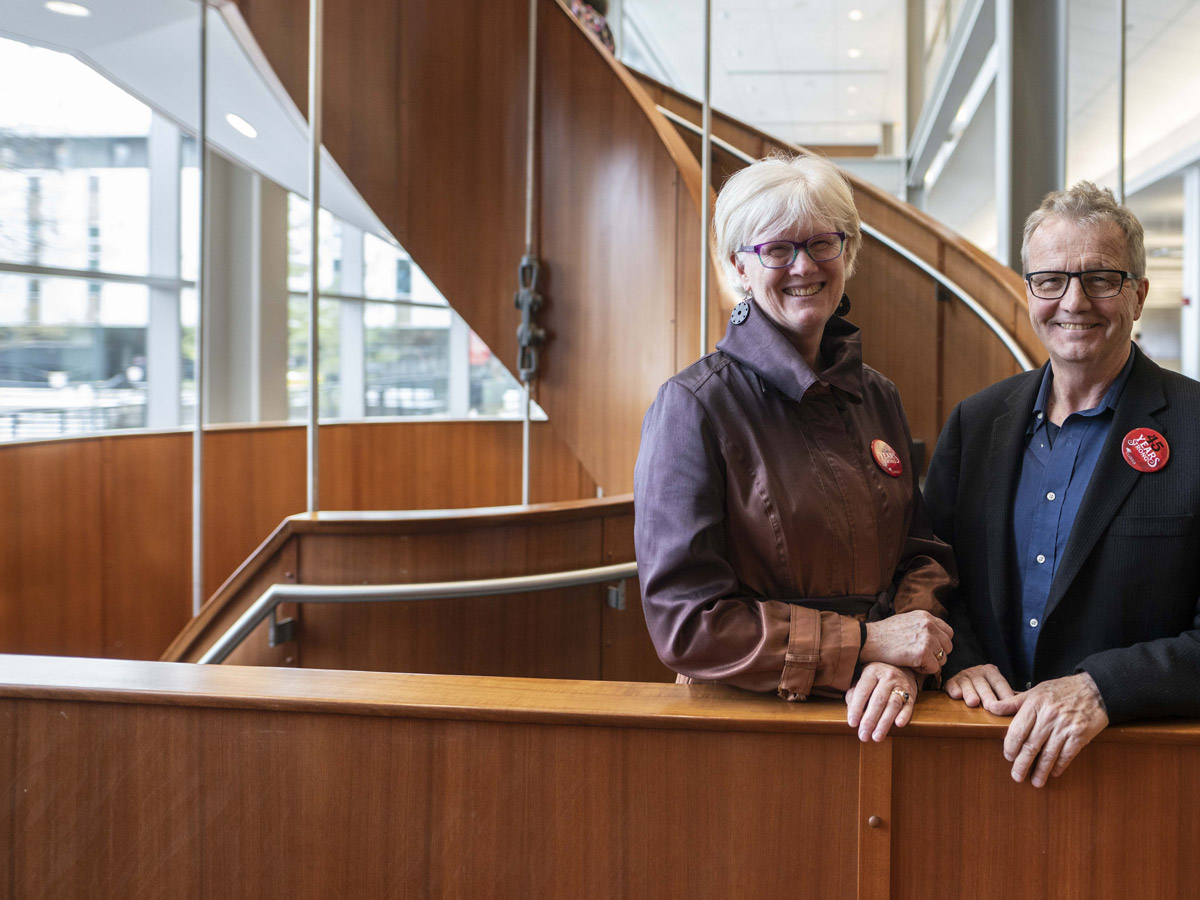
The film highlights Finn’s efforts, alongside fellow CUSSA organizer Sylvia Gruda; those of Valerie Swinton and Susan Jackson, Carleton University Academic Staff Association (CUASA) librarian organizers; and Jill Vickers, former CUASA president and faculty organizer. All except Jackson attended the film’s Dec. 5, 2019 debut on campus.
A Labour of Love
“This documentary was very much a labour of love,” says Carleton interdisciplinary studies librarian and historian, Martha Attridge Bufton.
The 22-minute documentary is based on her master’s thesis, which won the 2014 Eugene A. Forsey Prize from the Canadian Historical Association for the best thesis on labour history. The film is the Department of History‘s 75th anniversary project.
Attridge Bufton co-produced and directed the film with History Prof. David Dean, co-director of the Carleton Centre for Public History. Tai Zimmer, Carleton’s video editor/multimedia specialist in the Media Production Centre, is the film’s senior film editor.
It opens with the 1971 hit “I Am Woman” by Helen Reddy—a feminist anthem at protests and marches around the world in the 1970s—and contains interviews with the five organizers interspersed with black and white photos of social movements and campus life of the era.
Many new academics, librarians and support staff arriving at Carleton in the 1970s were women who recognized that their working conditions were often different than those of their male colleagues.
For example, female support staff had fewer benefits than men, their work was devalued as “less complex,” and they were regularly asked to take on extra responsibilities without compensation.
Social justice, Labour and Gender Movements
Influenced by social justice, labour and gender movements of the period, women in support, librarian and faculty roles decided to unionize to secure an equitable workplace.
“The empowerment of knowing that you have a union contract and that you can do things to protect or fight for your rights, to me is utmost in becoming a union,” says Gruda.
One of the key catalyzing moments for CUASA members came in the fall of 1975 when then- president Michael Kelway Oliver spoke at a general faculty board meeting about the dire financial situation facing university libraries in Ontario—a situation that could potentially lead to layoffs.
According to Jackson, the president suggested they take action if they wanted to see improvements.
“And that, I think, was the starting pistol,” Jackson says in the film. “That really got people thinking about serious organization issues.”
CUSSA members were galvanized by the layoffs of two longtime support staff and the certification of CUASA in April 1975. Clearly, without a union, they would continue to be vulnerable to arbitrary and unfair management practices. By March 1976, CUSSA had become the official bargaining unit for support staff.
Sponsors for the film and screening included the Canadian Union of Public Employees Local 2424 (CUPE 2424), the Centre for Research and Education on Women and Work, CUASA, the Carleton Centre for Public History, and the Workers’ Rights Museum.
The film is dedicated to all those who collaborated, supported and motivated organizers to lobby and achieve collective bargaining.
Following the screening, Attridge Bufton, Finn, Gruda, Swinton and Vickers took part in a panel discussion and reflected on Carleton unionization in the broader context of other labour and social movements. All agreed the key takeaway is not to take good working conditions for granted.
“You’ve got to keep fighting,” said Finn.
“Yes,’’ agreed Vickers. “Because things can be taken away.”