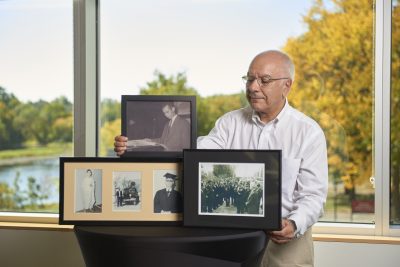
Ali Ramezani
By Laura Byrne Paquet, BJ/87
Photo: Jessica Deeks
In 2011, Ali Ramezani was disturbed by what he saw as an unfavourable media climate. Some politicians and other powerful people were treating journalists with disdain. Some media organizations lacked the budgets or the will to produce in-depth journalism. Ali—currently studying for a PhD in sociology and political economy at Carleton—saw unsettling parallels to his late father’s life.
At age 16, Jaleel Ramezani Namin had left his hometown of Namin to pursue a journalism career in Tehran. He eventually became a radio news producer and, later, a member of a newspaper’s editorial board, and he was one of the first graduates of the University of Tehran’s journalism program. “He really had to be really motivated, and he had to make great sacrifices to go to university,” says Ali.
However, after a 1953 coup overthrew Iranian prime minister Mohammad Mosaddegh and increased the power of the Shah of Iran, independent journalism in Iran became an increasingly difficult field. “He didn’t want to be reporting just what he was supposed to,” Ali recalls. “The repression was becoming more and more intense.”
In frustration, Jaleel left journalism and moved into the public service, where he spent the rest of his career. However, says his son, “His heart was always with journalism. He was a news junkie.”
Ali was thinking about this while writing his will. His spouse’s family had made a legacy donation to the University of Manitoba, and Ali began pondering making a similar donation to Carleton, inspired by his father.
He contacted gift planner Gillian Whyte. “By connecting him with the experts, Ali was able to explore his options and make an informed decisions,” Gillian says. “As a result, his legacy gift will honour his father in the most appropriate way and journalism students will benefit from his generosity for years to come.”
Gillian then put Ali in touch with Chris Waddell, then director of the school of journalism and communication. Chris and Ali discussed what sort of donation would fulfill Ali’s desire for a legacy that would honour his father’s life while also meeting the school’s needs.
Together, they developed the idea for a scholarship focused on ethics, accountability, and investigative journalism. It would fund graduate students who needed money to pay for travel expenses and equipment to research and write their theses. Ali anticipates that the scholarship will be able to fund multiple students each year.
“We want journalists who are brave, who love their field like my father did, and they would potentially be the cause of good reportage and accountability.”
He hopes the scholarships will provide “some direction at least, however small, in terms of encouraging investigative journalism,” which he says is more important than ever. “Blogs cannot replace good writing.”