Electrifying Mass Transit: Carleton Students Support Cornwall’s Energy Transition
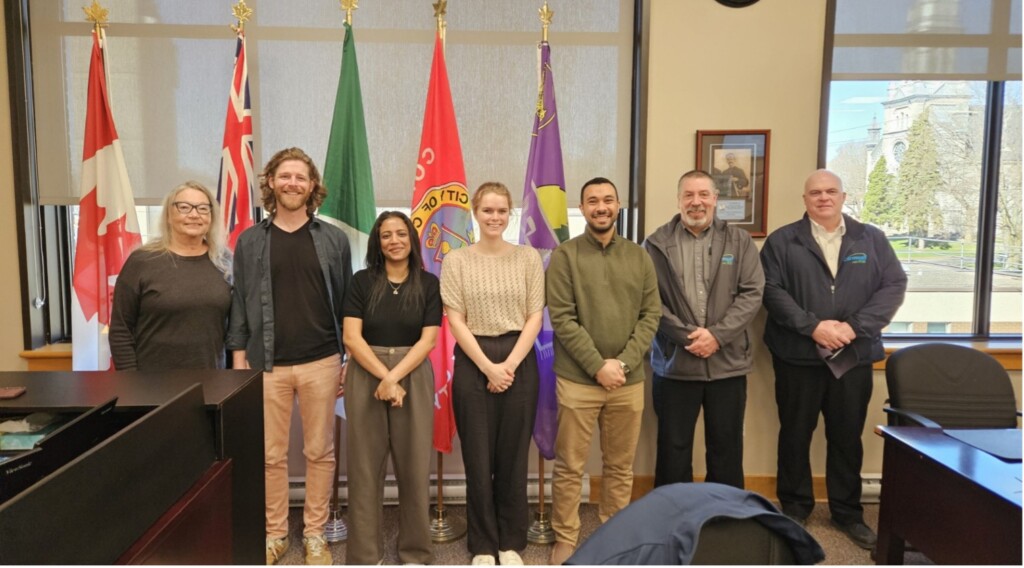
Students in Carleton University’s SERG 5005: Applied Interdisciplinary Project recently presented the results of their capstone project, Electrifying Mass Transit in Cornwall, to senior city and transit officials in Cornwall, Ontario. The project was completed by Abdulrahman Alsayed (MEng–Sustainable Energy Engineering), Amanda Gutzke (MPP–Sustainable Energy Policy), and Vedika Chandran (MPP–Sustainable Energy Policy).
The capstone project was developed in close engagement with Cornwall’s municipal and transit staff and aimed to support the city’s longer‑term energy transition planning. Early in the project, the students conducted a site visit in Cornwall, allowing them to ground their analysis in the realities of the transit system, depot layout, and daily operations. This visit enabled the team to identify potential charging locations and validate assumptions that would later underpin their technical and economic assessments.
Building on this applied foundation, the students examined how Cornwall could transition its existing diesel and gasoline bus fleet to battery electric buses. Three potential pathways were evaluated: full electrification by 2040, delayed electrification by 2049, and a business‑as‑usual scenario with no adoption of battery electric buses. The analysis integrated technical feasibility, economic and environmental impacts, social considerations, and risk and mitigation strategies, resulting in a set of actionable recommendations for the city.
The technical analysis assessed whether battery electric buses could meet Cornwall’s current route requirements under real‑world conditions, including winter operations. Most routes were found to be suitable for electrification, with targeted operational strategies identified for more demanding routes. The students also outlined the infrastructure upgrades required at the Cornwall Transit depot, including garage modifications necessary to accommodate charging equipment.
Economic analysis focused on the net present costs of each pathway from 2026 to 2040, distinguishing between capital and operating costs. While electrification was associated with higher upfront capital investments, the team identified substantial long‑term savings from reduced fuel and maintenance expenses – costs that would need to be borne by the municipality should it delay electrification.
“This project shows what students are able to accomplish when they engage directly with real infrastructure, operational constraints, and policy trade‑offs faced by decision-makers,” said Professor Daniel Rosenbloom, Ivey Research Chair in Sustainability Transitions and Program Supervisor for the Master of Public Policy – Sustainable Energy and the Environment. “This is precisely how we design our program: experiential, action‑oriented, and focused on producing analysis that can inform real decision‑making.”
The project culminated in a formal presentation to senior city and transit staff, with the team’s analysis feeding into ongoing municipal planning discussions. City staff indicated that the findings would help inform the development of Cornwall’s forthcoming master plan, particularly with respect to long‑term transit investment. The project illustrates how applied, interdisciplinary student research can contribute meaningfully to real-world decision‑making by providing timely, evidence‑based analysis.