Apartheid and After: Understanding Democracy as Work in Progress
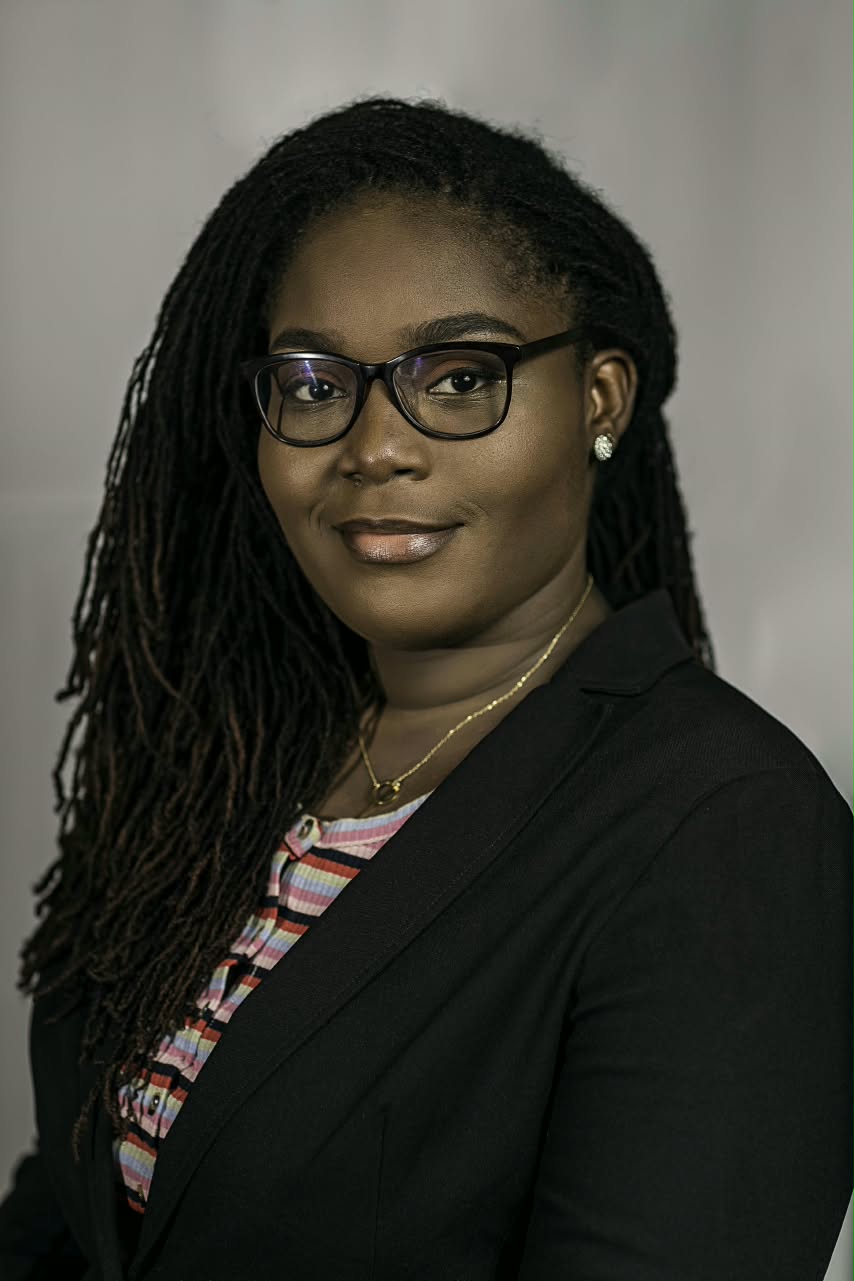
By summer 2025, I had visited South Africa twice before this research trip. My first trip to Cape Town was quintessentially touristic, from visiting Table Mountain and Camps Bay Beach to exploring the Cape of Good Hope, Boulders Beach and the fancy V&A Waterfront restaurants. Amid the mundanity of these experiences, I noticed the dynamics of who worked while others lounged and dined, who lived in which neighbourhoods, and the group walks to catch public transport once work hours were over. There was a glaring divide.
Yes, I knew about apartheid, but a quiet part of me kept asking: was it really that bad? How bad was it, and more importantly, wasn’t that years ago? Almost three years after navigating that reality without the language for it, this trip gave me tools – in the form of concepts and deep historical context (people, spaces, and stories) – that clarified my earlier observations. I thus found myself contemplating what truly defines South Africa, beyond the postcard version.
World-making and the violence of categories
The moniker “Rainbow Nation, ” was not new to me. Dare I say that the 2010 FIFA World Cup cemented the nickname? Honestly, teen me might have imagined this term referred to the vibrancy and animated atmosphere (remember the colourful vuvuzelas?), not necessarily South Africa’s racial diversity. Over the years, despite encountering South Africa’s diversity, I was not completely clued in to how it came to be.
The Camissa Museum, housed in the Castle of Good Hope in Cape Town, puts the long history of slavery and racial classification in southern Africa into context. The Museum presents a history that refuses to treat these categories and labels as natural. Instead, it shows how pre-colonial and colonial configurations laid the foundations for South Africa’s racial diversity by concentrating vastly different worlds at the Cape and in the interior.
We explored how many different African, Asian, and mixed heritage communities were lumped into the label “Coloured,” and how deliberately the colonial and apartheid states
engineered categories for an imperialist agenda and racial economic accumulation. From long-standing Khoi, San, and later Bantu-speaking polities to enslaved people from East and West Africa, Madagascar and Southeast Asia to Indian indentured migration. In the early 20th century, colonial governments assigned labels, seemingly neutral descriptors such as “Non-European,” “British Coloured,” “Native,” “Bantu,” and “Asian.” They were, in fact, tools of inclusion and exclusion wielded to decide who counted as “South African” and who was treated as a foreigner; who could own property; who was policed; who could claim indigeneity; who was set up to resent whom.
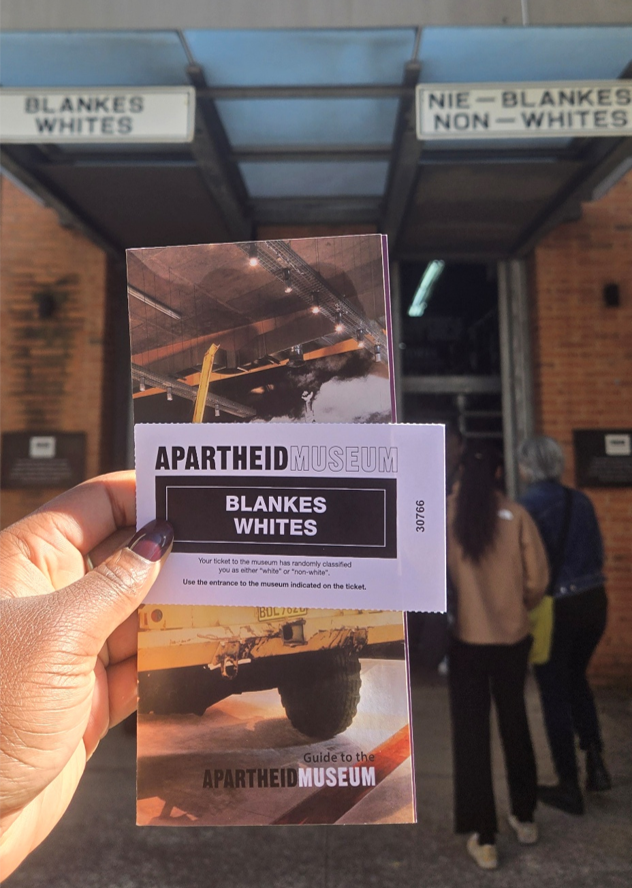
My interest in world-making, myths, and fiction led me to notice that classification itself is a kind of story. To call a diverse set of people “coloured” and then design hierarchies to place whiteness on a pedestal serves a dual function. First, it offers administrative utility to further Empire’s goal of extracting resources and maximising racial capitalist accumulation. Then comes the narrative work, inviting some to imagine themselves as buffers, as exceptions, as more deserving, while encouraging others to imagine their “rivals” as “not quite us,” and collaborators. An objective that socialises economic incentives of racial categories. Learning that many people now reject the term “Coloured” and choose identities like Camissa African, or reclaim specific Khoe, San, or other names, felt like another kind of world-making. An attempt to speak beyond the imposed grammar of race, to re-root belonging in histories of migration, enslavement, survival, and mixing that the state once treated as shameful.
Reparations and the unfinished work of freedom
In the wake of these developments, sites like the Desmond and Leah Tutu Legacy Foundation, District 6, and Apartheid Museums and even engagements with scholars revealed the possibilities and imaginaries activated through collective resistance to these classifications. The result “ended” apartheid and ushered South Africa into a new democratic dispensation, and in many ways, set the new nation as a beacon of democracy. Our visit to Constitution Hill allows one to contend with this post-apartheid temporality. Once infamous for the brutal incarceration of political prisoners and ordinary Black people under racist laws, its preserved cells and gallows now surround a Constitutional Court built from the old prison bricks, symbolically turning instruments of oppression into architecture of dignity, equality and democratic justice. South Africa’s Constitutional Court was born as the guardian of a transformative, rights-based order, striking down the death penalty, criminalisation of queer sex, and many apartheid‑era remnants.
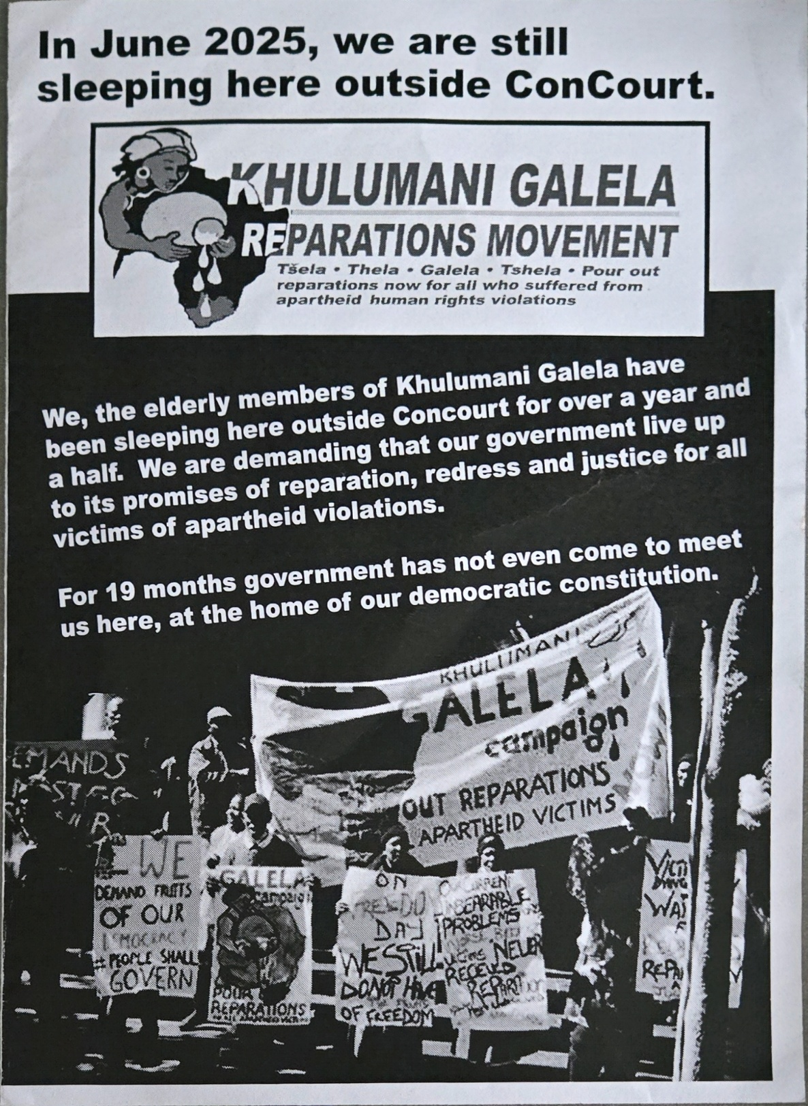
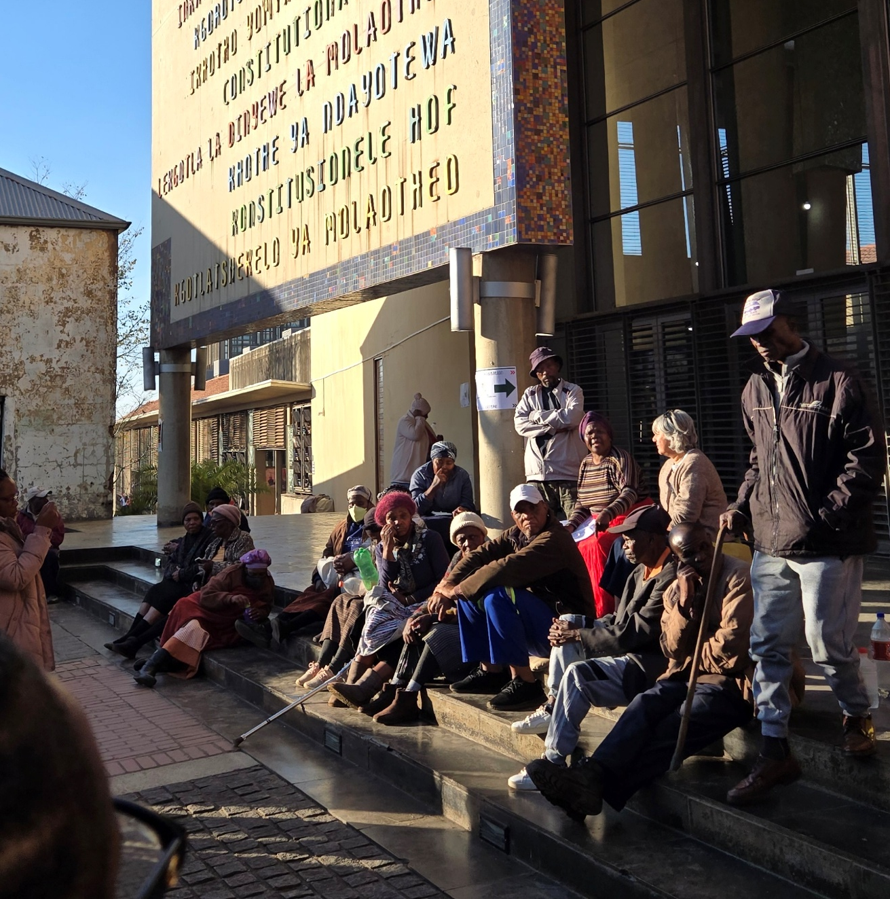
Yet, it embodies a stark paradox. While powerfully expanding formal rights in landmark rulings, material inequality, state capture, and everyday bureaucratic violence blunt its emancipatory promise, leaving a court celebrated globally yet often experienced locally as distant from lived injustice. This was exemplified during our interactions with elderly people, who form the Khulumani Galela Reparations Movement. They have been protesting, on and off, since October 2020, first outside the Union Building in Pretoria and, since 2022, at the Constitutional Court, calling on the South African government to finally deliver full reparations, redress, and justice to veterans, survivors, and victims of apartheid-era human rights violations. They argue that decades after the Truth and Reconciliation Commission (TRC) findings, promises have still not been kept. Reparations were restricted to a “closed list” of about 22,000 TRC-verified victims (with fewer receiving payments), payments were cut far below the TRC’s recommendations, and key benefits such as medical, housing, education, and community rehabilitation were largely not delivered. They noted that they sleep outdoors and have observed their numbers declining, having lost eight members since resuming protests in late 2023 despite bureaucrats’ repeated unfulfilled promises to meet with them.
The official story is that reparations have been “completed” with the TRC identifying victims, paying out grants to those who qualified, and the President’s Fund is now an administrative matter. But the people camping outside the Court insist that the process was too narrow, too bureaucratic, and too quick to declare closure. For me, this scene crystallised what it means to question the “post” in post-apartheid. How can we speak of closure when so many promises to restore citizens’ dignity have not been kept, leaving them to sleep on the ground outside South Africa’s highest court, denied an audience and access to the court’s public facilities? A court established to protect their human rights. What does democracy mean to someone whose continued suffering has been filed away as completed business?
The “ongoingness” of democracy and this thirst for better was evident in our interactions with members of the Black, queer, intersectional feminist collective, a spin-off of the 2015-2016 Fallist movement. This movement, which birthed the #FeesMustFall and #RhodesMustFall, demanded the decolonisation of higher education in South Africa, connecting it to the wider goal of a free and just South Africa. Ironically, its own spaces reproduced heteropatriarchal hierarchies in which womxn, queer and trans activists were sidelined, threatened and subjected to misogynistic and homophobic violence by fellow “comrades.” This paradox highlights the importance of continually challenging and resisting the hierarchies, silences, and violences. It also emphasises grounding any claim for democratic inclusion in the real, everyday experiences of the most marginalised, rather than in abstract ideas or virtuous language.
Contending with the fantasy of democracy
Unfortunately, what is at stake here is not a mere crisis of vague concepts of freedom and equality but a global unravelling of the democratic norms and institutions through which state and society have historically mediated their relationship. Democratic rollback is stark even in states long cast as “mature” democracies. Across the United States, the overturning of Roe v. Wade in June 2022 ended federal constitutional protection for abortion. In 2020, in Central and Eastern Europe, right-wing governments in Hungary and Poland systematically weakened courts, captured media and constrained civil society, prompting their reclassification as hybrid regimes. Today in Canada, proposals to limit government oversight through proposed restrictions on freedom of information access and procedural tactics that reduce public scrutiny of decisions. At the same time, delays and barriers within institutions like the Supreme Court of Canada make it harder to challenge authority, meaning rights and accountability increasingly exist more in principle than in practice. Together, these shifts signal a wider erosion of the substantive and procedural guarantees that once underpinned liberal democratic state–society relations. In this light, South Africa isn’t an outlier but is young enough and deeply scarred to more clearly reveal struggles for inclusion, redistribution and accountability.
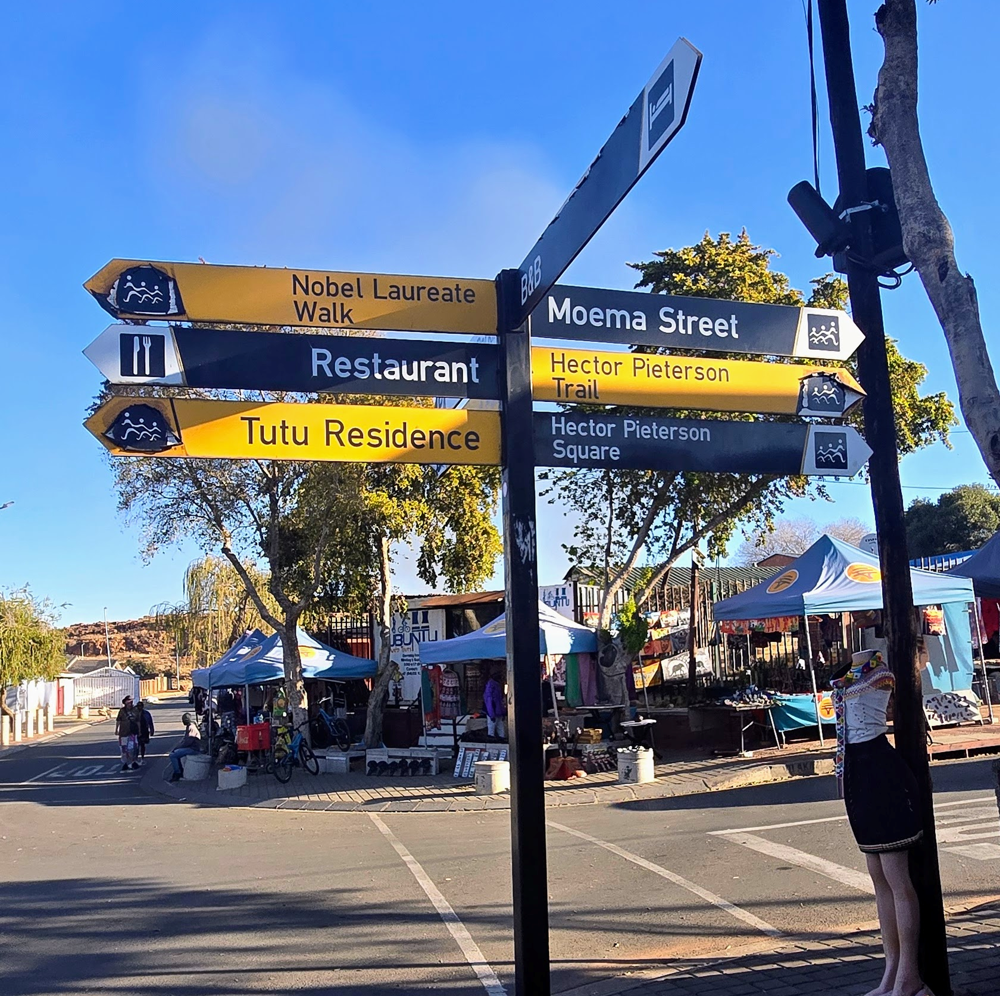
I left South Africa with a solid grasp of the deep histories that have underpinned this modern nation-state. I intend to continue grappling with the half-conscious fantasy that democracy, once achieved, is something like a secured status that is won, constitutionalised, protected and celebrated on anniversaries. Recognising the incomplete state of democracy involves acknowledging both the real, hard-earned successes of struggles and that the pursuit of freedom remains fundamentally unfinished. That double vision feels essential for how I want to study and write about the continent’s political history.
Sika Kudjawu is a doctoral Candidate in History and African Studies at Carleton University. This report originates from her study tour with a group of Carleton University doctoral students specialising in African Studies. The tour was organised by Professor Shireen Hassim and funded through the Canada150 Chair in Gender and African Politics.