Life Preserver : How a Legacy Slide Collection Introduced Me to the Lives of Artists & The Importance of Knowing Them
by Caleigh Cross – Practicum Student Winter 2026
After twelve weeks, 96 hours, I’ve completed my Art History practicum placement with Carleton University’s Audio-Visual Resource Centre. During my time here, I have conducted digital research to support the 35mm slide deaccessioning project, aiming to create more space in the AVRC library. Each slide was carefully researched, and when I could find a high-quality image within the public domain, the slide was deaccessioned. I consolidated four drawers in these twelve weeks, each five allow for a whole cabinet to be removed. This is important work, where you must balance the desire to preserve a massive legacy collection like this with the need for increased accessibility. It taught me a lot about collections work and preservation, yet surprisingly, even more about life.
A little over halfway through my semester, I came across an artist named Dan Eldon. Eldon grew up in Nairobi, Kenya, spending much of his time there and around neighbouring areas in East Africa. He also travelled the world. He was a photographer, eventually being hired by Reuters to be a war photographer. Eldon had an interest in how conflict worked; he wanted to understand, but in the same breath, did not stand for the topics he was covering. He found solace in his journals. Dan Eldon lost his life at the age of 22, along with three other journalists, killed in a riot in Somalia, after a wrongful bombing by the U.S. Marines.1 I learned about Eldon’s story through my research into his slides. The images I was looking at were beautiful, they captivated me, and as I researched more, I discovered his story, which is now preserved in The Journey is the Destination, a compilation of his journal pages, published posthumously by his mother, Kathy. She writes in the introduction of the book:
Only twenty-two when he died, Dan had already achieved prominence for his work as a war photographer. But his photographs told only half the story. The other half lay hidden away in seventeen black-bound journals filled with collages, writings, drawings, and photographs.I was intensely proud of what I was allowed to see in the pages of Dan’s journals, but I could never understand why he confined his artistic expression to the inside of books. Often I would ask him to produce works I could put on my walls. But Dan would always refuse, sometimes quite indignantly, and return to his black-bound journals, books he shared with only the closest of friends or family. By the time of his death, Dan had filled seventeen volumes, creating thousands of pages reflecting his own peculiar perspective on life. Layered like an archaeological dig, the pages are bizarre and colourful relics of a multifaceted civilization, intensely personal though inhabited by many different people. 2
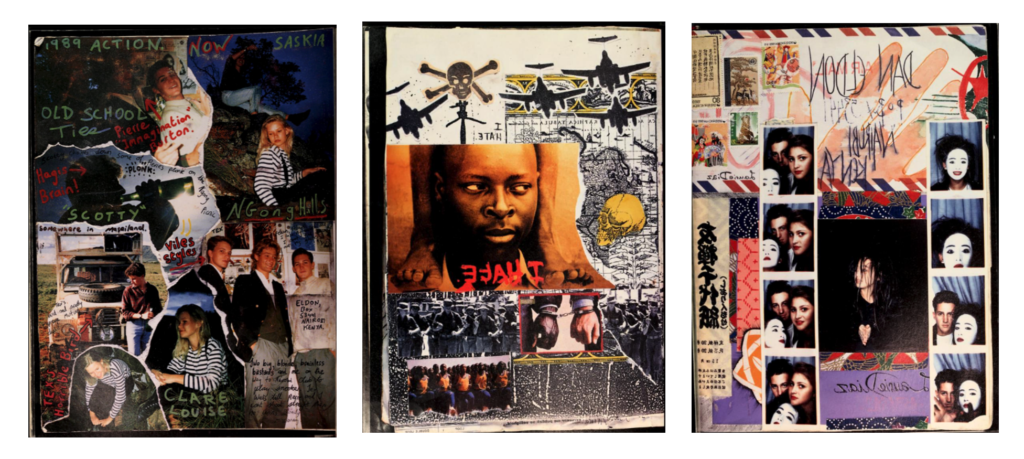
He lived a colourful life, surrounded by people, always on an adventure. It was cut so short by way of the very creativity that coloured his life so brightly, his art, his photography. In researching Dan Eldon, I learned an important lesson about the work being done here at the AVRC: It is not just about preserving a slide or finding an image, but about preserving life itself.
In this collection, there are thousands of images that are nearly impossible to find anywhere else, whether they were donations from an artist, from a gallery that no longer exists, or from a private collection that doesn’t exist online. Often, these harder-to-find images are the most intimate ones, the ones depicting life, and the things that inspired artists we know and love. I remember on my second day, going through the Arthur Dove collection. Dove, a well-known American artist, whose majority of works are available somewhere on the World Wide Web. A little gold nugget slotted between these slides of his lifetime of paintings – an image of him and his wife, with their boat at the dock of their cottage home – however, stuck out. Through all Dove’s artwork, I could try to understand him, to see his mind and his inspiration, but it was always muddled in colours, shapes,lines, and perceived meanings. Yet, through these couple of images of him at home, with someone he loved, I learned so much of it. The rest, learned through brief research into his home, his boat (a prized possession of his), and his wife, also an artist.
The same happened when I was going through the Marcel Duchamp collection, parsing through well-known works like Fountain, and L.H.O.O.Q, yet the moment I learned about Duchamp as a person was when I picked up the various portraits of or by his loved ones, and by other artists, like Man Ray.

One that stood out, Rrose Sélavy, a feminine alter ego of Duchamps, told me much about his place in society, his values, and what he fought for, as well as the deeper emotions that may have governed his life. This was gender-based activism in Duchamp’s day, created with the support of a well-documented friend of his.3 I had never heard of Rrose Sélavy before finding this slide in the drawer, yet it taught me more about him than many of the artworks I was familiar with. Portraits like these seemed to be a theme in the slide collection, small images that show the relationships between artists and the photographers, or those in the image. Photos of artist groups, like the surrealists of the 20th century. They all told me a story I likely wouldn’t have found on my own.
These slides act as clues to the lives of the artists we admire, an image title, a photographer’s name, or a handwritten acquisition record tucked into a binder somewhere on a bookshelf.
So, what do we do if these clue trails vanish, if physical media loses its value to the art world, the film fades, and the records decompose? We won’t have these trails to follow, and when they vanish, so will these hidden stories that live in all the darkened corners of our institutions. It’s already happening, not only the disappearance of a physical collection, but the privatization of what is already digital. Some images are unusable, unfindable, unless you have permission from an institution and eighty euros to send their way. Why is this? Public collections like the one at the AVRC are forced to shrink while massive, inaccessible digital collections continue to grow, auction after auction –support your local public collection!
So why deaccession when these trails are so important? Well, when we deaccession, the image is first found online. Every image that is sourced online creates a network on the internet that leads us down the same trails, but through our screens instead of through books. It builds reliance and relationships with online databases like JSTOR, The Internet Archive, public museum collections, or MDID, the AVRC’s digital tool. These tools are replacing the physical library, and they must be supported in their efforts. All this to say, to deaccession a physical collection and to research each image is to be a life preserver in a vast ocean where history is sinking. To build pathways that teach us not only about art, but about art history – the way life, culture, and the winds of time have changed a discipline that influences so much of the world. Without life, love, passion, and inspiration, art is merely beautiful imagery. Completing my practicum with the AVRC, and through that, learning about the lives of artists, has taught me the importance of preservation and instilled in me a personal investment in the humanity of art.
The creation of art is an inherently human act, and one that begs to be documented and saved, lest we forget ourselves and the creativity that animates us.
References
- Dan Eldon. The Journey Is the Destination: The Journals of Dan Eldon. Edited by Kathy Eldon. San Francisco: Chronicle Books, 1997. Internet Archive. https://archive.org/details/journeyisdestina00eldo.
- “Dan Eldon Biography.” Dan Eldon. Accessed April 8, 2026. https://www.daneldon.org/dan-eldon-biography/.
- Philadelphia Museum of Art. “Man Ray, Marcel Duchamp as Rrose Sélavy, c. 1920–1921.” Accessed April 8, 2026. https://philamuseum.org/objects/56973