2025 Convocation Address
By Dean Brenda O’Neill
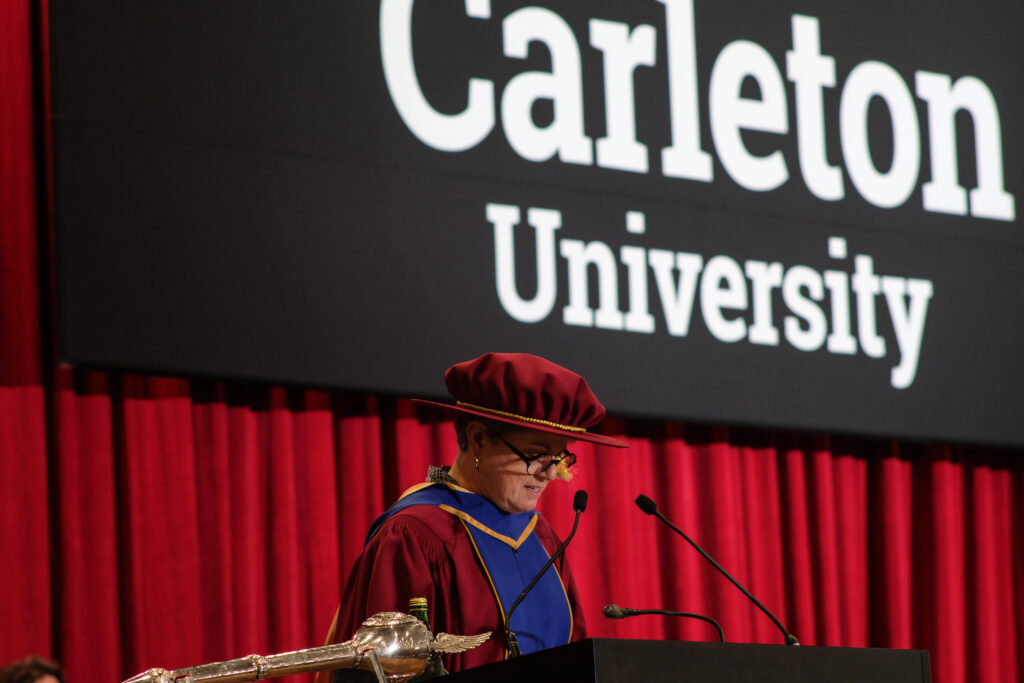
Thanks very much and let me start by saying that I consider it a privilege to be able to provide today’s convocation address.
Congratulations to each and every one of you sitting here today. And welcome to all the friends and family who travelled from all over to be able to share this day with each of you.
Convocation addresses are often of a type: most common is the address that tries to impart a deep message, one that resonates with the times and that we hope might stay with the audience long after graduation. That is often what we believe to be the case when we sit down to write them. And there are certainly a number of topics that merit consideration right now: the fragile state of the world order, the future of liberal democracy, reconciliation with Indigenous peoples, the state of Equity, Diversity, and Inclusion initiatives. But as I think back to my own graduation ceremonies, I can’t really remember who gave the address, much less what they actually said. It might be age, but I refuse to believe that.
So let me spare you my attempt at a deep meaningful address and instead try to say some things that might actually stick with you long after today. Maybe even try to make you laugh. And so what is it that I want to share with you, while you are a captive audience?
What I’d like to share with you are the things that I learned over the years that I wished I had known when I was sitting where you are. Things that come from a mix of experience and age, some from the invariable learning that takes place throughout life, some from mistakes, and some from very wise people who shared their thinking with me.
- Try to read the newspaper every day. This one came from one of my undergraduate political science professors at Brock University, Professor David Seigel, over 40 years ago. You can tell it was a long time ago because he didn’t tell me to read “trusted news sources” or indicate which app to use since neither was an issue at the time. It was a paper; a physical copy delivered every day. But the importance of the advice still stands.
Citizenship provides us with multiple benefits, but it also comes with responsibility. Knowing what’s happening around you and around the world is one of these. Have opinions – educated opinions — on issues. Know what policies are being discussed in your city and in your country. Know who you want to support and why when you head into an election booth. Democracy is fragile, and its survival requires people who are vigilant and knowledgeable. No matter how busy, I still scan a paper everyday to see what is happening.
- Don’t be afraid to be yourself. One of my favourite quotes is one I found in high school that I’ve returned to a number of occasions. It’s from Thoreau’s book Walden published in 1854 and it goes like this “If a man does not keep pace with his companions, perhaps it is because he hears a different drummer. Let him step to the music which he hears, however measured or far away.”
I come back to this quote to remind myself that it’s okay to do things differently than others, to feel as though no one gets you, it’s okay to buy crazy pink suede shoes rather than the more sensible black ones that go with everything. It’s okay dance on the street in public while waiting for the light to turn green when I’m out for a run listening to music. Remember that fewer people than you think are watching you, and even if they are, it might be because they wished they could also “dance like no one was watching”. But as I’ve gotten older, I now know that that quote also means that I need to give that freedom to others, to let them be who they feel they need to be inside, regardless of what society tells us is the “right” thing to do or the right way to be. It’s about the gift of tolerance. Everyone deserves the freedom and tolerance to be who they need to be.
- Take a chance. Take a risk. Be bold. Be brave. I think of my maternal grandmother, Angelina Ménard, who as a young teen at the turn of the century, left her home in St. Hyacinthe in Québec with her sister for Quebec city to work as chambermaids at the Chateau Frontenac to help support the family back home. That could not have been easy. Or my late father telling me as a young girl to look out the door and see the whole world which as he said “was mine for the taking.”
I now know that he was telling me that because he hadn’t had the chance to live his dream and wanted to be certain that his children did. So go for it. Take chances. The world needs risk takers. Ignore that little voice telling you that you can’t do it, that you won’t succeed. We need people who challenge the status quo and those with authority and power. Success will come with its own rewards. And so too will failure. You will learn about yourself, about your strengths and your weaknesses, which will make your next attempt that much better.
And we need to remember that the goal is important, but so too is the journey on the path to success or failure.
- Be humble. Humility to me is about never letting your own power and success blind you to the needs of those around you, to your own weaknesses. It’s also about recognizing your own strengths and weaknesses, your blind spots, and working to address them. None of us is perfect, we all now and always will have things still to learn, and we need to own and recognize our mistakes.
We also have to be able to say “I don’t know” and “can you help me with this?” I learned this lesson the hard way in fourth or fifth grade. The teacher asked me if I knew what the underground railroad was. I didn’t, but couldn’t bring myself to say so. I couldn’t bear the thought of admitting I didn’t know and looking dumb. So, I took a wild but seemingly risk-free guess. “It was an underground railroad that they built to transport slaves North and into Canada,” I said with confidence. As you know, it wasn’t. Since then, I’ve never hesitated to say “no.”
I know you’ve heard your professors say there are no stupid questions. Believe them. Admit to not knowing things.
Humility allows us to recognize that our successes are never truly individual, but rather are dependent on others. It allows us to listen more to those around us and talk less. And I see this—humility— as imperative for the development of mutual understanding and respect, which is core to addressing the problems that need solving in our world. Remember to ask yourself, “Might I be wrong?”
- Finally, cherish your family and friends. One of the best pieces of advice I have ever received came from a mentor (Professor Sandra Burt at the University of Waterloo) several years ago when I went to her for advice to ask about a career move. And it’s a simple one. As she told me “Brenda, what do people write on their headstones? It’s not the number of papers you’ve written or awards you’ve won or how many hours they spent at work. They write about the relationships they’ve had. Loving wife and mother. Loving son. Loving brother. Always keep that in mind when trying to figure out what is most important to you.”
I’ve never forgotten these words and I hope you don’t either.
Take a moment today to thank those friends and family who helped you on your journey to graduation. No one does it alone.