Alumni Entrepreneur Camille Dundas Calls for Change in Journalism
Camille Dundas called on the journalists and journalism educators in the audience at the first annual Mary Ann Shadd Cary Lecture to show compassion for—and collaborate with—the people they interview.
Dundas, the co-founder and editor-in-chief of ByBlacks.com, an online magazine featuring Canada’s Black community, described the decade she spent in the legacy media “going in, getting the story, rinse, and repeat” without considering the unintentional harm that approach could cause.
“One night I was working a late shift and the phone rang. The voice on the other end asked, ‘Are you going to do a follow-up story about my brother?’” recalls Dundas. “He said, ‘You did a story about my brother; he was accused of something, but he was found innocent.’ I really didn’t know what to say because I knew the answer was no.”
That was one of the moments when Dundas knew she had to get out of the “extractive journalism” business.
“It’s very arrogant to think we have ownership over someone’s story after they’ve shared it with us,” she said, noting the treatment of the Black community in particular. “We don’t let them read it before we publish it, but what do I gain from not getting their consent? I risk losing myself and my empathy.”
Dundas launched ByBlacks.com in 2013 with the intention of taking a collaborative approach to storytelling. This was especially true in the series, “When Black Boys Go Missing,” in which Dundas interviewed families whose teenage sons were groomed to become drug runners. She was determined to tell their stories in a respectful way.
“What did we do differently? For one, we granted ourselves the luxury of time. This gave us room to ensure that not only the story was ready, but the people in it were ready,” explained Dundas, who sent the parents a letter sharing the risks and realities of telling their stories.
“One of the parents immediately wanted to back out…terrified of being identified even though we had changed the names. But I made a choice that many in corporate media are not able to make: I shared it [with her] and together we came up with something that wasn’t the precise vision I initially had in mind, but still effectively supported the story.”
The Legacy of Mary Ann Shadd Cary
Dundas described the invitation to deliver the inaugural lecture as an “immense honour.” The lecture series is the first in the School of Journalism and Communication named after a woman, Mary Ann Shadd Cary, the first Black woman to publish a newspaper in North America and the first woman to publish and edit a newspaper in Canada. She founded and edited The Provincial Freeman in 1853 to advocate for equality and education for Black people, and to support the rights of women.
The lecture was co-founded by Journalism professors Trish Audette-Longo and Nana aba Duncan to highlight the voices of women and nonbinary journalists. Duncan is also the founder of the Mary Ann Shadd Cary Centre for Journalism and Belonging, launched in 2023.


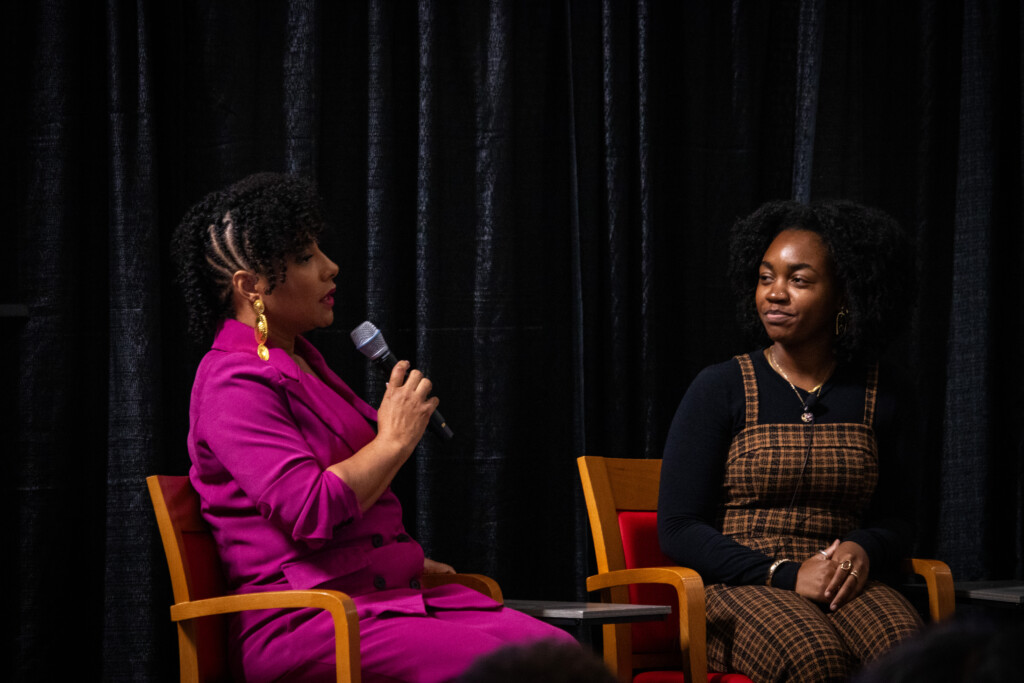

“Camille Dundas gave us so much to reflect on,” Audette-Longo said after the lecture. “She asked us to think about what journalism is supposed to accomplish and how trust is earned, and she challenged us to ask these questions in our everyday work. This is one of the goals of the annual Mary Ann Shadd Cary Lecture: to learn about how Canadian journalism is changing and urge consideration of new practices and alternative futures.”
The lecture began with a spoken word performance by Abena Beloved Green. Two of Mary Ann Shadd Cary’s descendants—historian, curator and writer Adrienne Shadd and former Buxton National Historic Site & Museum curator Shannon Prince—attended the inaugural lecture, and Shadd delivered opening remarks contextualizing her forebear’s legacy.
“It’s fitting that we honour Mary Ann Shadd Cary with a lecture in her name. As a publisher and abolitionist, she herself delivered lectures speaking up for the rights of Black people, and to gain financial support for The Provincial Freeman,” Duncan said.“She herself was a voice of change, so it makes sense that we would honour her in this format.”
Another objective of the lecture series is to provide opportunities for students. The organizers recruited and trained three journalism students— Simone R. Brown, Sarah J. Harb and Georgia Looman—to co-moderate the event on stage. Audette-Longo also invited Camille Dundas to speak in her graduate Journalism in a Changing Society class about the challenges of reporting the series, “When Black Boys Go Missing.”

Organizers also partnered with the Black Entrepreneurship Knowledge Hub, in the Sprott School of Business, to identify potential business owners to showcase their work.
The event reflected both Caribbean and West African culture. Dinner included Jamaican jerk chicken and sorrel, a sweet hibiscus-based drink, and the pop-up Black Women Business exhibit featured four West African women, highlighting Mary Ann Shadd Cary’s role as a Black entrepreneur.
The event is funded by the Canadian Race Relations Foundation as well as individual donors and the School of Journalism and Communication. If you’d like to support the Mary Ann Shadd Cary Lecture Series, please visit here.