Approaching Journalism from an Indigenous Perspective
The first day of Carleton’s journalism program for Indigenous students began at 6:30 a.m. around a campfire on Manitoulin Island on Lake Huron.
“Even though they had traveled the previous day, all 20 students were up and sitting around the fire welcoming Noshomis —welcoming the sun—and opening the beginning of our certificate in a good way,” recalled Duncan McCue, journalism professor and director of the Certificate in Journalism in Indigenous Communities (CJIIC).
The sunrise ceremony kicked off an experience much different from your average university program. McCue and his colleagues spent two years creating a curriculum that would embed journalism concepts into an Indigenous environment, with the values and the community support that would be familiar to these students.
After more than 15 years teaching journalism, McCue knew Indigenous students needed a different approach.
“When I was hired to create a certificate for Indigenous students, I knew what the main barrier was going to be for us: asking them to come to Carleton,” he explained. “The key principle was that they had to be able to stay at home and not have to worry about leaving their family and other cultural supports behind. They also wouldn’t face the financial barriers of moving to the city.”
McCue sought out partners who could help deliver the program he was imagining. He reached out to the First Nations Technical Institute, a forerunner in community-based education located in Tyendinaga Mohawk Territory in Ontario, and Kenjgewin Teg, an Indigenous-owned institution at the M’Chigeeng First Nation on Mnidoo Mnising on Manitoulin Island.
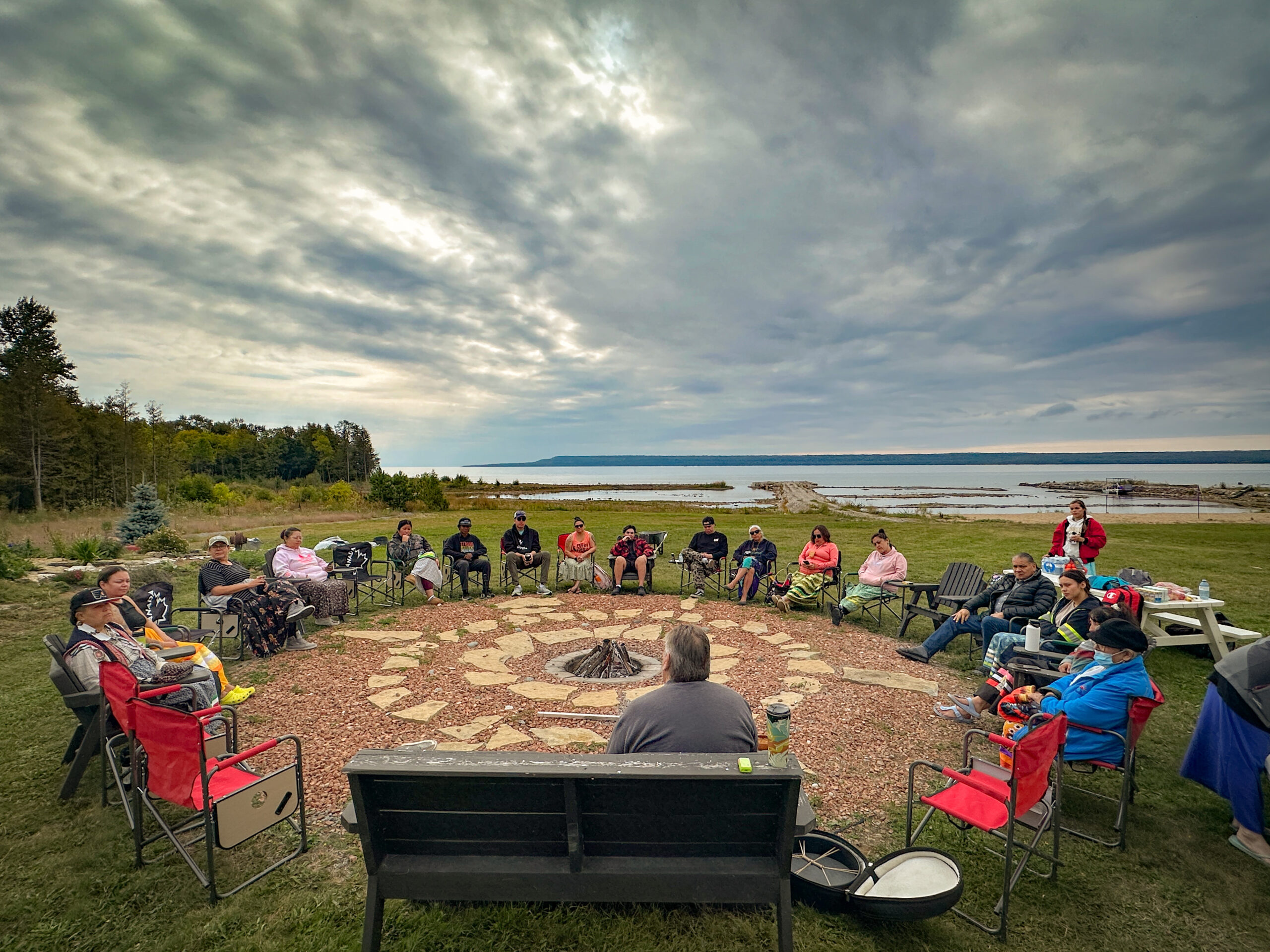
The program’s second week, an Indigenous storytelling course, was held at Kenjgewin Teg on Manitoulin Island.
“It’s truly a beautiful place. They had a fire going in the teaching lodge, which is made of birchbark, and students offered [traditional] medicines andid prayers,” said McCue, himself a citizen of the Chippewas of Georgina Island First Nation. “Kenjgewin Teg has knowledge keepers, elders, and traditional teachers. They shared a wealth of Anishnaabeg pedagogy and ways of knowing that set the tone for the week.”
To take on the role of an Indigenous journalist, Duncan told the group, they needed to draw on the rich history of their own communities.
That resonated with Shantel Sault, a member of the Mississaugas of the Credit First Nation, who lives in Southern Ontario. She said the experience helped her connect with her Indigenous identity.
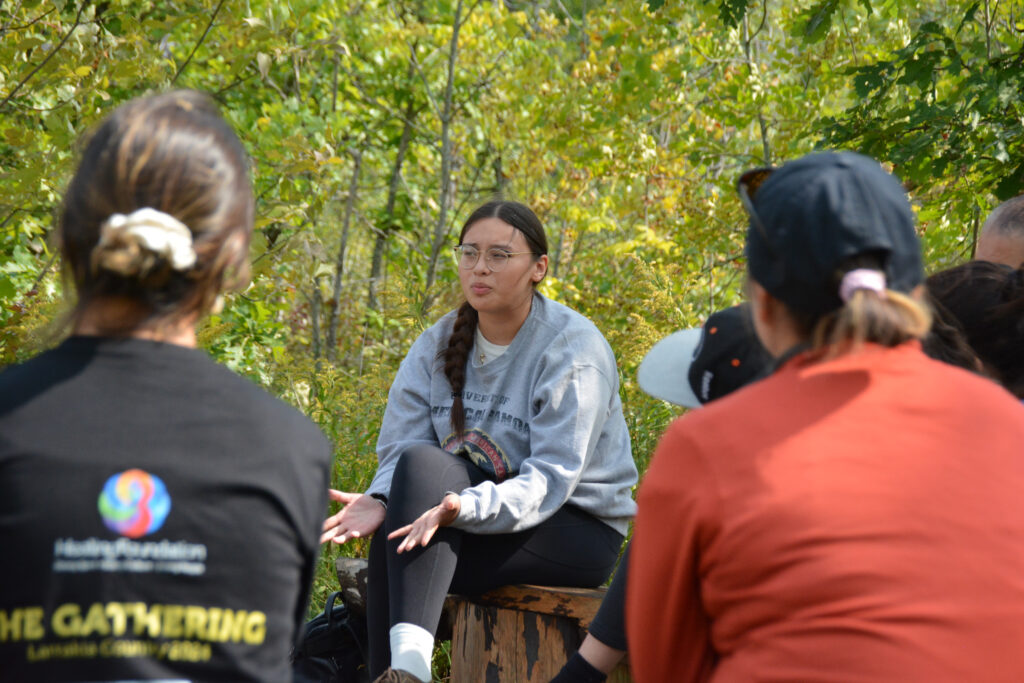
“As someone who grew up with Christian values and very little exposure to Indigenous culture (besides what was taught at my reserve-based elementary school), it felt amazing and incredibly affirming to explore that aspect of my identity,” Sault said. “One moment that stands out the most was experiencing a Sweat Lodge ceremony for the first time. I didn’t grow up in a culturally rich household, and therefore never had the opportunity to indulge in the ceremonial practices of my people, so I’m very grateful that I got to experience that with such a strong and welcoming group of individuals.”
Sault said the group shared stories and memories and, by the end of the week, were referring to each other as family.
“What I had hoped was that the storytelling class would help them connect and share with each other, and it did,” McCue said. “Part of the sharing circles and the environment we tried to create for them was to allow them to feel safe and to talk about the challenges in their lives outside of school and academics.”
The academic requirements of the one-year program includes in-person intensives at Kenjgewin Teg and Carleton, and virtual classes, all taught by Indigenous journalists.
“We offer them introductory skills and if they decide after one year that they’ve got as much as they need to do what they want in their home communities—whether it’s run a radio station or set up a podcast or work on the band newsletter—then they’ll be able to do that. They will also have the chance to complete an internship at a local news or media outlet.”
Additionally, graduates have the option to enter the second year of the Bachelor of Journalism program at Carleton or continue online with a BA, General Studies degree.
In addition to classes, the certificate program offers academic support from advisors at Kenjgewin Teg and First Nations Technical Institute, as well as a cultural advisor and a student success facilitator.
“We’re really attempting to support our learners in all aspects of their journey,” McCue said, “and we understand that for a lot of Indigenous learners, that means they need emotional or spiritual support because of the history of colonization and experiences they’ve had with education.”
For the first week of the program, the students were joined by Allan Thompson, the co-director of the School of Journalism and Communication.
“The birchbark lodge, which is a place of traditional storytelling and ceremony, was kind of a magical place to hold a class,” said Thompson, as he recalled the deeply personal storytelling that took place in the space. “This group of 20 students would probably not be studying journalism as a profession were it not for this program—and journalism needs them.”
Applications for the Fall 2026 cohort of the Certificate in Journalism in Indigenous Communities are now open.