Student EDI Research Projects Focus on Community
By Karen Kelly
While graduate student Farah Ormelet was considering topics for her master’s thesis in Communication, she spent some time looking at TikTok accounts targeting Haitians in Canada, as well as those interested in crossing the border.

“I found lots of reels on how to go to Canada, what to do and what not to do. Some were by lawyers giving legal advice; some were by smugglers who can drive you to the border,” recalls Ormelet. “It was a sea of information targeting this vulnerable population and I wanted to know how they were making sense of it.”
As the graduate student recipient of the 2026 FPGA EDI Research Award, Ormelet received a grant of $3,000 to pursue her topic, “The Digital Railroad: Haitian Asylum Seekers’ Transnational Journey through TikTok,” which will inform her master’s thesis.
In addition to analyzing social media content, Ormelet will seek out Haitians who arrived in Canada and ask them how social media use and the current political climate in the U.S. played a role in their journey.
“This is important because Haitians are often interviewed about the terrible things happening in their country. This project focuses on them as media users: we get to see them in a different light where they’re taking charge of their own life and using digital skills to do so.”
Japanese Canadians in the 1960s
The undergraduate FPGA EDI Research Award was given to Kiran Niet, a student in the Bachelor of Global and International Studies program, who received $2,000 to study his topic, ““Homeland Tourist/Coming Home: Exploring Japanese Canadian Cultural Identity in the Radical 1960s.”
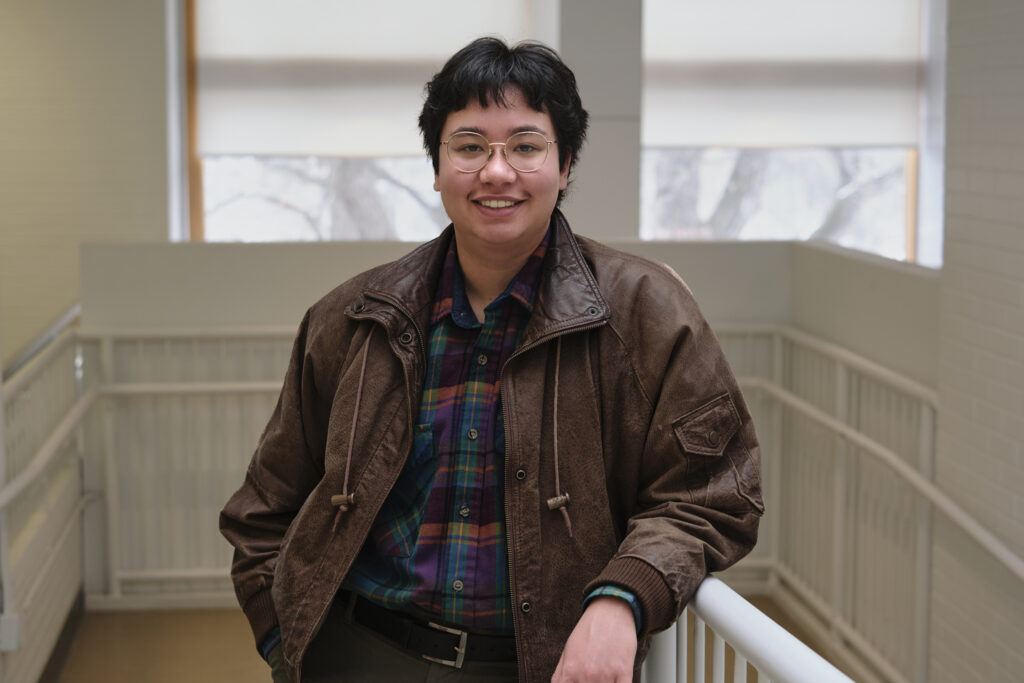
“I’m a fourth-generation Japanese Canadian and I didn’t grow up with a lot of Japanese culture or community around me, so I wanted to better understand my Japanese-Canadian heritage,” he explains.
That curiosity deepened as Niet learned about 1960s politics in a class led by Professor Candace Sobers.
“I just began to connect the dots and started wondering, what were Japanese Canadians doing? What was their relationship to the [protest] movement?”
In his research, Niet discovered The New Canadian, a newspaper published in Japanese and English, that linked Japanese communities across Canada.
“There was so much back and forth in the paper—lots of opinion pieces—debating how Japanese Canadians should think about their relationships to these movements and to their Canadian-ness,” says Niet. “This wasn’t long after Japanese citizens living on the West Coast were placed in internment during World War II. That legacy has permeated the community ever since.”
As part of his research, Niet plans to interview his grandfather, who was 22 years old in 1968, the same age as Niet is now. He was a professional photographer, and Niet hopes to include some of his photographs in the final project.
The FPGA Student EDI Research Awards are annual awards that recognize the importance of, and encourage student research in, EDI and reconciliation-related topics.