Three first-year Carleton students take on the Canadian Model EU
By Allyson Yang
Three Carleton first-year students represented the university at the 3rd Canadian Model EU, hosted by the University of Victoria from May 12 to 13, 2026. Rory Dupuis and Kennedy Durrell-Vander Meulen represented Hungary, and Kate Hunter represented Malta.
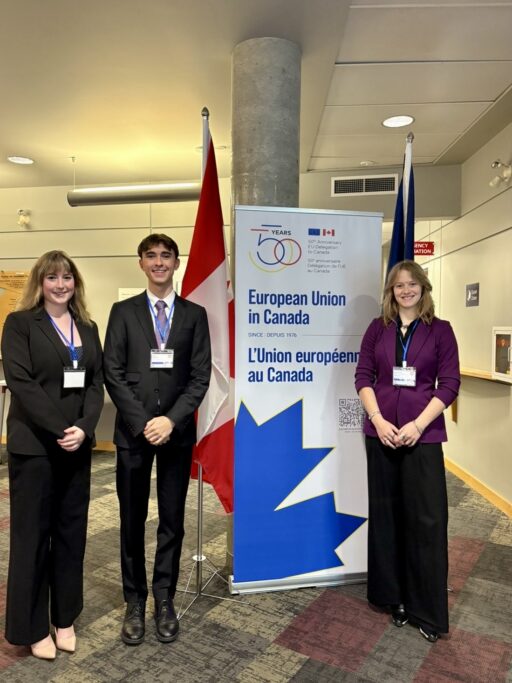
Hunter is a Political Science student, and had the opportunity to compete after being referred by her teaching assistant. Her past work mainly dealt with issues in Canada, but the EU experience broadened her understanding of international affairs.
“It was very interesting to see how people interacted, and I learned about new policies and how they were enacted. Now that I have done this, I feel that I can branch out more in the future,” Hunter said.
The experience also provided Hunter with an opportunity to strengthen skills beyond the classroom, particularly in public speaking and communication. “I think the biggest thing I learned was how to talk with confidence. Seeing how the others talked allowed me to see the effects of speaking with confidence. When you speak with confidence, people are more likely to agree with and trust you.”
Model EU has also influenced Hunter’s future goals; she now considers pursuing international relations after the experience.
Dupuis is a Global and International Studies student. He first worked with Durrell-Vander Meulen during The Schuman Challenge 2025. After the two teamed up, Durrell-Vander Meulen suggested seeking guidance from Political Science professor Achim Hurrelmann, an expert on the European Union. Their top-five finish in the competition led Hurrelmann to invite them to participate in Model EU.
Dupuis said representing Hungary required him to balance national interests with the need to reach agreements with other delegations, giving him a firsthand look at the compromises involved in international diplomacy.
Despite having previous experience participating in Model UN, this new experience gave Dupuis a new perspective on negotiation and diplomacy.
“I think being able to put myself out there to handle and negotiate such important matters was very eye-opening in my first year and definitely reinforced my interest in public relations,” Dupuis said.
Unlike Model UN, where delegates often focus on debate, Dupuis said Model EU placed a greater emphasis on coalition-building and negotiation. “Next time, I would definitely take a stand early on and formulate partnerships early. Model EU taught me to be open to opportunities and not to be afraid to ask.”
Joining Dupuis and Hunter at the event is Durrell-Vander Meulen, a physics student minoring in Political Science. Durrell-Vander Meulen said one of the most rewarding aspects of the competition was being treated as an equal among more experienced participants. “I especially loved how we were playing on equal grounds. Even though we were the only first years there, we felt respected and treated fairly,” she said.
Despite being fully prepared before attending, the immersive stimulation allowed Durrell-Vander Meulen to get a better understanding of how the EU functioned. As a result, Durrell-Vander Meulen won the award for “Best Negotiator (Heads of Government)” and was voted by the other students as the participant “Most Likely to Work For The EU.”
This opportunity was made possible by Professor Hurrelmann, who created a specialized mini-course to make sure the students were ready for the contest.
“It was an absolute pleasure working with them. All three were willing to put in the extra hours of work, to learn about the countries they were representing… They not only understood the political system of the EU and the policy challenges involved in the negotiations; they also thought really hard and creatively about negotiation strategies.”
Hurrelmann said he was proud of what the students accomplished and hopes they continue to build on the experience throughout their academic and professional careers.