Wayfinding Canada’s Energy Transitions: Politics, Policy, and Pathways
Field Notes
Daniel Rosenbloom, School of Public Policy & Administration
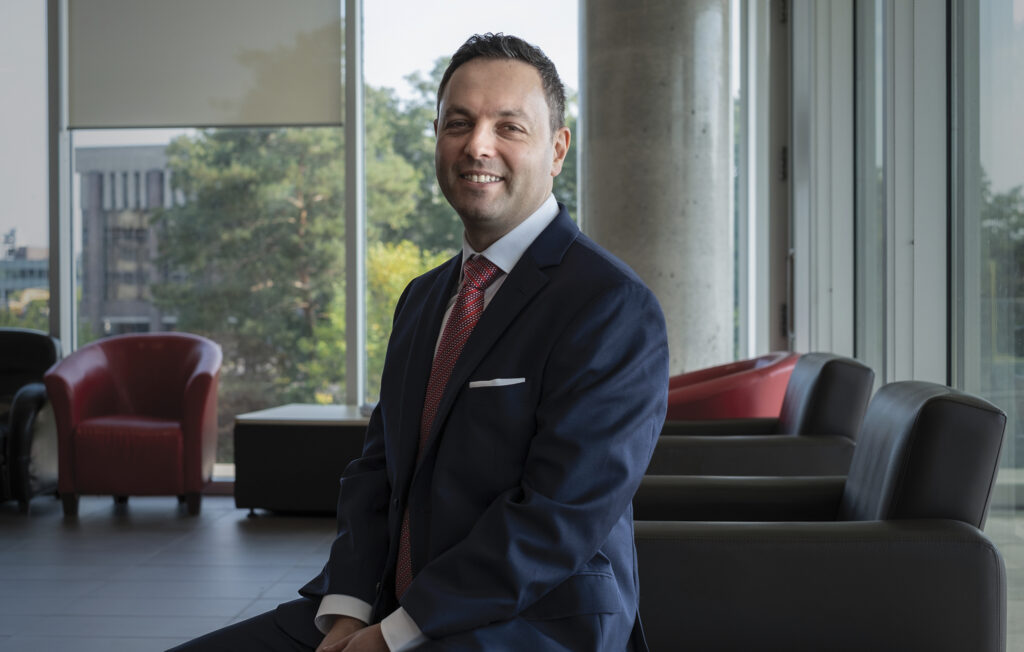
Professor Daniel Rosenbloom’s research sits at the intersection of climate, energy, and innovation policy. Grounded in sustainability transitions research, he studies the policy dimensions of past and present transitions in energy systems. His work develops governance strategies for overcoming resistance to and accelerating decarbonization pathways in Canada and abroad.
What are you working on these days?
My work as the Ivey Research Chair in Sustainability Transitions keeps me very busy.
I’m currently leading a SSHRC Insight Development Grant that maps stakeholder positions surrounding electrification across Canada. Electrification, understood as shifting energy end-uses met through fossil fuels to clean electricity sources, is well recognized as the most credible pathway for reaching our climate commitments. This project aims to reveal where the main points of friction lie across sectors and regions, unpack the basis for these frictions, and formulate policy strategies to smooth out electrification pathways. A highlight of this project is collaborating with colleagues from across Canada and several bright Carleton students.
I also continue to work closely with policy practitioners on unfolding energy transitions. A major focus right now is developing decisionsupport frameworks that help decision-makers align nearterm choices with longterm netzero transformations. This work connects to my role on the Executive Committee of the Energy Modelling Hub – a national consortium of universities dedicated to enhancing Canada’s modelling capacity and insights, which Carleton recently joined. It also links to work I am conducting with the Sustainability Transitions Research Network on enhancing science-policy engagement and impact.
Beyond this, I am coediting a special issue on accelerating netzero transitions with Karoline Rogge (Science Policy Research Unit, University of Sussex) and Qi Song (Cambridge Institute for Sustainability Leadership, Cambridge University). The goal of this work is to sharpen how we conceptualize ‘acceleration’ in transition processes and to highlight practical interventions that can support more rapid change. Contributing to this, I’m collaborating with Runa Das through another Insight Development Grant focused on regulatory innovation, which explores how regulators can become agents of accelerated change.
Then there are dozens of individual paper projects and collaborations stretching across transition topics and contexts – many of which involve our students.
What piqued your interest in sustainability transitions?
Early in my career I focused on the individual motivations for poor environmental outcomes, drawing on insights from psychology. But quite quickly, it became clear to me that the systems that condition individual behaviour merit the bulk of our attention. This is what drew me to both policy and transition perspectives as together they offer critical insights on how technological, political, and institutional dynamics interact in shaping societal trajectories.
I was also drawn to a field that isn’t afraid to be normative. Indeed, it is important to understand that our work is inseparable from the urgent societal problems we aim to address.
In the same way, I value that the field is solution‑focused. It doesn’t stop at diagnosing or deconstructing problems but asks what kinds of governance arrangements, policy mixes, and institutional reforms might actually move us toward more sustainable futures.
What is something people would be surprised to learn?
People are often struck to learn about the drivers behind the profound and sometimes quite rapid transformations of the past. Consider, for instance, how the shift from horsedrawn carriages to internal combustion engine vehicles in the early 20th century took only a few short decades and was propelled in part by a deepening public health crisis surrounding the accumulation of horse manure in major urban centres. These types of transition histories show that deep changes can occur more quickly than we tend to assume when the right pressures, innovations, business models, and policy signals align.
What’s the biggest misconception about your research area?
An important misconception is that transitions are primarily technological shifts induced by markets – that they happen because a better widget is invented and markets follow. Rather, transitions relate not only to technologies and markets but also policy interventions, business models, and political struggles. Returning to the diffusion of the automobile, this technology benefitted from technical advancements but also from a business strategy focused on mass production and decades of favourable state efforts, from the build out of road networks to the design of cities. The governance of sustainability transitions can learn from these episodes of change to deploy a much wider set of policy tools. It is not enough to passively encourage innovation, get the market structure right, and then wait for change to happen.
Any new projects you’re excited about?
One major initiative that I am quite energized about is my work with Professor James Meadowcroft to join up and strengthen the Canadian community of transitions scholars and practitioners. In November 2025, we brought together scholars from across the country to articulate a shared agenda for transitions research and action anchored in Canadian realities. The goal here is to both strengthen the Canadian community but also further translate transition insights to our context so that we can realize desirable futures.
What’s your favourite class to teach?
SERG 5005: Applied Interdisciplinary Project is a clear favourite of mine for three reasons. First, it is built around the principle of experiential learning, whereby students work handson with real societal partners on actual transition challenges. This year, student teams are working with societal partners on building out microgrids in Quebec, carbon dioxide removal solutions in the Prairies, and electrifying mass transit in the City of Cornwall. Second, it is solution oriented. I push students to design actionable proposals that help build along credible and prosperous pathways to net-zero. Third, it is fundamentally interdisciplinary. Recognizing that sustainability challenges span disciplinary boundaries, students from engineering and policy backgrounds work together to integrate insights from technology, economics, business, and policy. Overall, the course mirrors the systems approaches needed to advance transitions in practice, and these are precisely the skills policymakers are seeking in the job market.