Amanda Gutzke, Master of Arts, Public Policy in Sustainable Energy and the Environment
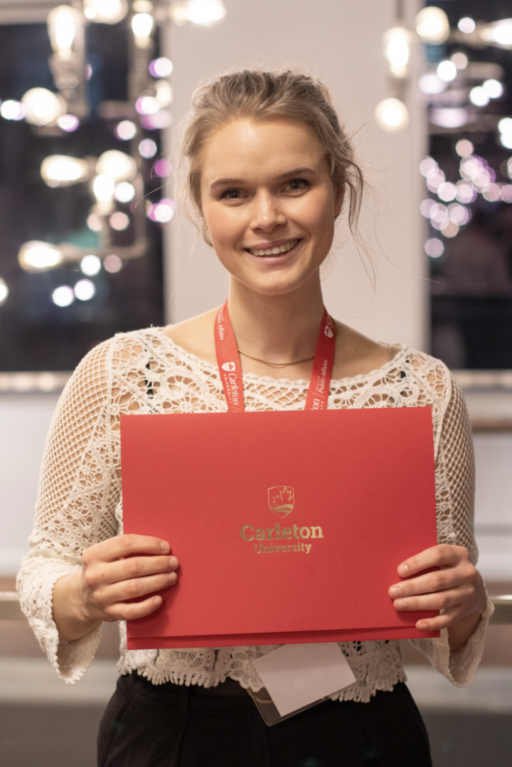
What degree are you receiving?
I am graduating with a Master’s of Public Policy in Sustainable Energy and the Environment.
What drew you to Sustainable Energy?
Before this program, I worked as a research assistant for domestic and international research institutes, where I supported research on municipal affairs. I was drawn to this program because I wanted to learn how to support the energy transition at the local level.
I achieved this academic goal through my capstone project, in which I worked with several other students to design an electrification pathway for the City of Cornwall’s transit fleet. Our project involved designing three potential pathways for the fleet: an electrification pathway, a delayed electrification pathway, and a no electrification pathway. My role was to find the net present cost of each pathway. I found that while electrification entailed higher capital costs, it yielded significant operational savings. Achieving operational savings is important because this form of expenditure is rarely covered by external funding. In contrast, capital expenditure may be eligible for grants and loans from upper levels of government.
Top 3 reasons to study Sustainable Energy:
- Interdisciplinary structure of the program (classes with engineering professors and students) gives students an understanding of the technical components of the grid and sustainable energy technologies,
- Sustainable energy is a high priority of governments, which contributes to job opportunities,
- Good cause: rapid GHG emission reduction can be achieved by cleaning the grid and electrifying transit and heating.
What was the highlight of your experience?
The highlight of my experience would be connecting with my fellow classmates. Sustainable energy is a smaller program, and there are lots of opportunities to work with your classmates on projects. I also didn’t know many people in Ottawa when I moved here for school, so being able to build relationships that will extend past the classroom has been really meaningful.
What was the biggest challenge?
The biggest challenge was planning the annual gala, which was a significant undertaking. However, with the support of the other students on the planning team, we pulled off a successful event! We had over 100 students, professors, alumni, and representatives from local industry attend. We were also able to raise money for the student society, which we will use to support networking and training opportunities.
What skills are you taking into the workplace?
SERG 5003: Energy Evaluation and Assessment Tools gave students the opportunity to practice various valuation methods, which I used for the economic analysis of my capstone project. This costing experience will be extremely valuable in the workplace. Another valuable course was PADM 5611: Science, Tech, and Innovation Policy. In this course, students had the opportunity to learn how governments can support the scaling of innovative products and methods.
What’s next for you?
Up next, I’ll be taking a much-needed vacation where I’ll eat some great food and see some fantastic views. I’m currently looking for employment opportunities. My interests include supporting utilities in adopting new technologies, customer energy solutions, and community energy planning.