Autonomous Vehicles On the Move
By Dan Rubinstein
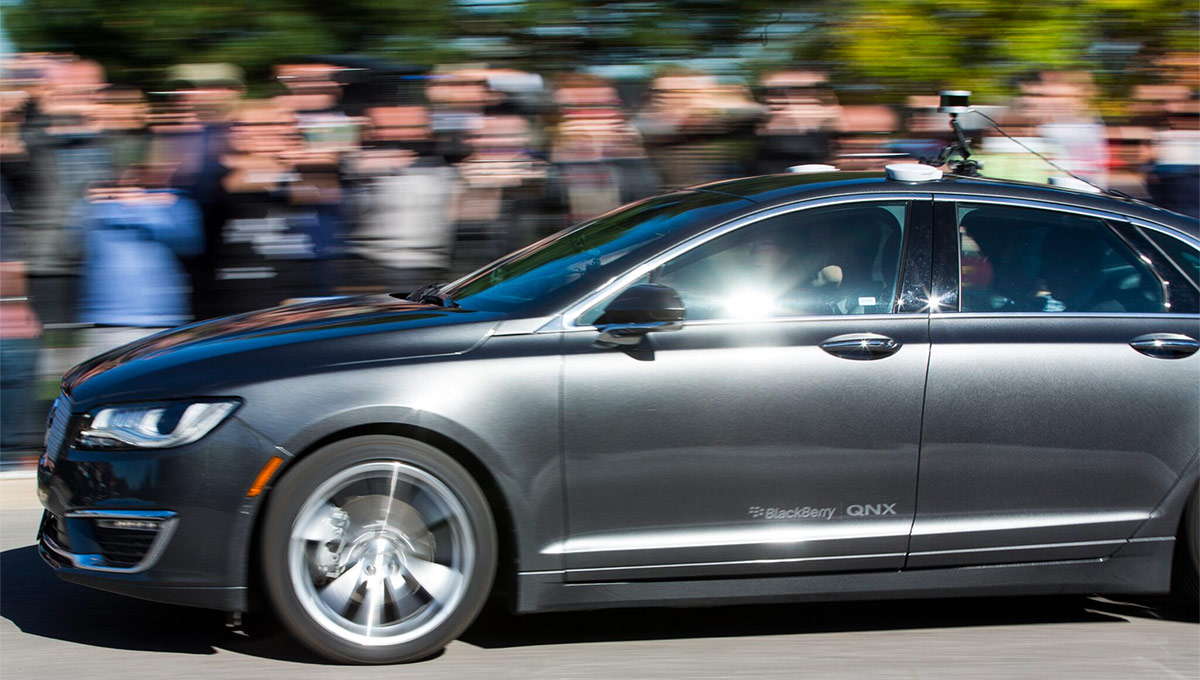
For the first time anywhere in Canada, an autonomous car is being road tested on a public street while communicating with live city infrastructure such as traffic lights and global position system base (GPS) stations.
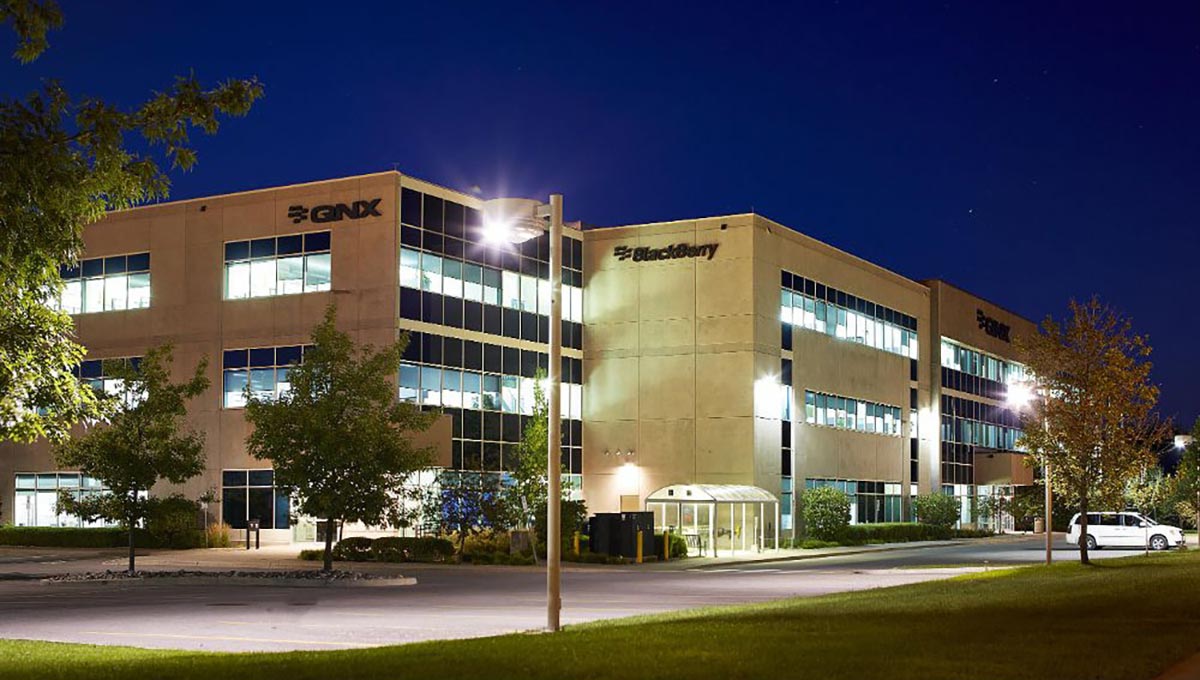
The test area — on a track that loops around Kanata North Technology Park, the country’s largest tech park — is equipped with the latest GPS and telecommunications technology from high-tech company BlackBerry QNX and other local contributors, including NovAtel, Luxcom and Codha Wireless.
Tests like the one on Oct. 12 will enable the collection, management and analysis of data from the vehicle and city infrastructure, and allow the municipality to put the information to work in beneficial ways on city roads.
The demonstration is being organized by BlackBerry QNX, which opened the Autonomous Vehicle Innovation Centre (AVIC) last year, and a cluster of partners who are working together to develop Ottawa into a national and global leader in the autonomous vehicle industry.
But long before any rubber hits the road, whether for a test or eventual commercial deployment, research is required to ensure that these exciting new technologies are safe and secure. Which is where Carleton University’s expertise in connected cars and next generation wireless systems, sensors and real-time data analytics, software engineering and artificial intelligence come into the picture.
Across the university, more than 125 researchers from four faculties are actively engaged in a wide range of projects that can help BlackBerry QNX and partners such as the City of Ottawa, the Kanata North Business Association and Invest Ottawa, as well as about 70 other local companies, put the city on the international autonomous vehicle map.
“When it comes to autonomous vehicle innovation, I want people around the world to think of Ottawa as the place making it happen,” Mayor Jim Watson said in a news release.
“Our rapidly growing ecosystem of customers, partners and developers will benefit from this advancement,” said John Wall, senior vice-president and general manager of BlackBerry QNX and a Carleton Engineering graduate. “Anybody who has driven in Ottawa in February knows that no matter who is behind the wheel, driving isn’t easy when it comes to ice, sleet and snow. We believe these conditions, coupled with the city’s commitment to supporting research and development from BlackBerry and its partners, makes Ottawa a fantastic place to advance autonomous vehicle technology.”
Finding Efficient Safety
Features for Autonomous Vehicles
Earlier this year, Ontario became the first province to set a regulatory framework to permit testing self-driving vehicles.
Carleton’s research on fully autonomous vehicles will help pave the way for more efficient safety features that will improve road safety.
Increasing the automation level in vehicles will also extend the number of years of driving for older drivers, making them more mobile and socially engaged.
“Carleton, the University of Ottawa and Queen’s University believe that the Ottawa region is a national centre for pursuing the research and development of autonomous vehicle technologies,” Carleton Vice-President (Research and International), Rafik Goubran, said in a news release. “Each university’s faculty are producing the scientific research and highly qualified personnel that will position Ottawa as a hub for leading-edge autonomous vehicle design.”
Carleton is already working with QNX in a couple of areas, including autonomous vehicle security, and using the company’s software in university labs.
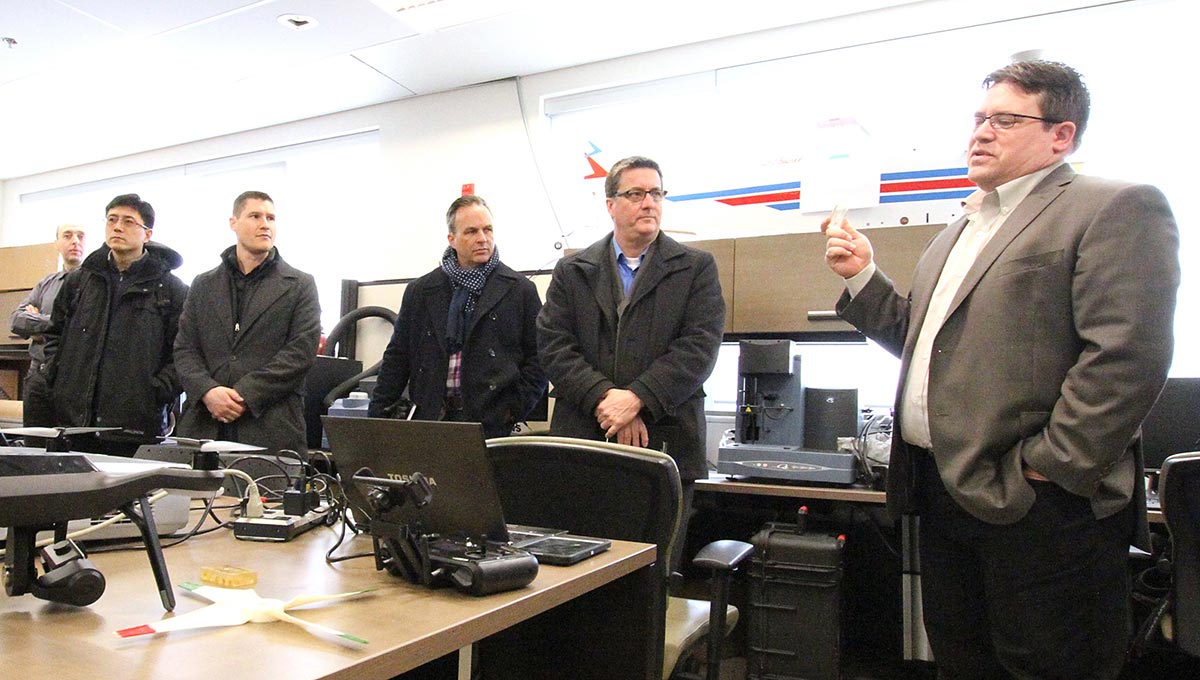
Last March, Carleton hosted a group from QNX that toured campus and visited several laboratories as a stepping stone toward further collaboration.
“We have a strong interest in the research that’s taking place at the university,” Grant Courville, senior director of product management at QNX, said during the visit.
“We wanted to see first-hand some of the labs and meet some of the people who are doing work at Carleton that relates to autonomous vehicle and connected car technology. We want to see where there might be areas of collaboration, and how we can leverage these connections.”
Advancing the
Connected Car Industry
Among the many researchers at Carleton whose work can help advance the autonomous vehicle and connected car industry are:
- Halim Yanikomeroglu, whose research focuses on customization and adaptation of state-of-the-art 5G wireless networks, multi-hop relaying and co-operative communications for connected vehicles;
- Richard Yu, with research focusing on addressing existing research challenges to make innovative 5G wireless networks more efficient and effective relevant to autonomous systems;
- Yvan Labiche focuses on detecting faults of various black-box software testing techniques and model-driven software engineering relevant for ICT (Information and Communication Technologies) and autonomous vehicles;
- Thomas Kunz focuses on integrating ICT into smart grids, multi-hop wireless networks and bandwidth demand engineering;
- Yuhong Guo focuses on machine learning, artificial intelligence, natural language processing, computer vision and big data analysis;
- Paul Van Oorschot focuses on operating system design, security and authentication management tools;
- Qi-Jun Zhang focuses on modelling, optimizing and design of high-speed and high-frequency electronic devices, circuits and systems used in computers, as well as wireless and wired systems used in telecommunications, and intelligent and autonomous systems;
- Mohamed Atia focuses on real-time embedded systems, sensor-fusion, signal processing, estimation, machine learning and artificial intelligence.