The fifth task of marrow extraction is also hearth-related (Fig. 4d). Again, the few in the southwest
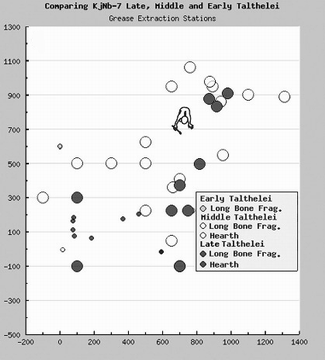
Figure 4d. LT, MT, ET Grease Extraction
are from my original test-pit. Marrow is mostly fat, the most concentrated easily stored energy source, especially for transport south for winter. It is also needed to reach the minimum of 18% body fat content needed to bring a fetus to full term (e.g., Frisch, 1988; Rosetta, 1992), which could be difficult to achieve in some, if not many years, due to seasonal restrictions in herd follower diet. Bone breaking and marrow extraction were female tasks. Marrow exists in ribs, vertebra and ankle bones, but long bones produce the best quality fat (Jenness, 1922:102-3; Wilson, 1924:174). They were crushed on a hide so fragments were not lost or soiled, and quickly transferred to boiling water. So I looked for hearths, unburnt long bone fragments, fire-cracked rock or boiling stones and enough space for the boiling operation. This was done in a birch bark vessel or sand depression lined with rawhide and filled with water. Space for these is excluded in these combined palimpsests, but the female icon is scaled. She is shown with a forked stick in her right hand for moving hot rocks from the fire to the water for boiling. Floating grease was removed with a muskox (Ovibos moschatus) horn or bark or wood skimmer, to be mixed later with dried meat powder and stored as pemmican. As the water filled with extracted long bone and fire-cracked rock, bone and fragmented rock were deposited further right while intact rock was returned to the fire for reheating. In my single palimpsests from each of the three levels, marrow extraction was rarely east of a hearth because the dominant west wind would scatter ash and cinders into the floating grease, rendering it inedible. There is also a limit to the amount of smoke one might tolerate.
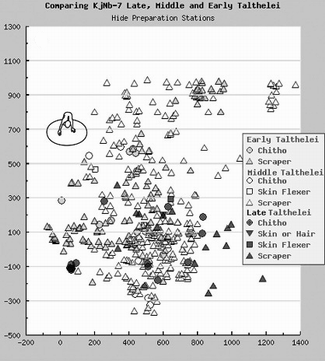
Figure 4e. LT, MT, ET Hide Preparation
The sixth task was hide preparation, and I plotted used chithos, scrapers and flexers (Fig. 4e). Chithos are thin, rough sandstone disks, while flexers resemble worn bifacial scrapers. Both were used to soften and stretch hides by dragging them over the outstretched hide from its center to its periphery like a huge scraper. Hence, the loss of these tools around the arc made by the hide, and their subsequent finding by us centuries later when we penetrated the wind-blown sand covering the palimpsest. When I plotted palimpsests individually, I set a 60-120° minimum arc of scrapers and chithos to orient a 1×2-m ovoid outstretched hide, adding a female icon opposite the artifact arc for scale.
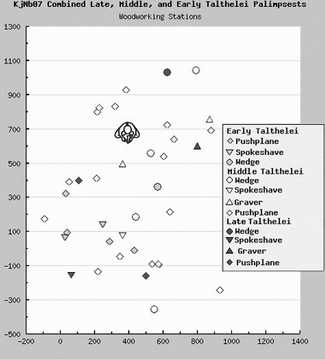
Figure 4f. LT, MT, ET Woodworking
As my final task was woodworking, I included denticulates, wedges, pushplanes and spokeshaves used to cut, split, plane and round spruce poles and tool handles (Fig. 4f). These widely distributed tools were likely used on larger wooden objects requiring room to work.