Ram Achar

Project Area: AI-Enhanced Analog Circuit Simulation and Design Exploration
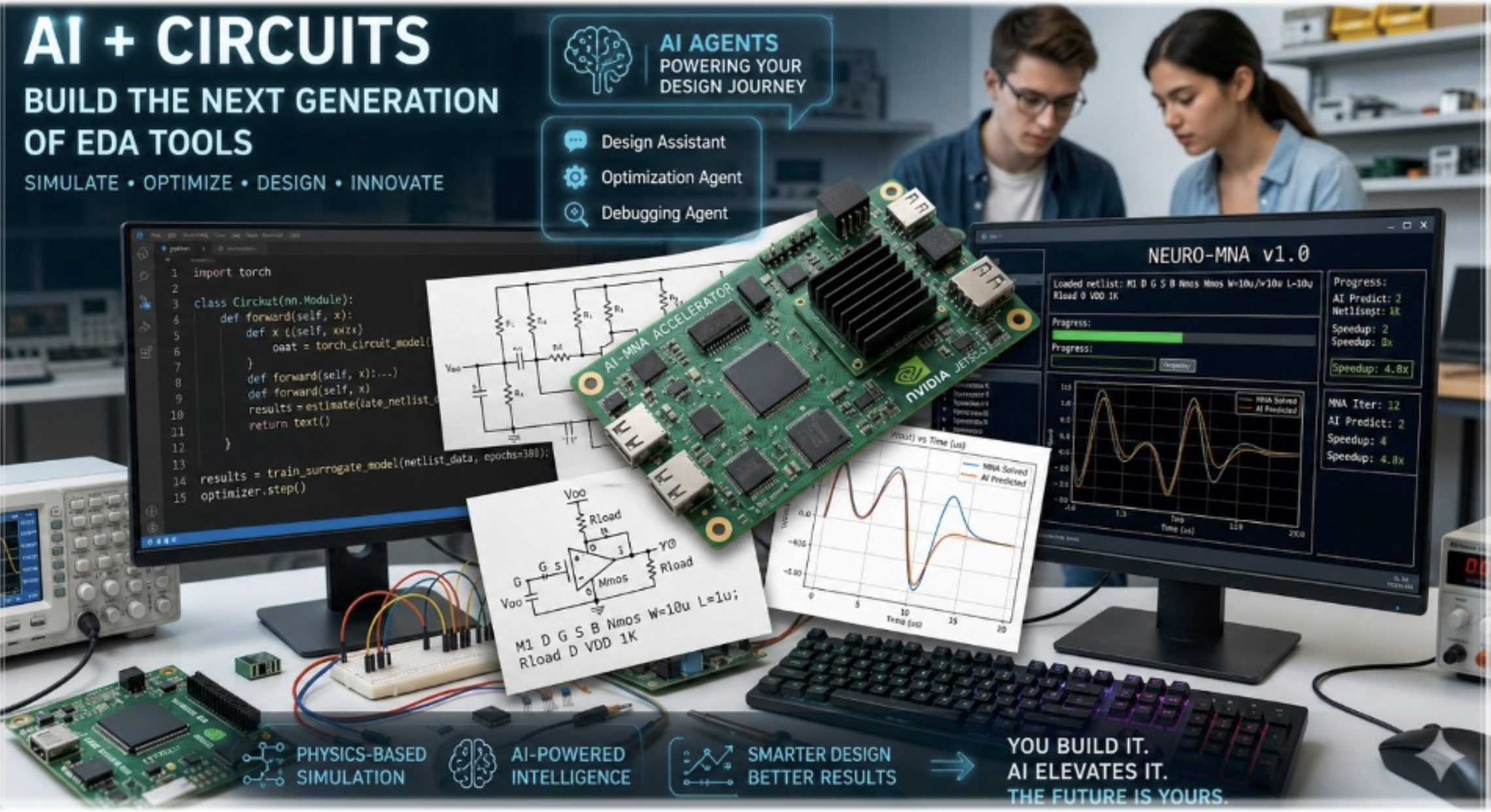
Project Overview: Electronic Design Automation (EDA) sits at the heart of modern electronics, enabling the design and verification of everything from consumer devices to advanced communication systems. Design Automation tools such as SPICE (HSPICE from Synopsys, SPECTRE from Cadence, ELDO from Siemens EDA, ADS from Agilent and Nexim from Ansys) have long been the industry standard for accurate analog circuit simulation, forming a critical bridge between theory and real-world implementation. These tools help millions of designers across the world to design and build next generation electronic products.
At the same time, the rapid emergence of artificial intelligence is beginning to reshape how engineers approach design, optimization, and analysis; shifting from purely physics-based simulation toward intelligent, data-driven assistance. This capstone project brings these two worlds together: by developing a foundational analog circuit simulator based on Modified Nodal Analysis (MNA) and augmenting it with AI-driven capabilities. It provides an opportunity to students to build something that sits at the intersection of classical electrical engineering and modern intelligent systems. The goal is not just to replicate existing tools, but to push toward what next-generation EDA software and tools could look like: not only accurate, but also fast, adaptive, predictive and capable of assisting engineers in decision-making. This project will provide significant opportunity for students to train/position themselves to be relevant to the emerging real-world where the existing/traditional methodologies are being replace/enhanced with AI-based methodologies.
Project Vision and Modules
The project is designed keeping in view of the emerging AI influence in the electronic design and analysis landscape. This project combines two complementary tracks:
- Analog Circuit Simulator: Development of a physics-based simulation engine grounded in Modified Nodal Analysis (MNA)
- AI-powered enhancements: Development of A set of AI-powered extensions that enhance usability, speed, and design intelligence of circuit simulators
By the end of the project, you will have a working prototype where traditional simulation and AI modules interact seamlessly through an integration layer; demonstrating both engineering rigor and innovation.
Details of the modules:
- Analog Circuit Simulator: This team will focus on building the foundation: a reliable and modular analog circuit simulator.
Key responsibilities:
- Design and implement a netlist parser (input format for circuits)
- Implement basic component models:
- Resistors, capacitors, inductors, Controlled Sources
- Diodes and transistor models
- Ensure correctness through:
- Validation against known analytical results
- Comparison with existing industry standard Tools (HSPICE, Specter etc.).
Outcome: A working simulation engine capable of analyzing complex analog circuits.
- AI-powered enhancements: This team will build AI-assisted intelligent features that enhance the efficiency, convergence, predictive and decision-making abilities of the simulator while making it more adaptive for design exploration. Several of the following sub-modules are anticipated to be developed as part of this project.
- Neural Surrogate Models
- Train models to approximate circuit behavior: Developing GNNs or PINNs to approximate high-complexity sub-circuits with fast inference models.
- Use the simulator to generate training data
- Compare:
- Accuracy vs simulation speed
- Potential use:
- Real-time or large-scale design exploration
2. AI-Assisted Smart Parameter Optimization
- Automatically tune component values to meet design goals
- Example: achieve a target gain or cutoff frequency
- Possible methods:
- Bayesian optimization
- Evolutionary algorithms
3. AI-Assisted Circuit Design
- Generate circuit topologies from high-level specifications
- Example: “Design a low-pass filter at 1 kHz”
- Explore:
- Rule-based + ML hybrid approaches
- Genetic algorithms for topology search
4. Intelligent Circuit Design Debugging Assistant
- Analyze simulation outputs to detect issues
- Provide suggestions such as:
- Biasing errors
- Instability or unexpected saturation
Outcome: AI modules that clearly enhance the simulator’s capabilities and user experience.
Integration Layer
A key part of the project is making everything work together:
- Define clean interfaces between the analog simulator and AI modules
- Enable workflows such as:
- AI → proposes design → simulator validates → AI refines
- Build a simple user interface or API to demonstrate features
Why and for Who? This project is a chance to build something that feels both current while forward-looking; rooted in established engineering practice, while exploring how the emerging AI-based intelligent systems can reshape the design process. It also gives an opportunity to use industry standard analog simulators such as HSPICE (from Synopsys and Spectre from Cadence, etc.).
Required Student background: Good understanding of the Circuit analysis, interest in math and software development (using any platforms of Matlab, C++ or Python with PyTorch/TensorFlow).
Interested students or team of students can directly get in touch with Prof. Achar for further consultations: