Republika Srpska Referendum as Dayton Stress Test
By Ilija Nikolic
Bosnia and Herzegovina, more specifically the Serbian-majority region of Republika Srpska, is currently experiencing a difficult political and constitutional crisis centred around its President, Milorad Dodik, and his defiance of Bosnian institutions and the international community.
On August 1, 2025, a Bosnian appeals court upheld a criminal conviction for Milorad Dodik, which includes a one-year prison term and a six-year ban from holding public office, as a result of his failure to implement decisions made by the Bosnian Office of the High Representative (OHR). The OHR, an international organization led by High Representative Christian Schmidt, is responsible for overseeing the 1995 General Framework Agreement for Peace in Bosnia and Herzegovina (Dayton Agreement), which ended the Bosnian War.
In line with election law, Bosnia’s Central Election Commission (CEC) revoked Dodik’s presidential mandate on August 6, 2025. Importantly, the OHR was not the body in charge of sentencing Dodik; the court conviction (for failing to implement OHR decisions) came first, and the CEC’s mandate came after. However, Dodik and his allies assert that the decision to remove him from politics is baseless, and argue that the verdict is not directed against the President of Republika Srpska, but rather against the Serb-majority region itself.
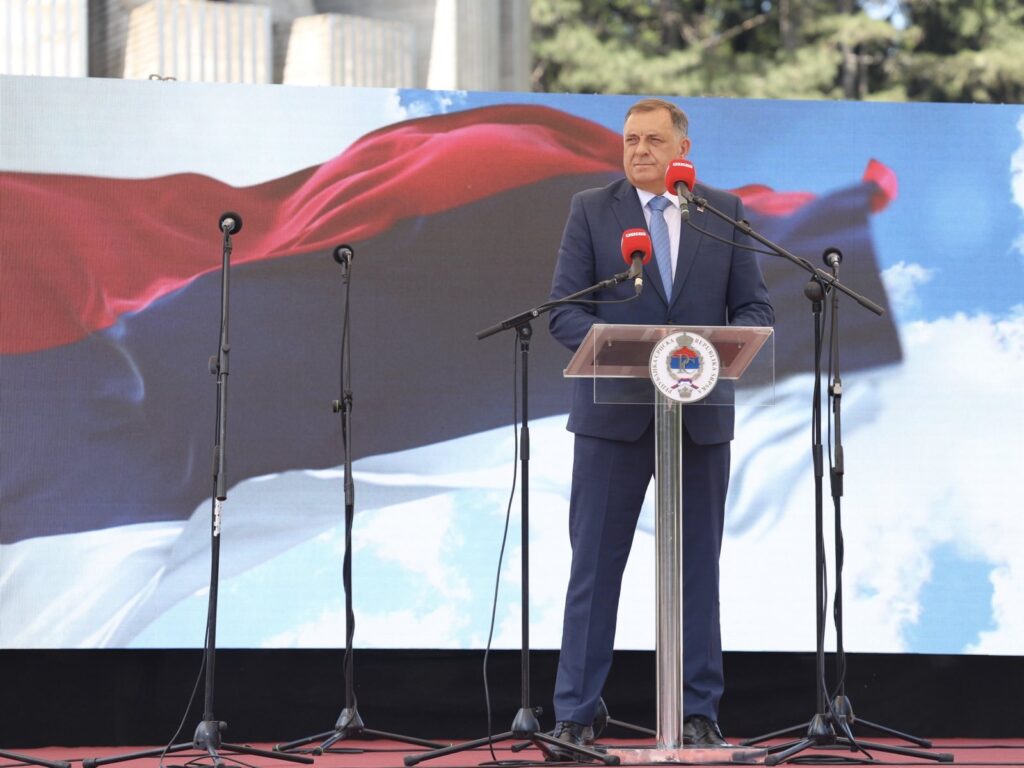
Dodik’s defiance to this ruling is also apparent as Republika Srpska moves ahead with a referendum scheduled for October 25, 2025, which challenges Bosnia’s political institutions and the OHR’s peacekeeping role in the country. The referendum itself asks the following: “Do you accept the decisions of the unelected foreigner Christian Schmidt and the rulings of the unconstitutional Court of Bosnia & Herzegovina issued against the President of Republika Srpska, as well as the decision of the Central Election Commission to strip the President of Republika Srpska, Milorad Dodik, of his mandate?”
After removing Dodik from office, the CEC set an early election for November 23, 2025, to establish a new president for the region. After Republika Srpska lawmakers temporarily floated the idea of boycotting the election, they have now cleared the way for it to go ahead as scheduled. The result therefore represents a two-headed challenge for Bosnia’s democracy: a referendum aimed at delegitimizing state decisions – despite a legal basis indicating that the referendum cannot nullify court sentences – and a succession contest in which Dodik seeks to maintain control.
The situation surrounding the referendum matters for Bosnia’s security because it targets the rule-of-law guardrails of the country’s democratic infrastructure, which are designed to work across ethnic boundaries. By holding this referendum, Republika Srpska’s political authorities are effectively challenging the rules of the state and who has the power to set them. Depending on the results of this vote, Bosnia could see the emergence of parallel legal structures and an increase in friction between entity and state bodies. Such erosion could also threaten the conditions for Bosnia’s EU accession process across the “European neighbourhood” by inviting external influence and drawing more EU/NATO attention and resources due to instability in the region.
The timing of the unfolding crisis magnifies this risk. The referendum is held just before the UN Security Council is scheduled to take up the annual renewal of EUFOR ALTHEA, a peace support mission led by the EU that is currently the only executive security presence in the country. ALTHEA is also mandated to successfully implement the military components of the Dayton Agreement. Any political crisis, politicization, or delay in renewal could weaken deterrence when core institutions are being tested. Dodik has in the past expressed the possibility of employing his connections to Russia, a UN Security Council member and guarantor of the Dayton Agreement, to veto the extension of the ALTHEA mission.
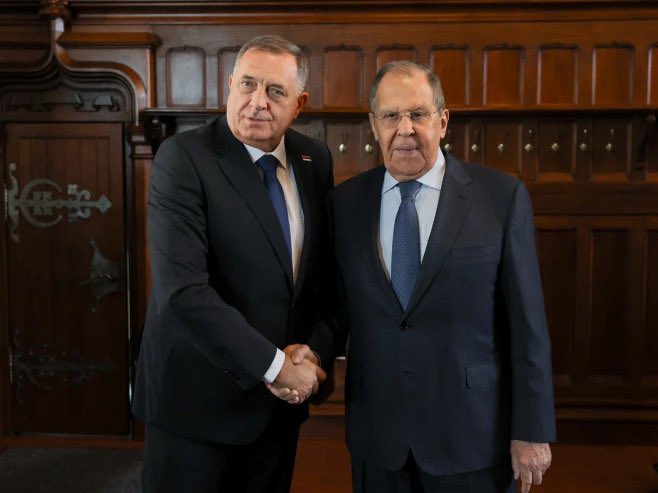
Dodik’s long-standing ties with Moscow consistently influence his political calculus, as evidenced by his frequent travels to Russia, as well as his regular meetings and consultations with representatives of the Russian government. For example, the Russian Ministry of Foreign Affairs issued a statement condemning the sentencing of Dodik and expressing its support for both Dodik and Republika Srpska, going so far as to declare that calling for Dodik’s removal from office was “anti-Serb.” Russian Foreign Affairs Minister Sergey Lavrov also claimed during a speech at the UN General Assembly that the “West” was directly at fault for destabilizing the Balkan region by undermining peace and sovereignty. Another representative of the Russian government stated that the OHR for Bosnia and Herzegovina should be shut down as soon as possible.
Taken together, the diplomatic cover and narrative framing provided by Russia on this issue give Dodik the political space needed to continue his non-compliance with the court ruling, and to ignore the EU-based conceptualizations of rule-of-law, such as respect for court decisions and OHR authority. All of these factors contribute to the stalling of Bosnia’s EU accession process.
Canada has an interest in monitoring this situation, given its renewed focus on European defence and security. Questions surrounding ALTHEA’s renewal and a broader breakdown of governing institutions in Bosnia serve as a challenge to the agenda that Ottawa has taken on with Brussels. Coordination with European (and American) partners on enforcement and sanctions will shape the credibility and efficacy of pressure on actors who seek to obstruct state institutions. At the same time, a crisis in the Balkans would likely divert resources and attention at a time when support for Ukraine in its continued fight against Russia remains essential.