The 2025 BRICS Summit: Divisions or Unity?
By Sam Paquette
The 2025 BRICS Summit, hosted in Rio de Janeiro by Brazil, featured noticeably more divergence in terms of political priorities when compared to last year’s Summit in Russia. This group, which began as an informal bloc of emerging economies (Brazil, Russia, India, China, and South Africa), has since morphed into a politically diverse alliance of 11 countries, which have different perceptions on how to reshape the international system. Historically, Russia and China have utilized the BRICS institutions to promote an anti-Western governance model. Meanwhile, Brazil’s and India’s approach is non-aligned and focused on promoting economic cooperation with the West and other emerging economies.
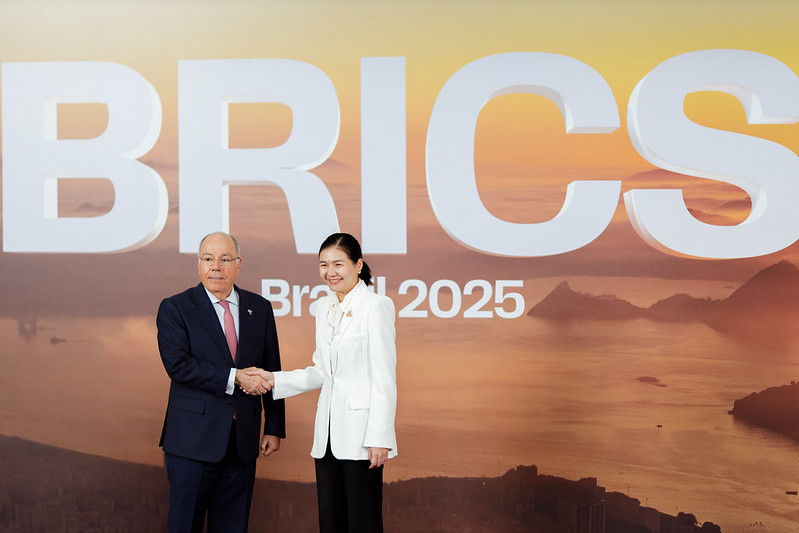
During the 2025 BRICS Summit, the parties released a 31-page declaration that highlights these diverging priorities. The declaration outlines 126 commitments focused primarily on promoting the interests of the BRICS’ two largest democracies – India and Brazil. These commitments range from reforming multilateral institutions like the UN Security Council as well as reshaping the governance of international finance, climate change, and artificial intelligence. On the geopolitical side, the declaration condemns the Israeli attacks on Iranian nuclear facilities and Ukrainian attacks on Russian civil infrastructure but makes no mention of United States involvement in either conflict. Indeed, some analysts argue that the relatively more moderate agenda at this year’s Summit was an intentional effort to not antagonize Trump due to his tariff threats.
In contrast, last year’s BRICS Summit was framed by Russia as “the largest foreign policy event ever held” in the country, showcasing its resilience to Western sanctions and its ability to counter narratives of diplomatic isolation from the West. The 2024 Summit also introduced a new partnership status for members and called for de-dollarization, as well as building an alternative financial system to sanction-proof key members.
Another notable difference is that the 2024 Summit had greater diplomatic representation than the 2025 Summit. The 2024 Summit was attended by 22 heads of state, including the newly joined members of Egypt, Ethiopia, Iran, the United Arab Emirates, and Saudi Arabia. That Summit also included representation from Vladimir Putin, Xi Jinping, and UN Secretary General Antonio Guterres, and Türkiye (which is notably also a NATO member). Conversely, the 2025 BRICS Summit was attended by only 11 leaders, with Vladimir Putin appearing via video call in order to avoid arrest on war crime charges issued by the International Criminal Court in 2023. Xi Jinping did not attend the Summit, marking his first absence since becoming the leader of China in 2012. The disinterest of certain BRICS leaders underscores how some may prefer to avoid the Summit if it is not used as a platform to promote anti-Western rhetoric.
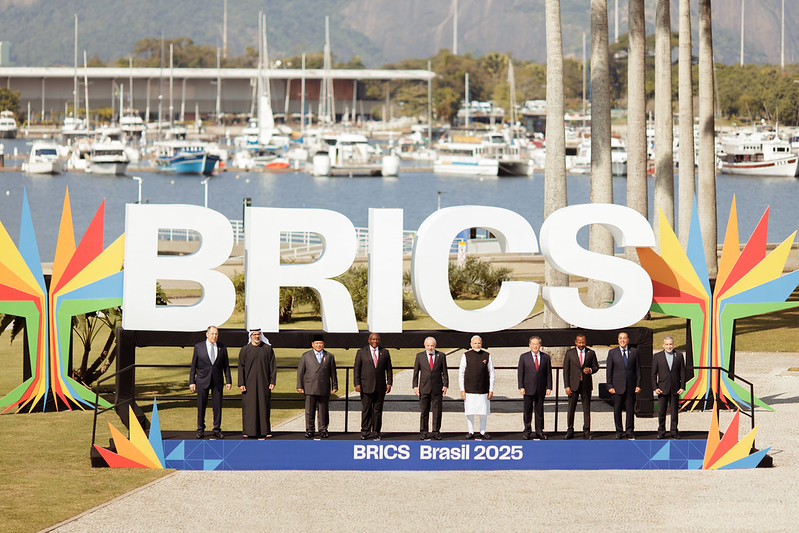
These leadership absences highlight deeper political divisions within the group, including differing views on the wars in Ukraine and the Middle East. This division was most prominent in Iran, a newly joined member, which criticized the Summit declaration for its call for a two-state solution to end the Israel-Palestine conflict. Such breaks in unity are also present when looking at how different members view the future of BRICS. For instance, during the 2024 BRICS Summit, some members expressed concerns about the inclusion of non-democratic states within the organization. These countries feared that the bloc was favouring the inclusion of autocracies as a way to consolidate Russian and Chinese influence over emerging economies at the expense of promoting democracy. These rifts make the ideological trajectory of the BRICS increasingly uncertain as divisions deepen between authoritarian and democratic members.
Considering that India will host the next BRICS Summit in 2026, the bloc is likely to focus on issues related to economic cooperation rather than anti-Western rhetoric, which may lead to some greater political rifts. The coming years will reveal how the BRICS alliance will either develop a unified geopolitical identity or remain a fragmented alliance.