Armenian Public Opinion And Opportunities For Greater NATO Engagement
By Mahsa Ebrahimzadeh Asl Tabrizi, Carleton University
Key Takeaways
- Most Armenians feel that their country is “on their own” if faced with a military threat, displaying a perception of personal safety associated with geopolitical alignment.
- With uncertainty widespread and perceptions on security partnerships polarized, many in Armenia are open to diversifying security ties.
- Considering public opinion, while NATO has a relatively limited set of cooperation tools, they should nonetheless prioritize visible engagement with Armenia, communicate limitations of such partnership clearly, and manage expectations. Sustained and predictable cooperation should be kept in practical rather than geopolitical terms and perceptions.
Context
This policy brief examines the implications of public attitudes towards security issues in Armenia for the North Atlantic Treaty Organization (NATO). It assesses the prevalence of insecurity narratives among Armenians and shows how such attitudes are associated with opinions towards external security actors. Survey evidence shows that Armenia’s core security challenge is a sense of abandonment among its public. Confidence in international security institutions is weak, as nearly half of Armenians (48%) believe their country would not receive support in the event of a military conflict.
As confidence in Armenia’s traditional security partners – Russia and the Collective Security Treaty Organization (CSTO) – stands low, other international actors are seen as positive contributors to Armenia’s overall security, including both NATO and China. The Armenian public’s openness toward alternative security partners and a broader reassessement of Armenia’s security architecture creates an opportunity for NATO to push for more active involvement. As available options are limited, NATO should strive for realistic, civilian-oriented cooperation based in institutional resilience, without raising expectations of formal guarantees. This increased involvement, along with sustained and visible engagement, should offer better reassurance to Armenia without otherwise escalating geopolitical tensions in the region.
Between its independence in 1991 and the start of the second Nagorno- Karabakh War in 2020, Armenia’s security architecture was heavily Russia-centred. Armenian political elites leaned towards Russia due to a lack of alternative options on account of its landlocked status and persistent conflict with Azerbaijan and Türkiye, along with a limited domestic military capacity. Russia served as Armenia’s primary security guarantor through bilateral agreements and CSTO membership; Western military and security engagement remained largely symbolic. Although Armenia and NATO collaborated through Partnership for Peace (PfP) and Individual Partnership Action Plan (IPAP) frameworks, these initiatives focused on technical cooperation and institutional dialogue rather than substantive security guarantees.
The failure of Russia-led security arrangements to prevent military defeat in 2020 marked a critical rupture in Armenia’s security system. The second Nagorno-Karabakh War significantly undermined public and government confidence in Moscow and the CSTO as reliable protectors and intensified feelings that Armenia had been betrayed by its traditional security partners. In response, the Pashinyan government increasingly sought to diversify Armenia’s external security ties. This shift is visible in several developments, including the “Normalization of Armenia-Turkey Relations,” the deployment of the European Union’s (EU) monitoring mission along the Armenia–Azerbaijan border, and the launch of enhanced cooperation with the United States (US) under the Strategic Partnership Charter in January 2025.
Public Insecurity, Security Preferences, and Reported Future Vote in Armenia
A nationwide survey in Armenia, conducted by Carleton University’s Eastern European and Transatlantic Network (EETN) in February and March 2025, shows that Armenians are almost equally split between who report to feel safe (52%) and unsafe (47%) in their daily lives. Residents of Yerevan tend to feel more unsafe (52%) compared to these in other urban (44%) and rural areas (45%). The risk of war with Azerbaijan (59%) is the major concern consistent across society.
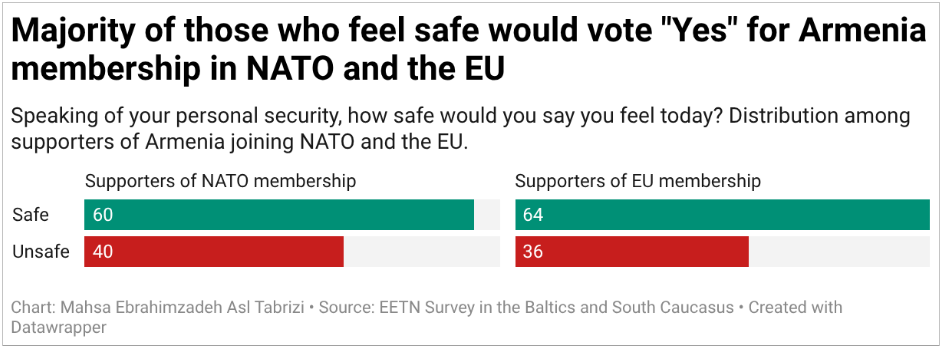
Perceived personal security is closely associated with positive attitudes toward Western alignment; those who feel safer are substantially more likely to support NATO and EU membership than those who do not. Among individuals who report feeling safe, 60% would vote “Yes” in a hypothetical referendum for Armenia joining NATO and 64% would do the same in a potential referendum on joining the EU. In contrast, among those who feel unsafe, only 40% would support NATO, and 36% would back EU membership, with clear majorities in this group opposing both initiatives, 56% against NATO and 64% against the EU.
Armenians are divided across party lines in their assessment of personal safety. With a clear majority (71%) either recusing themselves from voting in parliamentary elections, intending to spoil the ballot, or not share voting preferences. Among those who would engage in elections and/or share their preferences, the majority who support the Civil Contract party (86%) feel safe, compared to 36 percent of opposition supporters that include the largely pro-Russian Armenia Alliance party.
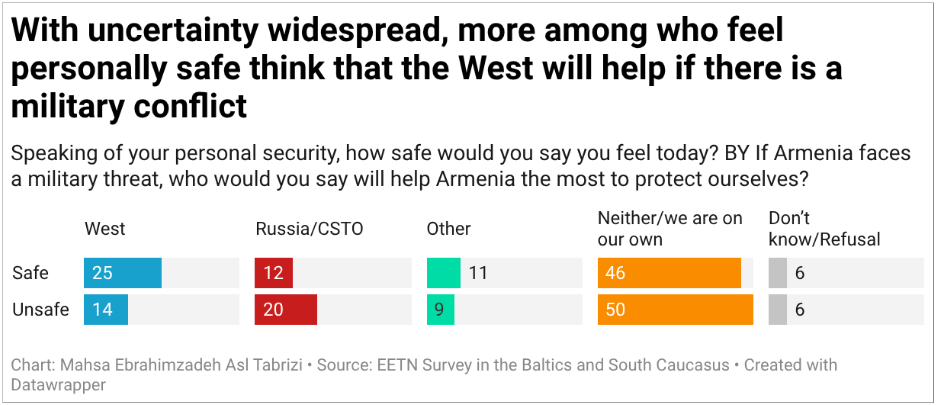
Many in Armenia feel that their country would be left on their own if it faces a military attack, with nearly half (48%) thinking so and only 6% being unsure about who might help. As the sense of abandonment is widespread, still, those with different perceptions of safety have distinct expectations on who might help. Those who feel unsafe are more likely to choose Russia or the CSTO (20%) as a likely ally in case Armenia faces military conflict, compared to NATO or the West (14%). Conversely, more amongst those feeling secure would expect NATO or the West to come to their aid (25%) than Russia or the CSTO (12%). In sum, perceptions of insecurity are associated with greater reliance on Russia, whereas feelings of security are more strongly linked to expectations of Western support.
At the same time, support for diversifying security partnerships beyond existing allies is relatively broad, with 53% agreeing that searching for new defense and military ties with other countries would make Armenia safer against foreign threats. This idea is popular across the political divide, including 70% of Civil Contract supporters and 59% of opposition voters. While uncertainty is higher among those with no declared voting intentions, still, more among this group believe that diversification of defense and military ties would make Armenia more secure compared to those who disagree.
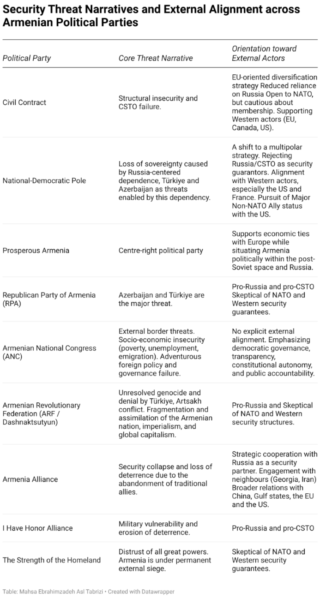
This preference for diversification also resonates with elite threat narratives. While Armenian political parties differ in their preferred alignments — some favouring Russia, others emphasizing Western engagement, or expressing self-reliance — they somehow share a recognition that reliance on a single security partner is no longer sufficient.
Despite widespread pessimism about Armenia’s security environment, preferences over geopolitical alignment remain divided rather than consolidated into a single dominant orientation. Equal proportions of respondents believe Armenia would be safer moving closer to NATO (36%) or Russia (36%). Furthermore, more than half of Armenians consider that having NATO troops on the ground would make Armenia safer, indicating a veiled sympathy towards the NATO Alliance.
Overall, these patterns do not indicate a clear preference toward any single geopolitical bloc, although the Western side carries somewhat greater weight. Armenians are somewhat engaged in a survival-driven reassessment of security providers and remaining open to diversified allies clarifies this viewpoint. This creates potetial opportunities for NATO to expand its partnership with Armenia.
Conclusions and Policy Recommendations
Given Armenia’s non-member status in NATO and the structural constraints created by Russia’s influence in the region, formal security guarantees from Western institutions are unlikely to materialize in the near future. NATO’s internal dynamics — particularly Türkiye’s membership and its close military partnership with Azerbaijan — further limit the NATO’s capacity to provide direct defence commitments to Armenia.
At the same time, Armenia’s security landscape is shifting as the government seeks to diversify its external security partnerships. In practice, this has created space for forms of cooperation that do not rely on military guarantees but instead focus on civilian-oriented, visible, and predictable initiatives such as resilience building, civil emergency planning, institutional reform, and confidence-building measures. These efforts aim to address vulnerabilities rather than establish broader geopolitical alignment.
Evidence from NATO’s engagement in partner countries illustrates the value of this approach. The substantial NATO–Georgia Package has supported defence reforms, institutional coordination, and national resilience through training, interoperability programs, and civil–military cooperation. Similarly, cooperation with Moldova has strengthened energy resilience, medical capacity, disaster response, and defence education, showing that civilian-focused partnerships can deliver sustained, practical outcomes.
For Armenia, diversification therefore functions as a pragmatic way to expand sources of security support in the absence of formal guarantees. Within this framework, NATO could become a more constructive and realistic partner for Armenia. While direct defence commitments remain improbable, civilian-oriented initiatives offer tools to strengthen institutions and reduce security risks. This perspective underpins the policy recommendations that follow.
1. Given the substantial support of Western-led political structures, NATO should prioritize visible engagement with Armenia.
NATO’s Individually Tailored Partnership Program (ITPP) is the central framework coordinating cooperation with Armenia, bringing together planning, training, exercises, and institutional reform in a multi-year, capacity-building process. As outlined in NATO’s 2023 Annual Report, the program is designed to deepen cooperation in line with Armenia’s priorities and level of readiness. NATO should use this initiatives not only as a coordination tool, but as a delivery mechanism for visible, locally-implemented cooperation, particularly beyond Yerevan. By translating the framework into routine, practical engagement, NATO and Armenia can bilaterally strengthen security capacities and address perceptions of abandonment from the Armenian public.
2. NATO should clearly communicate limitations and manage expectations about its partnership with Armenia.
NATO already frames cooperation with Armenia as partnership-based rather than guarantee-based, but could benefit from communicating more clearly and publicly about what cooperation involves (e.g., preparedness, institutional reform, resilience) and what it does not (e.g., full membership). Additionally, engagement should be consistently framed as capacity-building rather than a security provision to avoid creating public expectations of any security guarantees. Simple cooperation roadmaps with regular milestones would strengthen predictability, credibility, and reassurance. Furthermore, this should happen in a sustained manner, emphasizing repeated training cycles, ongoing institutional support, and routine regional exercises rather than isolated events. Predictable, long-term cooperation builds trust without raising unrealistic expectations.
3. NATO should keep cooperation with Armenia practical and not geopolitical.
Finally, as the Armenian public remains divided in their geopolitical preferences, it is important for NATO to prevent its partnership with Armenia from expanding into questions of geopolitical alignment. Engagement should remain centred on functional areas such as crisis preparedness, emergency coordination, institutional reform, and civilian resilience rather than Western-versus-Russian narratives. Expanding direct and clear communication with the Armenian general public can further limit perceptions of forced geopolitical choice and better align external policies with insecurity-driven public concerns in Armenia. This action would strengthen Armenia’s security capacity while minimizing escalation risks and domestic polarization.