Willing to do Nothing: Addressing the Societal Resilience Gap in Estonia and Latvia
By Elizabeth Tobias, Carleton University
Key Takeaways
- About one in three residents of Estonia and Latvia say they would do nothing in the event of a military threat, with even lower likelihood to act among ethnic Russians.
- Interest in participating through non-combat roles (e.g., financial contributions) is higher than in combat roles but still does not reflect a significant portion of the population in either Latvia or Estonia.
- NATO (and Canada) should address the societal resilience gap among local communities. Targeted grants for trusted local organizations, coupled with strong monitoring and evaluation, can help build social cohesion and civic preparedness across Estonia and Latvia, particularly in regions with a significant ethnic Russian population.
Background
Recent polling data from Estonia and Latvia suggest there is a significant gap in societal resilience among the residents of both countries. While Russia is overwhelmingly perceived as a security threat within these nations, an overall willingness to act in the event of a military threat is low. This gap is particularly pronounced along demographic lines, with lower willingness to act among ethnic Russians in Estonia and Latvia. As the Baltic states are widely considered likely targets for potential future Russian aggression, this deficit in resilience has direct implications for Canadian and NATO security commitments in the region.
Since their post-Soviet independence, Estonia and Latvia have invested heavily in defence preparedness through joining NATO, bolstering their cyber networks, and educating their youth on mis- and disinformation. After Russia’s illegal annexation of Crimea in 2014, Canada joined its NATO Allies in strengthening defence structures in Eastern and Central Europe under Operation REASSURANCE, currently the Canadian Armed Forces’ (CAF) largest overseas mission. Recognizing the particular vulnerability of the Baltic states to Russian aggression, Canada took the initiative to lead the Multinational Battlegroup in Latvia in 2017. After Russia’s full-scale invasion of Ukraine in 2022, Canada committed to scaling this presence into a full Multinational Brigade. Following his election in Spring 2025, Prime Minister Mark Carney emphasized that these operations work to reinforce NATO at a time of great global instability and change.
To meet NATO’s Article 3 requirements, Estonia and Latvia have adopted “Total Defence” models, recognizing that societal resilience and civilian participation are just as crucial as military structures for overall defence of the country. Learning from the success of the Ukrainian Territorial Defence Forces in fighting the Russian military, Estonia is working to promote its own reservist force through public awareness campaigns, increased daily allowances for reservists, and crisis preparedness education. Latvia’s comprehensive defence plan similarly promotes civil protection while identifying “political trust” and “inter-ethnic cohesion” as vital to national security. Both Baltic countries are also working to increase civil support for their law enforcement agencies, fire departments, and medical systems.
As highlighted in the Latvian defence plan, social cohesion and confidence in state institutions and partnerships are essential for building and maintaining civil engagement in total defence. The NATO Strategic Communications Centre of Excellence (Stratcom COE) in Riga engages in public diplomacy, information operations, and psychological operations to align national efforts with NATO’s strategic objectives. The Latvian government has also partnered with the Latvian Transatlantic Organization (LATO) – an NGO with the goal of informing the public about NATO and Latvia’s participation in it.
Social cohesion between ethnic communities has been a focus of national and local NGOs, as Russian-speaking minorities remain less likely to trust NATO or volunteer for national defence than their neighbours. In the northeastern region of Estonia, VitaTiim works mostly with Russian speakers of all ages on projects developing critical thinking and media literacy. These projects promote active citizenship and social entrepreneurship through youth work and international exchanges. VitaTiim already has international partnerships, including with the European Solidarity Corps and the US Embassy in Estonia. In Latvia, the organization New East focuses on education, culture, media, and civic engagement in the Baltics and beyond, specifically striving to foster open dialogue and social inclusion for underrepresented ethnic minorities.
Despite these institutional frameworks and nonprofit initiatives, recent polling reveals a high likelihood amongst the public to do nothing to defend Estonia and Latvia from a military threat, as well as a persistent gap in how different ethnic communities perceive national security and threats to their country. To better understand these dynamics, the following data examines security perceptions across the region.
Survey Evidence: Societal Resilience Gaps in Estonia and Latvia
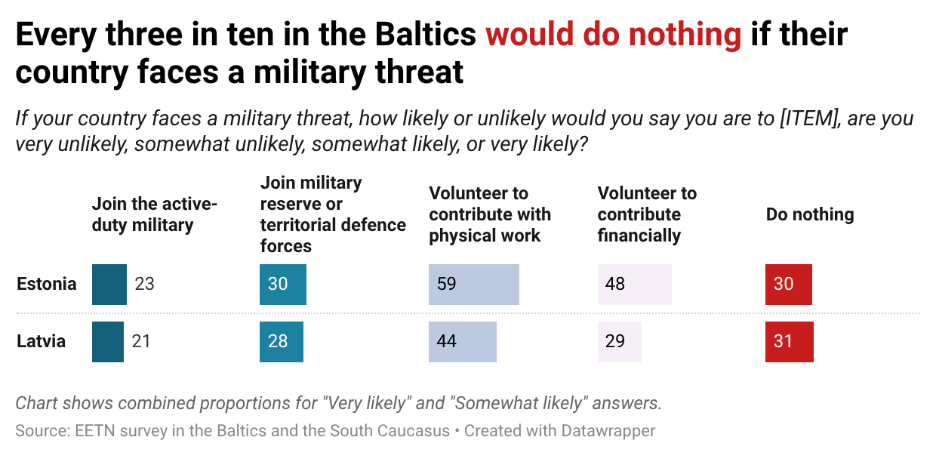
Polling from Carleton University’s Eastern European and Transatlantic Network (EETN) shows that, as of Spring 2025, many people in Estonia and Latvia do not see themselves as active participants in defence during a crisis. Most significantly, about 30% of Estonians and Latvians say they are likely to do nothing in the event of a military threat.
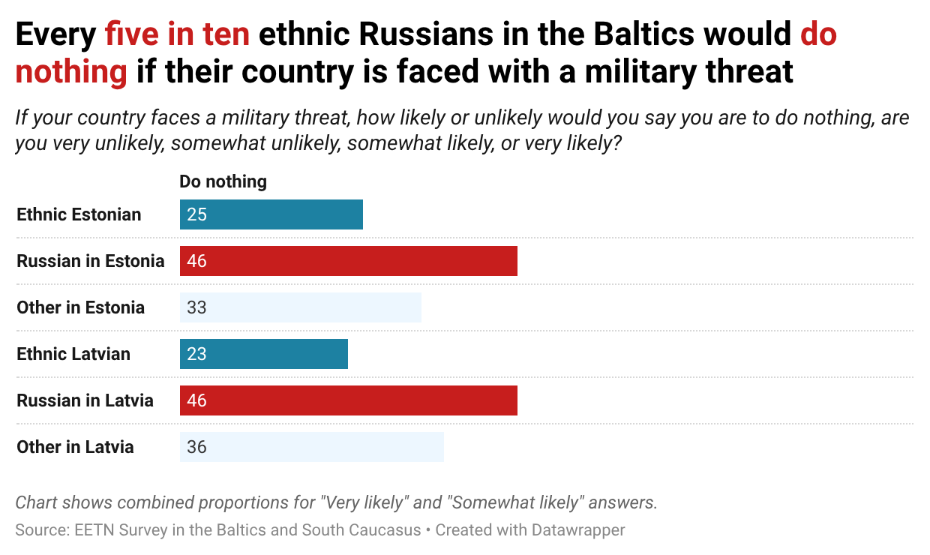
Demographic and geographic characteristics of this vulnerability show a stark division: almost half of ethnic Russians (46%) residing in Latvia and Estonia would do nothing if their respective countries face a military threat. Four in 10 (43%) polled residents of Latgale, a region of Latvia directly on the border with Russia comprised of a large Russian-speaking minority, say they would not act. Half of those polled in Northeastern Estonia (51%), another region sharing a border with Russia and having a similar demographic composition as Latgale, are also likely to do nothing.
Reported willingness to participate in national defence is low. When asked whether they would join the active-duty military in the event of a military threat, only about 20% of Estonians and Latvians say they are likely to do so, and only about 30% are likely to join the military reserves or territorial forces in response to the same threat.
While more people are willing to take up non-combat forms of national defence, still, even such likelihood is low. Estonians appear to be more likely to assist in this way than Latvians, approximately six in 10 (59%) of Estonians are likely to volunteer to contribute with physical labour, versus 44% in Latvia. About half (48%) of Estonians are likely to volunteer to contribute financially, compared to only 29% of Latvians.
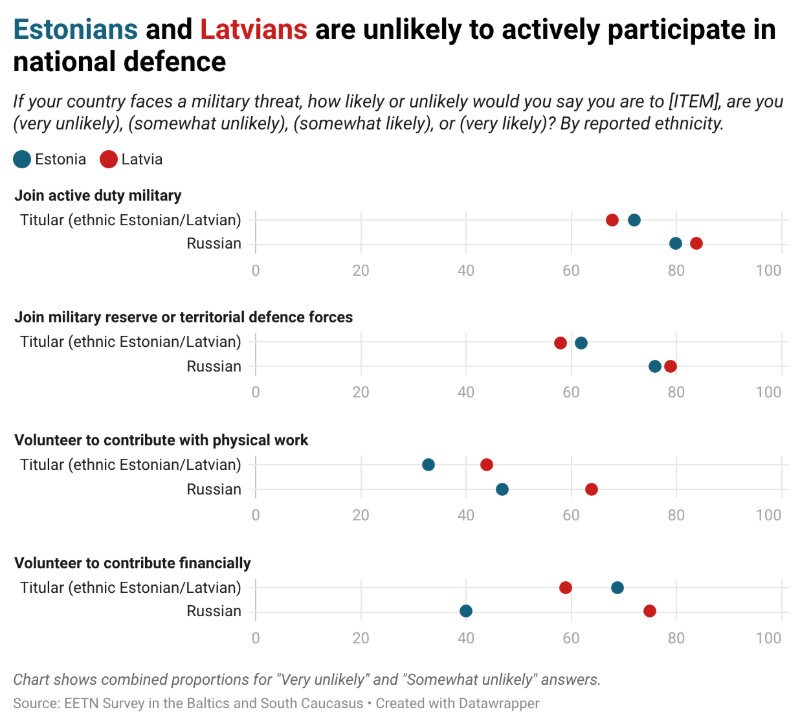
Ethnic Russians in both countries are even less likely to be active defenders in the event of a military threat. A staggering 80% of ethnic Russians in Latvia and Estonia are unlikely to join the active-duty military, military reserves, or territorial forces. In Estonia, 41% of ethnic Russians are likely to volunteer to contribute with physical labour, but this number drops significantly in Latvia, with only 29% of ethnic Russians likely to do so. Finally, only about 20% of ethnic Russians, in both Estonia and Latvia, are likely to volunteer to contribute financially.
From a policy perspective, this polling data highlights both a gap and an opportunity. If a significant segment of the population is unlikely to contribute to the active defence of their country, resilience-building efforts must expand beyond military deployments. To foster the social cohesion necessary for resilience, trust and cooperation between minority and majority communities must be bolstered. NATO and Canada can do this through collaboration with local community networks – such as VitaTiim and New East – that are already on the ground in the region.
Conclusion
Recent polling data from Estonia and Latvia suggests a region with a significant gap in societal resilience. While Russia is overwhelmingly perceived as a security threat, willingness to act in the event of a military threat is low. This gap is particularly pronounced along demographic lines, with lower willingness to act among ethnic Russians. As Estonia and Latvia are widely considered likely targets for potential future Russian aggression, this deficit in resilience has direct implications for Canadian and NATO security commitments in the region. By supporting well-monitored projects with local organizations that build social cohesion and civic preparedness, Canada and NATO can help ensure Estonia and Latvia are more resilient and better prepared to withstand a military threat.
Policy Recommendations
1. NATO and Canada should create a dedicated societal resilience grant to support local NGOs such as VitaTiim and New East that advance social cohesion and civic preparedness. Supported projects should have bilingual messaging (in Russian and Estonian or Latvian) and may include media literacy and cyber safety training, community initiatives fostering dialogue across demographic lines, and projects that engage citizens as partners in international governance.
The grant should emphasize collaboration between local and international organizations, promoting a shared responsibility in local, national, and international governance. Priority should go to local initiatives in regions with large Russian-speaking populations.
2. Each NATO/Canadian-supported project should be required to include a monitoring, evaluation, and feedback plan in alignment with NATO’s strategic planning framework. Thorough monitoring is necessary in order to accurately evaluate how effective projects are at bolstering societal resilience and civic preparedness.
3. Canada and NATO should use existing NATO StratCom COE platforms to highlight successful partnerships in relatable ways to the Estonians and Latvians, including through multilingual media and public events. Positive views of NATO and the West expressed by individuals and organizations that already have credibility in their communities should be amplified to strengthen civic preparedness.