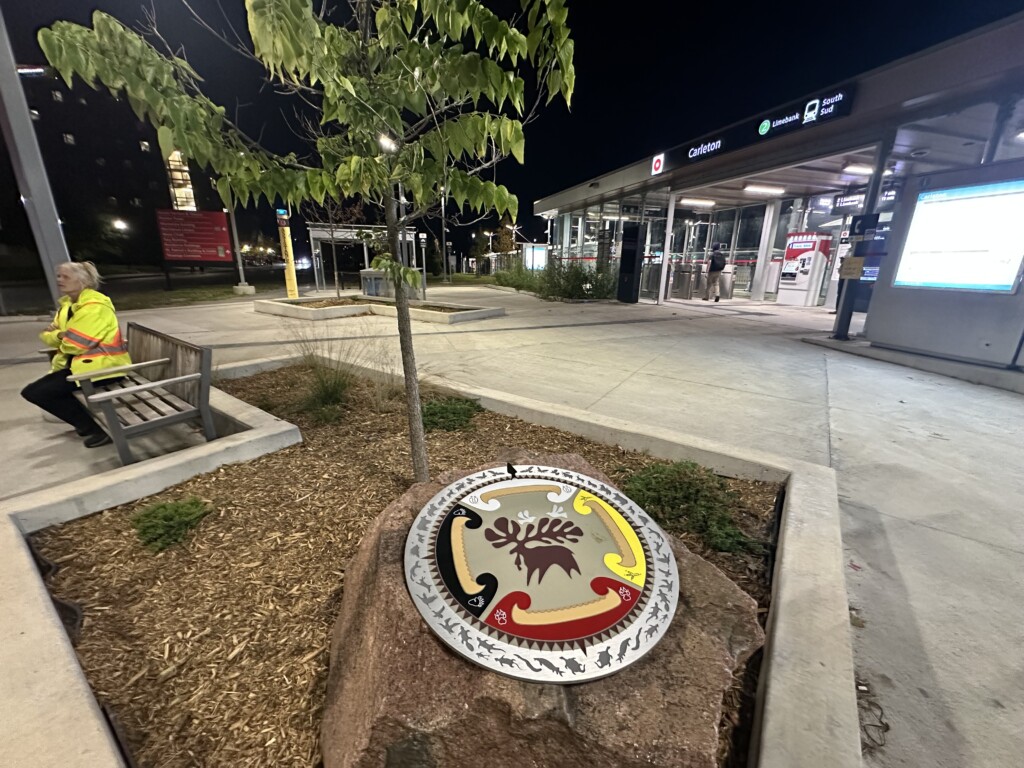
Algonquin Wayfinding Wheel Installed at Carleton
The chosen site for the Wayfinding Wheel is at the Carleton University OC Transpo station and Trillium Line. By placing the Wayfinding Wheel at a transit-adjacent and visually prominent location, the work invites those who pass by to consider the layered histories and ongoing presence of Algonquin Anishinaabe Peoples on this land.
We are pleased to announce that in September 2025, a new Algonquin Wayfinding Wheel was installed at Carleton University, as part of the City of Ottawa’s ongoing public art and Indigenous engagement projects.
The Algonquin Wayfinding Wheel was created by Simon Brascoupé, adjunct research professor in Carleton’s Department of Sociology and Anthropology, in collaboration with Mairi Brascoupé, who at the time was completing a master’s in design at Central Saint Martins, London. Developed in partnership with Algonquin Elders, Knowledge Keepers, and community members, the work draws deeply from Algonquin cosmology. Its design incorporates symbols such as the four sacred directions, animals of spiritual significance, and the north arrow, weaving them together into a unified whole.
More than a map-like device, the Wheel functions as both a visual landmark and a site of orientation and reflection. In Algonquin artistic practice, such a form is not static but living, embodying relationships of connection and balance and reminding us of the responsibilities we carry to the land and to one another.
Algonquin Wayfinding Wheel
The chosen site for the Wayfinding Wheel is at the Carleton University OC Transpo station and Trillium Line. This installation represents a meaningful collaboration between the City, campus planners, and Carol Brascoupé, Project Manager, and marks a significant step in weaving Indigenous presence into the landscape of the campus and city. This location is significant, on a nexus where many students, faculty, staff, and visitors pass daily, and it offers a moment of pause on journeys across the campus. As part of Carleton’s campus wayfinding and landscape planning strategies, this installation helps bridge functional orientation with deeper cultural and relational meaning. It aligns with the campus design goals to embed navigational and interpretive elements at intuitive locations, thereby enhancing both legibility and belonging across the campus fabric.
By placing the Wayfinding Wheel at a transit-adjacent and visually prominent location, the work invites those who pass by to consider the layered histories and ongoing presence of Algonquin Anishinaabe Peoples on this land. It also opens space for dialogue about how we move through, name, and engage with campus and city environments. In this sense, the Wheel contributes not only to physical orientation, but to relational orientation, helping viewers shift perspectives, ground in reciprocal respect, and remember interconnected responsibilities.
We invite everyone on campus and in the broader community to visit the installation, learn about its significance, and share the gift of presence with it. For more information and an animated video about the Algonquin Wayfinding Wheel project across Ottawa, visit the OC Transpo website.