Knowledge is Power
Libraries helped Carleton English alum Tara Sypniewski better understand her identity as a transgender woman. She created Ottawa’s first-ever trans library to help others find themselves.
When Tara Sypniewski reflects on her days studying English literature at Carleton University in the 1970s, some of the memories that surface are unfortunately, in her own words, “not especially happy.”
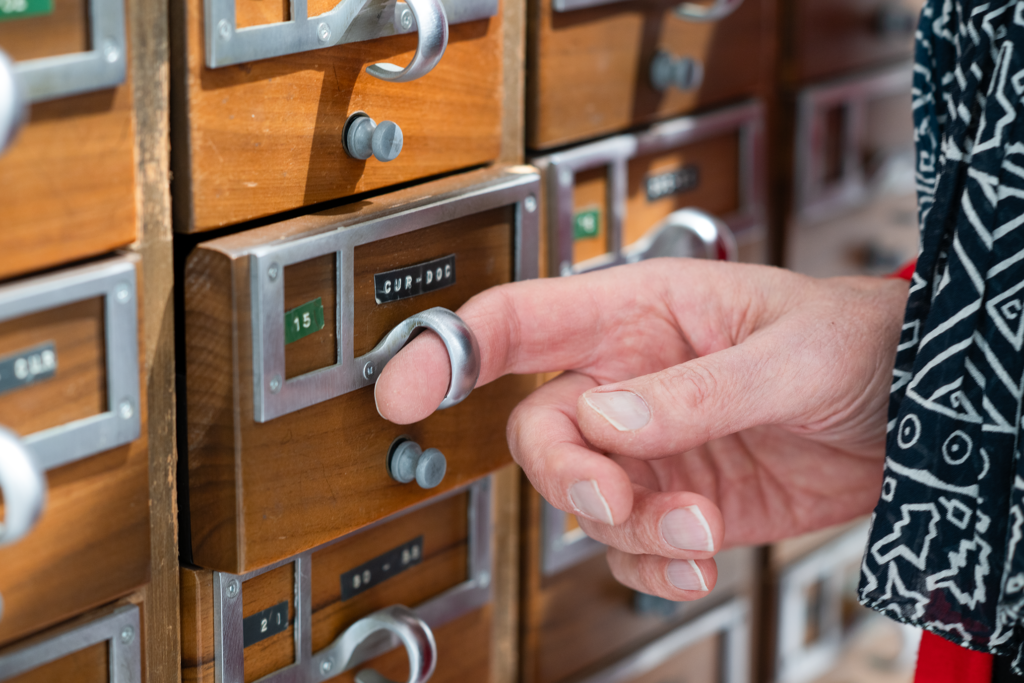
Grappling with her gender identity and questioning what the future held in store for her, Tara remembers fingering through card catalogues and stalking the stacks of the university library in search of books that could help her better understand who she was.
In the end, Tara did more than find her own place in the world after graduation. In addition to leading a successful career at the Canadian Museum of Nature’s library until her retirement in 2014, Tara has spent her life trying to create space for others like her through her activism as a longstanding member of Ottawa’s transgender community.
Tara is a founding member and former president of Ottawa’s Gender Mosaic, a group formed in 1988 that connected and supported trans people across the city for 35 years. Gender Mosaic also advocated for trans rights, lobbying to amend the Canadian Human Rights Act to include gender identity and gender expression in 2017.
A prolific writer, Tara launched Gender Mosaic’s newsletter, Notes from the Underground, where she served as editor and frequent contributor for four years. She published a zine on transgender experience from 1998 to 2003 called Triple Echo and launched the website Trans Ottawa in 2017.
It was in a blog post on Trans Ottawa where she first proposed the idea of opening a library: somewhere to make her substantial collection of trans writing – accumulated through years of meticulously combing through bookstores and garage sales – actually accessible to the public. The exact sort of library she wished she’d had access to when she was in university.
In May 2022, the Ottawa Trans Library opened its doors in Hintonburg, quickly becoming a beloved community space where anyone is welcome to drop by, browse the shelves and borrow a book written by a trans author, as well as other “historical, important and interesting works” about trans issues and people. The library also doubles as a social hub, hosting board game nights, arts and crafts sessions, and other events where people can casually meet fellow trans folks in Ottawa.
This summer is a significant one for Tara, as she is officially stepping down from her leadership role at the Ottawa Trans Library and passing the torch to the next generation of activists – though she’ll continue to help the library grow as one of its 200+ supporters on Patreon.
We spoke to her earlier this year about her time at Carleton, the importance of archiving trans writings of all sorts, and what she’s reading these days.
What motivated your decision to apply to study English at Carleton?
I had several interesting and passionate English teachers in high school. English was the class where you were encouraged to think for yourself. I took a number of history courses at Carleton for the same reason, but ultimately decided on English as my major.
What was your time at university like? Where on campus did you spend most of your time?
My time at Carleton wasn’t especially happy. I enjoyed my courses, but I knew who I was and I didn’t see much future for myself. Consequently, the two places I spent most of my time were the library and Oliver’s Pub. In the library, I focused on my studies and then would read and re-read Havelock Ellis’s volume on trans people in his multi volume work, Studies in the Psychology of Sex. It made me feel less alone to know people like me existed in the past. In Oliver’s Pub, I enjoyed arguing with my fellow English students, but it was also a place where I buried it all.
Is there a class you took during university that has stuck with you since or changed your way of thinking?
I took a course on Chaucer in my second year. I went in with low expectations. The professor, who I believe was Alistair Tilson, had us sit around the room and read The Canterbury Tales out loud. At first, I felt like I was in Grade One, but I soon understood what he was doing. As I became accustomed to hearing and speaking old English and as I fell into the rhythm of Chaucer’s poetry, I had a great revelation. I suddenly understood everything! It was as if I had learned a new language and had been transported back in time to the Middle Ages. This started me thinking about the connection between language, culture and history. I still have my Chaucer textbook. I pull it out from time to time to relive the experience.
If I may be permitted an honourable mention, it would be English 343: Defoe to Scott. It was in this class I discovered The Life and Opinions of Tristram Shandy. I got so into Laurence Sterne that I made two pilgrimages to Coxwald, the lovely Yorkshire village that was Sterne’s home from 1760 to his death in 1768. I first visited Coxwald in 1977, a year after graduation. Shandy Hall – Sterne’s “delicious retreat” – had only recently been rescued from collapse and so I wasn’t able to see the inside. This warranted a second pilgrimage over a decade later. I thought I could feel Sterne’s presence as I stood inside the little library where he’d written Tristram Shandy and Sentimental Journey. I turned to the curator and asked semi-jokingly, “Can I stay?” Coxwald is much as it was during Sterne’s time. His remains lie in the churchyard behind the church where he preached and the village pub dates to the 17th century. I have a small collection of rare editions of Sterne’s works.
Could you share the story of how coming across a fake card in a library card catalogue helped you reach out to other trans people in Ottawa?
The fake card was in the card catalogue of the main branch of the Ottawa Public Library. At the time, I was trying to meet other trans people, but finding it very difficult. We had no rights and the threat of physical violence against us was real. How do you find other trans people when we have been rendered invisible by fear and transphobia? The card I found under the subject heading ‘Transvestism’ was for a California organization called the Society for the Second Self or Tri-Ess. They issued them with membership, which meant there was at least one member in Ottawa. I wrote to California, waited for their material, went to the post office to buy a US money order, sent them my membership dues and finally received a membership package that included a coded member directory. That’s how I met my first trans woman! I was 24. Few communities have benefited more from the internet than the trans community. Suddenly, all this invisibility was erased. We were not alone after all.
While information about transgender people was scarce while you were in university, were there other works of literature where you saw yourself reflected, or that were formative to how you understood gender?
I read Virginia Woolf’s Orlando while I was still at Carleton. I enjoyed it, but it was too much of a fantasy to be meaningful to me. However, it introduced me to the Bloomsbury Group, that interesting group of writers, artists and intellectuals with whom Woolf kept company. That was the kind of environment I wanted to live in, as it seemed to offer me the most freedom. I also read The Well of Loneliness, which is more often regarded as a lesbian novel, but can also be viewed as a trans novel. The central character, Stephen Gordon, is what the terminology of the time called a ‘sexual invert’; that is, a masculine woman or a feminine man. There were truths in that novel that I could easily relate to, but it wasn’t a happy book either. It was a necessary book, however. Two Strand River by Keith Maillard was published in 1976, the same year I graduated. Maillard was (and still is, as far as I know) a professor of English at the University of British Columbia. I thought it was insightful, not something I came across often in my reading at the time. I’ve since learned Maillard identifies as non binary, which explains a lot. I need to catch up on some of his current writing.
The Ottawa Trans Library houses some materials that express explicitly hateful, transphobic ideas. Can you speak to why it’s important to also read and archive materials that depict transgender identity and experiences in a negative light?
The short answer is “knowledge is power.” Before I came out, I read everything. I read the sexologists from the early 1920s, the surprisingly non-judgmental stuff from the early 1960s that I found in second hand bookstores, laughable psychological analysis, dubious anthropological studies of the lives of Two-Spirit indigenous people, transphobic books from the 1970s. I interrogated a lot of the assumptions and I learned a lot about myself and what I was up against. I was arming myself for the day I’d come out, and when it came, I was ready. It wasn’t hard to demolish people’s arguments in the late 70s and early 80s when there was so much ignorance around. Not everyone is an avid reader, but if you read the texts and you spend time thinking about them, you will be much better prepared for the life that’s yours. I understand that transphobic books can be triggering. I did not escape my reading (and my life experience) without developing some anger issues. However, I am much better for reading and thinking about what I read. This is essentially what I did at Carleton. It was a transferrable skill that has served me well.
There are now thankfully a lot more resources about being transgender available online and in Carleton’s MacOdrum Library. If you were an English student in 2026, with all those resources at your fingertips, what kind of topics or research would you interested in?
This is a difficult question. The dearth of reading material on trans people and issues back then was a reflection of the time I lived in. It’s a luxury to have all this information available, and good that society isn’t as transphobic, but it’s hard to know what effect that would have had on me. I’m pretty sure I would have been living as my true self earlier than I did, which would have given me more options than I had. My struggle to live authentically and my trans activism have consumed a lot of my life. I sometimes wonder what I could have done if it weren’t so, but I have no answers. This is the life I had.
What’s going on at the Ottawa Trans Library these days?
The collection is constantly growing, although we are running out of space to house it and the archives (much of which is still in my basement). We will need to move sometime, which of course brings a lot of challenges. Our space has served us well, however, and has proved to be surprisingly adaptable.
We hold an assortment of events, besides those that specifically serve the queer and trans community. Board Game Night originated soon after we opened in June 2022, and has always been popular, especially with the late teens to late twenties demographic. Trans people don’t generally have a lot of money, so we started Soup Night recently. Food and community are always a good combination. Music Jams are always fun and Poetry Nights are once a month. Check the calendar on our website. We often host special events organized by folks from the trans and queer community.
What’s next for you, now that you’re stepping back from your role at the Ottawa Trans Library?
I don’t have any major projects planned. I’m 71 and would like to spend more time with people I enjoy and things that give me pleasure. I have an itch for social justice, and will probably need to get involved again, although probably not with trans issues. I am happy just to help out. I don’t want to take on another responsibility. I’m thinking of writing again.
Finally, the most important question for any English lit major: What are you reading these days?
I’m reading three books now, which is more than I usually like to read at one time, but when the library holds come in, I like to embrace the challenge. They are:
- Proto: How One Ancient Language Went Global by Laura Spinney. My reading of Chaucer sparked an interest in how language evolves. This is an amazing investigative story of how one language evolved to become the dominant group of languages spoken around the world.
- On the Calculation of Volume I by Solvej Balle. The first novel of what is to be a seven-part series. I understand six volumes have been published in the original Danish and four currently translated into English. In volume one, the protagonist is stuck in a recurring November 18th. Balle is a good writer, but I doubt I’ll continue beyond volume one.
- Hermaphrodite Logic: A History of Intersex Liberation by Juliana Gleeson. It was standard procedure for intersex infants to be “fixed” surgically and then have this concealed from them. The procedures often left scar tissue, caused infertility, left people grappling with their identities and struggling with lifelong trauma. Cruelty in the name of the gender binary. (I borrowed this book from the Ottawa Trans Library.)