The Kids Are Alright
When it comes to civic engagement, young people are often written off as either apathetic or naïve. A new handbook co-edited by Carleton researchers finds that youth activism is alive and well, despite barriers to political engagement.
When you picture a crowd of people at a protest, chances are what comes immediately to mind is a group of young people – marching in the sun, holding banners and chanting slogans together in a moment of collective action.
Yet while youth are the poster children for many social movements, their opinions as activists are too often relegated to the sidelines, considered less important due to their age and perceived inexperience.
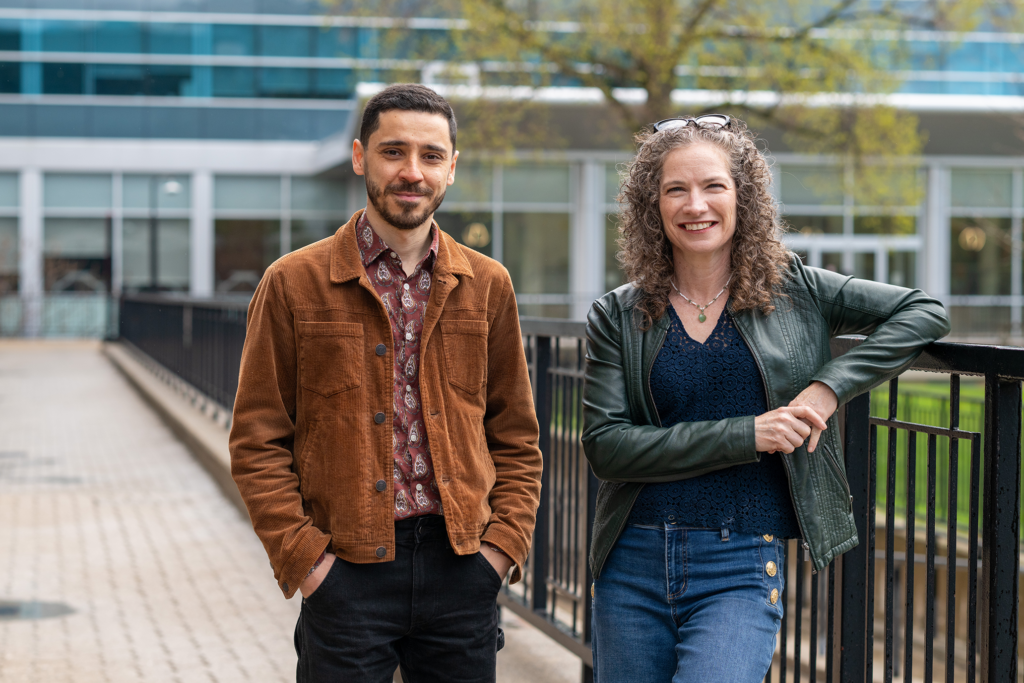
The De Gruyter Handbook of Youth Activism, co-edited by Carleton University sociology researchers Dr. Jacqueline Kennelly and Dr. Cihan Erdal, brings these young voices to the forefront.
Featuring 38 contributions from 56 scholars, organizers and activists, the handbook provides a comprehensive overview of youth activism as both a field of study and a global phenomenon.
Many of the authors featured in the handbook are affiliates of the Centre for Urban Youth Research, a research centre launched in 2019 by Kennelly, a Professor in the Department of Sociology and Anthropology at Carleton, with the mission of creating space for critical youth scholars to connect and for young people to not only be heard, but to be understood as having their own expertise.
“Given how youth activism is so central to many major movements across the world, you would assume that there would already be a dedicated handbook on this topic,” said Erdal, an Adjunct Research Professor in the Department of Sociology and Anthropology who completed his PhD in Sociology at Carleton in 2025.
“With this book, we wanted take youth activism seriously as its own field of inquiry and treat it as a site of political knowledge and theory.”
A Handbook Inspired by Collective Action
The handbook reveals that today’s youth activists are rallying around a collection of core issues that, at first glance, seem quite varied: authoritarianism and threats to democracy, war and international conflict, identity and discrimination, housing and precarity, and climate justice.
What connects this wide range of struggles, Erdal explained, is a strong sense that these multiple crises are all intertwined.
“The economical, ecological, geopolitical – so many young activists nowadays are not treating these as separate issues, but as part of a broader struggle over what kind of future is possible,” he says. “Rather than there being a primary, single concern, they’re thinking of it as a constellation of interconnected struggles, or different faces of the same systemic condition.”
These insights are outlined throughout the handbook, which itself was curated with a spirit of collective action in mind.
“I have a personal scholarly commitment to inclusion, and part of that commitment means hearing from more than just the usual suspects,” said Kennelly, referring to how much of the existing research on youth activism originates from the Global North (e.g. Europe, Canada and the United States). For the handbook, she and Erdal sought not only to bring in more authors from the Global South, but to build a real sense of community within their group of international collaborators.
“Often in edited collections, and I’ve contributed to a bunch at this point, the authors never meet each other,” Kennelly remarked. “It’s all conducted over email these days. The only time that all these voices and ideas get to engage with one another is in the final published book.”
To counter this, Kennelly and Erdal organized several initiatives to bring people together: A series of webinars, two panels and a pub night at the 2024 International Journal of Youth Studies conference in Belfast, and a virtual book launch event this winter.
“As much as we could, we tried to make this not just a bunch of people contributing to a book, but an intentional effort to build relationships across locations and disciplines.”
Another intentional decision was to integrate writing by youth activists across the handbook’s scholarly conversations, including three recently graduated Carleton students: Megan Dicker, Cherie Wong, who is starting her PhD in Sociology at Carleton in the fall, and Prema Kapoor, who is currently pursuing her Master of Arts in Sociology at Carleton. Youth activists and Centre for Urban Youth Research affiliates Sophie Handford and Peyton Wilson also both contributed chapters.
“I was teaching a course at Carleton on Youth Activism and Social Change, and a few of my students who took the course wrote incredible assignments focusing on youth activism. I fell in love with their pieces, and I shared this idea with Jackie of inviting them to contribute to this handbook,” recalled Erdal.
“We approached the students and asked if they would be interested in turning their final papers into book chapters – which didn’t require much work, as they were already beautifully written.”
Apathy or Access: The Real Barriers to Youth Activism
There is a cultural reflex to dismiss younger generations – Gen Z, at our current moment in time – of being checked out when it comes to politics.
“Every single generation has been called lazy by the generation before it,” said Kennelly. “This narrative has been repeated since the creation of the idea of youth itself.”
“Young people get put in an impossible position: If they’re activists, they’re considered foolish and ideological; if they’re not politically engaged enough, they’re apathetic.”
But Kennelly and Erdal argue that narrative collapses when you actually look at what youth activists are doing around the world.
“There’s incredible work happening at the grassroots level,” Erdal said, noting that stereotypes about Gen Z as apathetic reveal more about intergenerational tensions and narrow understandings of what counts as political activism, than they do about young people themselves
Their research also points to structural barriers that make civic engagement unevenly accessible to youth.
“I’ve done a lot of research on how differentiations in class, gender, and race can determine who gets to become an activist,” explains Kennelly, whose 2024 book Burnt by Democracy: Youth, Inequality, and the Erosion of Civic Life drew on interviews with young people and young activists who had experienced homelessness from five different liberal democracies, including Canada.
“There’s a lack of recognition that to become an activist requires time, resources and specialized knowledge that is not generally taught in public schools, and that’s often quite exclusive to middle‑class families, at least in the Global North,” she said.
One solution, Kennelly suggests, is rethinking how civics is taught. Current curricula focus almost entirely on formal politics—how voting works, how legislatures function—leaving out the forms of political action most accessible to young people.
“If you’re too young to vote or you’ve had negative experiences with the system, then that’ll all feel meaningless in terms of creating actual change,” she said. A more expansive civics education, she argues, would acknowledge online activism, protest, mutual aid and other grassroots forms of engagement that young people are already using to shape their communities.
With this in mind, Kennelly and Erdal are running a youth housing activism field school this summer through the Centre for Urban Youth Research, where 29 participants – the majority of whom are racialized, queer, and have lived experience of poverty – will learn how to advocate directly on the issues of housing precarity and homelessness.
“We’re trying to train young people, especially folks who might otherwise have faced a lot of barriers to being engaged in activism,” Kennelly said.
A Radical Hope for a Better Future
While the first flames of activism can spark at any age, many youth activists can trace their radical politics back to a formative moment in their lives where injustice or inequality was ignored – or sometimes perpetrated – by the adults in power.
For Erdal, as a young person living in Turkey, it was the assassination of Turkish-Armenian journalist Hrant Dink in 2007 that profoundly reshaped his understanding of the world and inspired him to become an activist and scholar.
He argues that youth activism is what happens when waiting becomes unbearable.
“It’s a refusal to accept that the present is the only possible future. It’s a defiance of how young people are told to wait, to be patient, to prepare for their future career, to defer their political desires, demands and voices.”
Erdal is particularly interested in the different ways that youth activists choose to mobilize their political desires when called to action. In the fall, he’ll be travelling to Montreal, New York, Berlin and Athens to speak with young artists – dancers, musicians, and more – whose artistic practices operate as radical, emotionally-moving forms of democratic engagement that can help soothe the loneliness and nihilism weighing down many young activist shoulders.
“Youth activism, I think, is not only about reacting to what is happening,” said Erdal. “It’s also imagining how we might build different ways of living together and caring for each other.”
Kennelly also sees care as a key part of the solution.
“I really do believe that people inherently want to be good to each other. Humans are innately relational and want to build things together,” she said. “We’re just not living within systems that are necessarily set up to allow us to actually collaborate.”
“It’s those structures and systems that keep us isolated from one another, that perpetuate hatred, that pit us against each other, that leave people so exhausted because they’re just working their asses off to barely pay rent, that keep people from getting involved at all in any kind of community or civic life. Those are the things that we need to change. And those things can be changed, and that’s something that gives me hope.”