Driven by Curiosity, Focused on Care: Meet Mehdi Ammi
Field Notes: Research Profile
Mehdi Ammi, School of Public Policy & Administration
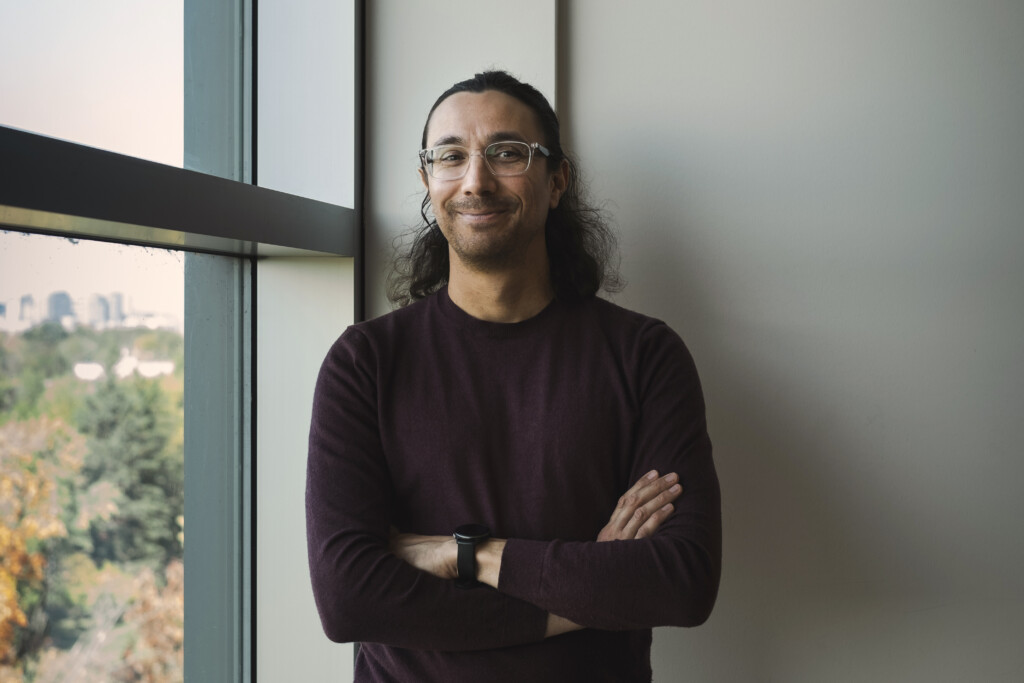
Mehdi Ammi investigates the long-term value of preventive public health spending, analyzing how smarter investments can save lives and improve population health.
Can you offer a “lay” description of your research topic?
If only I had just one! I’m half-joking there, but I’m a curious person, and it seems that answering one research question tends to lead to more. There’s a bit of a sprawl of research interests. Still, my research falls within health economics, health policy, health services research, and public health. Overall, I want to understand how the characteristics of health and healthcare systems can be modified to balance comprehensive access, high quality, and low cost of care, along with healthcare providers’ satisfaction, and ultimately improve population health. This is known as the quintuple aim, and my research touches on different aspects of it.
One of the things I’m particularly interested in is the value of expenditures on public health, meaning spending that’s more preventive than curative. These expenditures tend to be small, around 5% of total health spending in Canada. While there’s a general sense that prevention is better than cure, I’m trying to understand the differential returns of spending on preventive versus curative care.
What piqued your interest in this topic?
For my overall research topic in health, I’d say it’s not what got me into economics in the first place. Initially, I was interested in finance – until I realized I really, really didn’t like the idea of making more money from money. I discovered health economics, along with other areas related to human capital (like labour and education), and realized this was more “me.” Health raised fascinating problems: it’s mainly public, full of market issues like information asymmetry and uncertainty, and lacks real prices to guide resource allocation. That intrigued me, and I thought, maybe research in this area could actually help improve society.
As for the value of public health expenditures, two things made it both interesting and challenging. First, when public health succeeds, nothing happens. It prevents bad things from occurring, so how do you prove you matter when success looks like nothing? Second, despite its importance, public health is often under attack, seen as paternalistic or an easy target during austerity. Third, I kept hearing from public health professionals and decision-makers that they needed evidence to justify their budgets, especially given pressures on hospitals and primary care. I didn’t know what the answer would be, but it felt like an important and fascinating puzzle.
What question were you hoping to answer in your research?
I wanted to see whether public health produces results in the long run, over several decades. As I mentioned, nothing happens immediately in public health, but what about all the lives saved down the road? Can we measure that? It turns out there’s some good, long-term data from national agencies and the OECD, spanning 40 to 50 years. Plus, new econometric methods now exist to address known issues in these datasets.
With co-authors, we did two studies. One focused in Canada, looking at all the provinces, published last year. And one looking at OECD countries, including Canada of course, published last month. Go read them, they are both open-access thanks to Tri-Council funding: here and here.
What is something people would be surprised to learn?
The punchline is that public health spending does make a difference in the long run. A 10% increase in public health expenditures leads to a 2% decrease in preventable mortality in Canada over the past forty years. Across OECD countries, a 10% increase in preventive spending reduces all-cause mortality by 1% and increases life expectancy at age 65 by 0.4% over fifty years.
That might not sound dramatic, but remember, curative spending saves lives now, while preventive spending saves lives later. And given that public health accounts for only around 6% of total spending in Canada in 2024 ($22 billion out of $372 billion), those long-run effects are pretty remarkable. It’s not about cutting curative care, of course, people who show up in emergency rooms need treatment. But it’s a reminder: just because the benefits aren’t visible right away doesn’t mean it’s not working.
What’s the biggest misconception about your research area?
The number one thing I hear is that “health isn’t about money.” I agree. It’s not about money; it’s about value. They’re not the same thing. The biggest misconception is that health economists only care about cutting costs. That’s completely wrong. We’re social scientists trying to understand how people and societies work, including incentives, efficiency, and equity.
We don’t say, “cut here.” We ask, “If you had $1 more, where could it do the most good?” Maybe that dollar saves more lives in prevention than in hospitals, or vice versa. Our role is to bring evidence to the table, not to dictate policy, but to help make it better informed.
Any new projects that you’re excited about?
I have too many projects, and I’m excited about all of them! That’s the beauty of being a professor: you choose what you want to work on (as long as you can fund it). If it doesn’t excite you, you just don’t do it.
Some projects I can’t talk about yet. Research ideas are only good if they’re original! But one I can share is a grant proposal on the impacts of public health expenditures on equity. We know these expenditures improve health in the long run, but we don’t know for whom. For example, do the health gains go mostly to wealthier groups, or do they help reduce disparities? The project will develop measures of health disparities in Canada (by income, ethnicity, gender, and more) and test whether public health spending helps narrow them. What I find especially rewarding is the number of public health policy makers and practitioners involved as full partners. That’s what “research for the public good” should look like in my mind.
What’s your favourite class to teach?
I am in a graduate school. At the Master’s level, it’s my Health Policy in Canada (PADM 5221) elective in the Master of Public Policy and Administration program. The title says it all (and if that’s not obvious, you clearly weren’t paying attention… go back and read from the start).
At the PhD level, it’s the Doctoral Seminar (PADM 6201) in the PhD in Public Policy program. I love it because it’s about teaching future researchers what a research plan really is: how to come up with interesting, answerable questions and secure the resources (financial, human, intellectual) to get the work done. The course is different every year depending on the students’ interests and methodologies. It’s also a humbling experience; it pushes me to revisit the foundations of social sciences. I learn something new every time I teach it. Remember, I’m a curious person!