Alec Louis-Seize
Minor in Japanese
Current Occupation: Assistant Director of Admissions
Current Location: Ottawa, Canada
Program: BA (Cultural Anthropology)/10
[We met up with Alec over Zoom. Here’s some of what he had to say.]
Notable Quotable
“…if you have the chance, go study abroad! Immerse yourself in the culture and language…because that will just completely change your ability to speak and your motivations for learning. It really opens you up because there’s nothing like going to another country where they speak the language that you’ve been studying and being able to speak with people…”
How did learning Japanese influence your life?
Well, I can’t really encapsulate it because, I mean, learning Japanese really was the catalyst for my entire life all the way up till now.
For context, when I started at Carleton, I came in through the Enriched Support Program (ESP). I had done really poorly in high school but ESP gave me a pathway in. So, I did my first year and I was like, this is amazing!
Then in the summer, I decided to go tree planting and spent two months living in the forest and planting like 20,000 trees. It was a really cool experience and my first time living away from home…being out of Ottawa…and when I came back I was like…okay, I want to learn another language…but not a European one. I want to learn an Asian language…one with all those squiggly characters. So then I was like, hmm, Chinese or Japanese? So I literally just sat down and listened to some audio of Chinese and then of Japanese and I thought that Japanese sounded nicer so I decided to start learning Japanese.
I felt I wasn’t activated in high school and I think that once I started university that’s when I started to be become activated and Japanese was the first real thing I became passionate about.
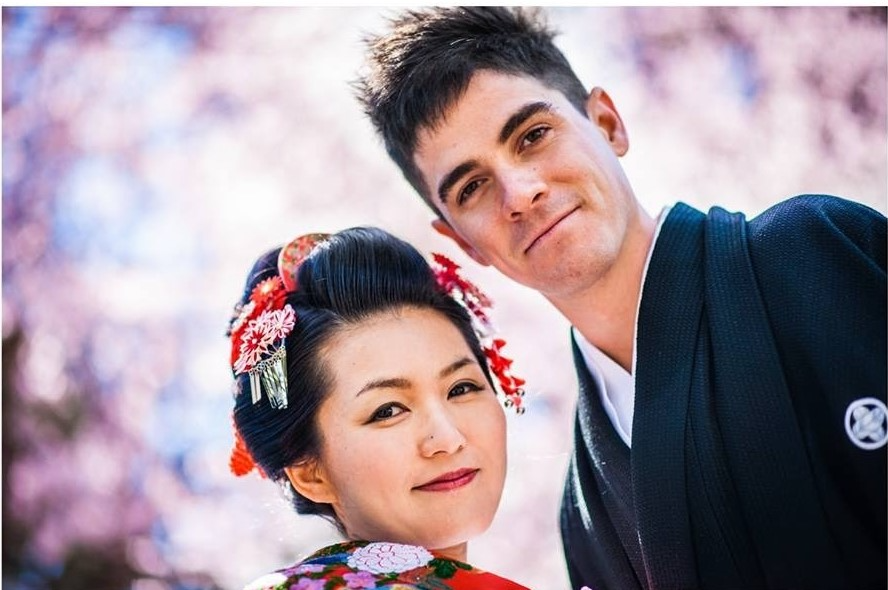
Around the same time, I got connected with the ESL program where I met Ayumi – she was my conversation partner back then, today she’s my wife – and just everything took off from there…my minor…my major in university…my whole life trajectory into teaching English and working with ESL students and living in Japan and all the stuff that followed.
What was the impact of your involvement with the ESL program on your life?
I loved the ESL program. Growing up in a small town like Rockland, I didn’t really have a lot of experience with people from other countries…but I was super-intrigued by all the different cultures, people, and perspectives that I found in the program. And the more I got to know them, the more I began to notice that some of them seemed a bit bored with life in Ottawa. So, I decided I wanted to share Canadian culture with them; to take them to the beach and bring them to different places in Ottawa. So, I started volunteering with the ESL program…then eventually I was brought on as a part-time, kind of, events coordinator for I think it was two academic years and I loved it. And actually, I was so affected by all the diversity I was encountering that I ended up changing my major from English to cultural anthropology, something I wasn’t expecting at all…and continued to minor in Japanese.
Anyway, to summarize: after graduating in 2010, I went to Japan with the JET Program where I taught English for two years in a kind of small village in the north of Japan. Then I moved to Toyota City – yes, like the motor corporation – which is where Ayumi is from. And for the next seven years, I commuted to work in Nagoya where I worked as a coordinator for teachers throughout a large region of Japan. Ayumi and I got married, had two kids, all that fun stuff.
Oh yeah, I also studied abroad for a year when I was at Carleton. I was an exchange student at Kanzai Gaidai University.
What is a particularly memorable moment from your university Japanese classes?
I would say it was my first day…’cause when I got to class there were a lot of the people who were taking Japanese because they were really into anime or manga or video games. But me, I literally went in with like zero. I could maybe say konichiwa but that’s it. And on that first day, the teacher was speaking all in Japanese and it looked like everybody understood what she was saying and I was like what the ****?! This is supposed to be an introductory course! And I was just like overwhelmed with the amount of stuff that they knew compared to me, not just about the language but about the culture too. ‘Cause when I was talking to them…they were like really nerdy about Japanese and I was like…man…I know nothing. And I wanted to give up. But then I just decided no, I’m going to do it. I’m going to do the best I can in this course. And so I studied a lot and I think the truth is, I based a lot of my personality for many years on how much Japanese I can speak.
What is your current occupation?
Today I am the Assistant Director of Admissions at Ashbury College where I work mainly with boarding students. So international students again! And every year I represent the College all over the world. Obviously, East Asia and Southeast Asia are my primary markets but also the Middle East…and this fall I’m going to Azerbaijan for the first time. I’ve also represented Ashbury in Japan, Korea, China, Vietnam, Thailand, Indonesia, Germany, Saudi Arabia, United Arab Emirates and…I think that’s it. Did I miss anything? Oh yeah, and Hong Kong for my first time this fall as well. So that makes it 15 years that I’ve been working with ESL students…Yeah, so being part of that program was pretty pivotal.
What advice would you give to a student considering taking a Japanese course or a language course in general?
Yeah, I mean, take it and enjoy the fact that everything that you are learning is the most important stuff that you’ll learn in that language. It’s the foundation. ‘Cause everything that you learn at the beginning is stuff that you’ll use for the rest of your experience with that language, right?
And, if you have the chance, go study abroad! Immerse yourself in the culture and language…because that will just completely change your ability to speak and your motivations for learning. It really opens you up because there’s nothing like going to another country where they speak the language that you’ve been studying and being able to speak with people who you would not be able to speak with if you didn’t speak their language.
Oh, and also, as you go through the language learning process, remember it may get more and more convoluted and more and more boring…’cause you have to start learning the words for things like “tuberculosis” and “semiconductors”. But it’s worth it. ‘Cause I think almost all my relationships in Japan were with Japanese people and I think I wouldn’t have those relationships if I hadn’t put in the time to learning the language.