Fighting Fire with Engineering
Lead image by Landon Parenteau / Pexels
By
Dan Rubinstein
Photo Credit:
Terence Ho
Residential development across Canada is encroaching on the wildland-urban interface, a landscape where houses and infrastructure brush up against forests and other vegetation. Global warming is making summers hotter and drier.
This dangerous combination, coupled with the use of new construction materials, is changing our susceptibility to fires. From St. John’s to Vancouver Island, hundreds of communities from coast to coast have experienced destructive blazes in recent years.
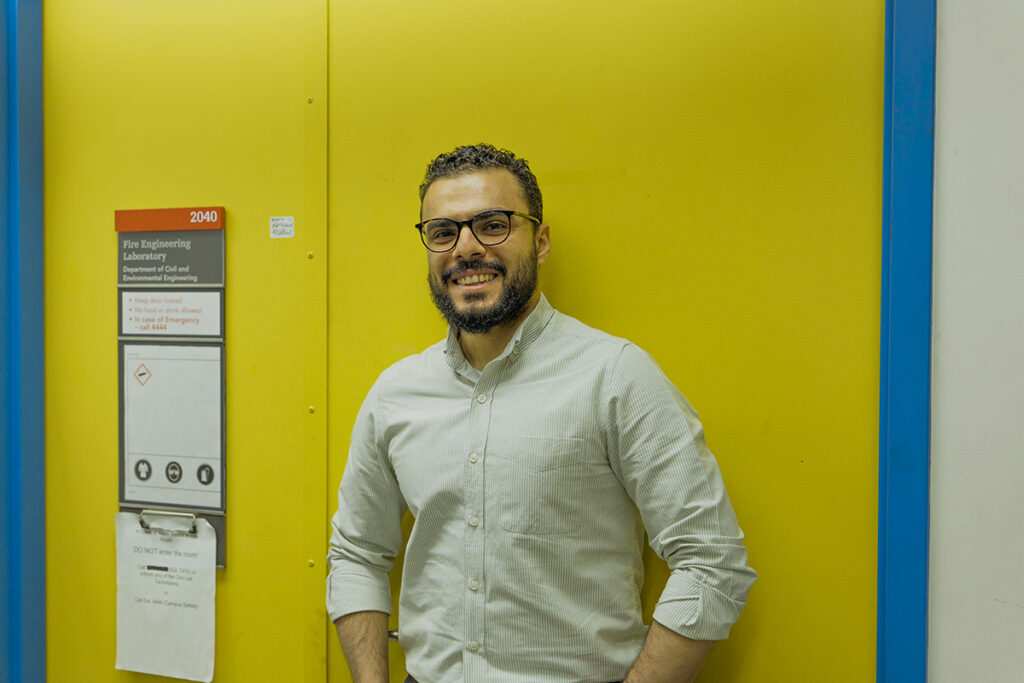
These mounting risks, and the need to develop more sustainable and resilient buildings, are the key drivers of Mohamed Beshir’s research in fire safety engineering. A Civil and Environmental Engineering professor at Carleton University. Beshir leads the Ember Fire Group, which focuses on understanding and mitigating fire risk in the built environment.
Through a combination of laboratory experiments and field testing, the group studies fire behaviour across scales, from the thermal decomposition of materials to the generation, transport and ignition of firebrands. Their work aims to enhance understanding of how fires start, spread and interact with structures and communities.
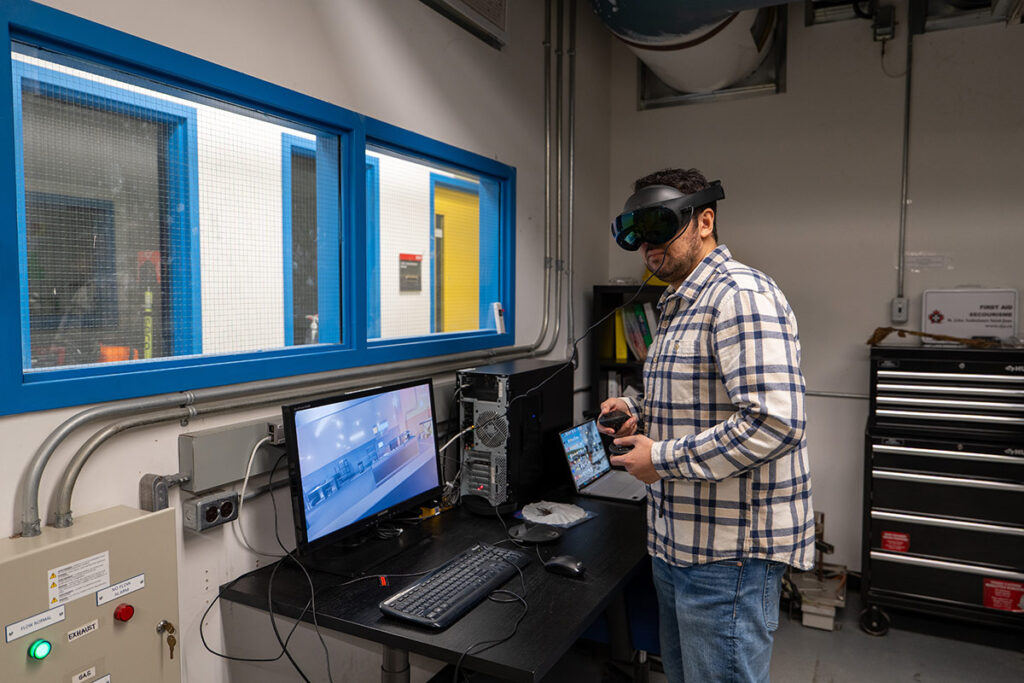
The Ember Fire Group also integrates virtual reality (VR) and human behaviour research to study evacuation under realistic fire conditions. In controlled VR scenarios, participants navigate environments with reduced visibility, blocked exits and evolving hazards, allowing researchers to deconstruct decision-making during emergencies.
“Our goal is to transform how we design buildings and communities to withstand fire and protect occupants,” says Beshir.
“Climate change and urban development are rapidly changing fire risk. Engineering must keep pace through physically grounded models, experimental validation and direct application to design and practice.”
Predictive Fire Engineering
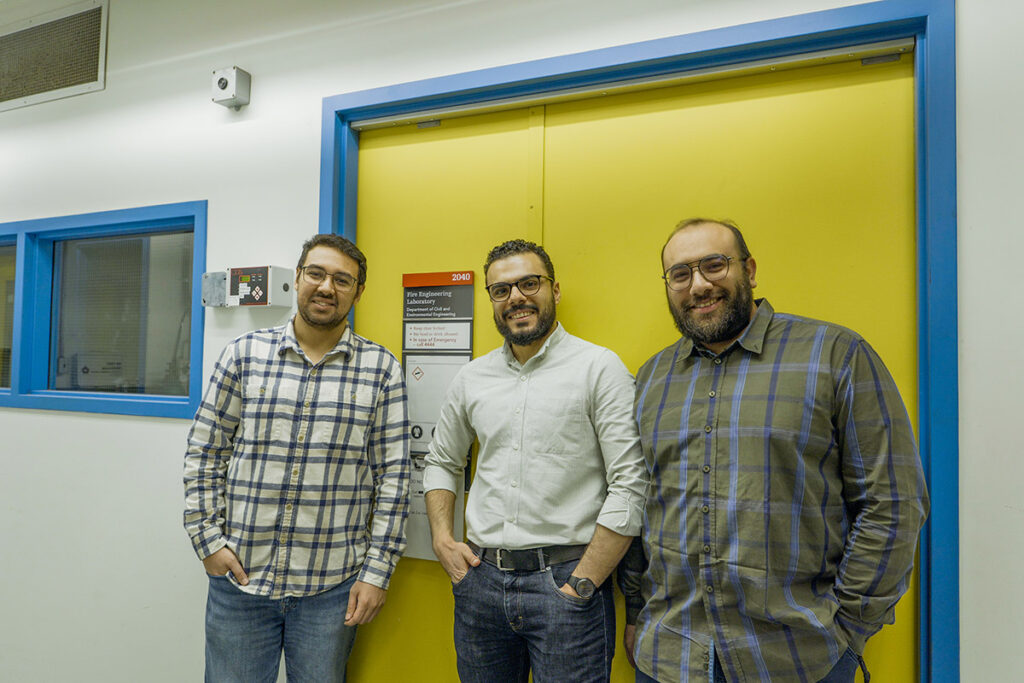
In their lab on the ground floor of Carleton’s Minto Building, Beshir and PhD students Ahmed Abdelnabi and Mohamed Tawfik demonstrate the intricacy of their work.
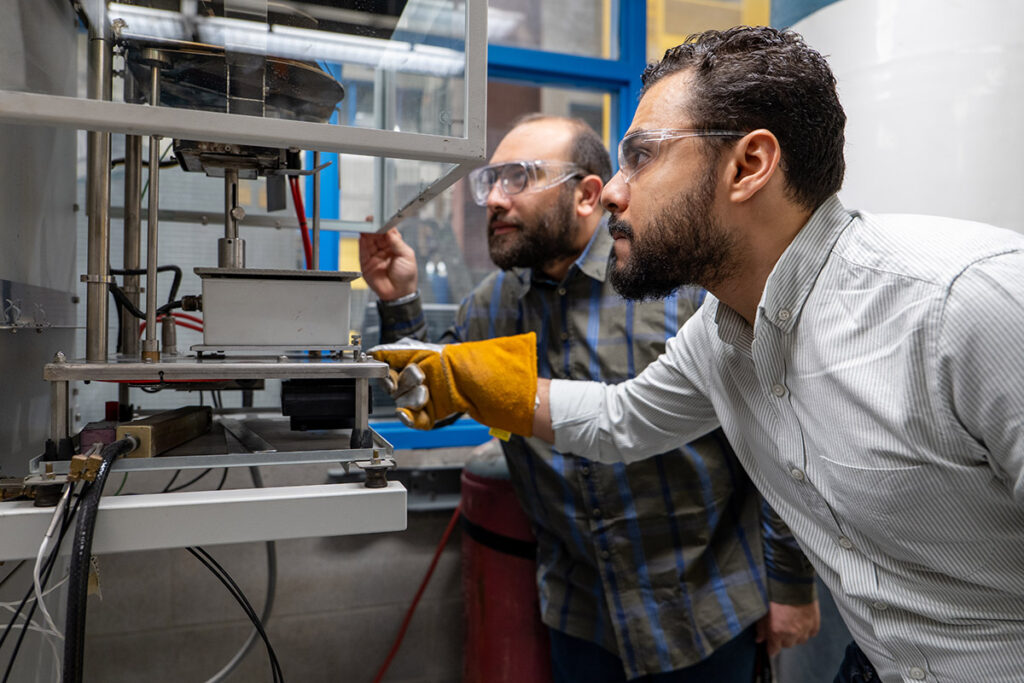
At the core of the lab is a cone calorimeter, an instrument used to characterize how materials respond to fire. Samples of wood and composite materials are exposed to high heat fluxes, producing combustible gases that are captured and analyzed in real time.
These measurements provide detailed insight into ignition, heat release rate, mass loss and the combustion byproducts of different types of building materials — fundamental properties that govern how fires develop and spread.
In the lab, Beshir lights a small wooden pellet with a blowtorch, approximating a burning ember, and places it atop the wood sample, which makes it burst into flames. Cone calorimeters can also assess the impact of embers of different size and shape.
These measurements are not collected in isolation. They are used to develop and validate physics-based models that can predict fire behaviour across scales, from material-level decomposition to fire growth in structures and communities. This is particularly relevant as new construction materials, including mass timber systems, are increasingly adopted in the built environment.
“Our work focuses on understanding fire at a fundamental level and translating that knowledge into predictive tools,” says Beshir.
“By combining detailed experiments with modelling, we can better anticipate how materials and systems will behave in real fire scenarios.”
The research group also conducts experiments with organizations such as the Calgary Fire Department. Last year, they carried out a series of controlled burns of lodgepole pine trees of varying heights at an outdoor training centre on the outskirts of the city.
Recording with thermal cameras, the researchers tracked where and how embers moved: up the fire’s plume and then horizontally with the wind before dropping into concentric rings of containers positioned around the tree. Experiments like this have direct relevance to the wildland-urban interface, where ember showers frequently cause ignition.
Interdisciplinary Fire Expertise
As an undergraduate student at Alexandria University in Egypt, Beshir studied mechanical engineering and was very interested in combustion science. But it wasn’t until he did an internship at the University of Wisconsin that he realized there’s an entire engineering discipline dedicated to fire safety.
Beshir completed a unique international master’s degree in fire engineering split between three universities: Sweden’s Lund University, where he learned about how people act during disasters; Belgium’s Ghent University, which has expertise in combustion modelling; and the University of Edinburgh in Scotland, where he concentrated on how structures are impacted by fire.
He remained in Edinburgh for his PhD and, in 2023, brought this interdisciplinary experience to Carleton.
“Fire safety engineering is inherently interdisciplinary,” says Beshir.
“We bring together material behaviour, fire dynamics and human response to understand how fires develop and how people and structures are affected.”
Beshir’s Ember Fire Group collaborates with a wide range of partners, including national organizations and academic institutions across Canada, to address emerging fire risks in both buildings and the wildland-urban interface.
“In the challenges we face today, risks are interconnected,” says Beshir. “A single event can trigger cascading effects — for example, an earthquake followed by fire. Addressing these problems requires integrated, performance-based approaches that bring together multiple areas of expertise.”