Follow the Money: Carleton PhD Grad Helps Combat Illicit Financing
Lead image by NanoStockk / iStock
By Dan Rubinstein
If you want to really understand somebody, take a close look at how they spend their money. The same thinking applies to state and non-state actors, such as terrorist and criminal organizations.
“Regardless of what they’re saying, what they spend their money on is a much more valuable signal than any sort of public commentary or propaganda,” says Jessica Davis, the president of consulting firm Insight Threat Intelligence and a PhD graduate of Carleton University’s Norman Paterson School of International Affairs (NPSIA).

“Money can tell you so many interesting things. It’s almost like the plumbing of geopolitical chaos.”
The majority of Davis’s work involves investigating illicit financing and assessing whether the methods governments and security agencies use to combat the flow of funds are effective.
Terrorists need to pay people and purchase weapons to mount attacks. Attempting to influence a foreign election is expensive. This leaves an illuminating paper trail.
“Without money, bad people can’t do bad things,” says Davis.
“If there’s money involved, I’m interested.”
A Love for Learning
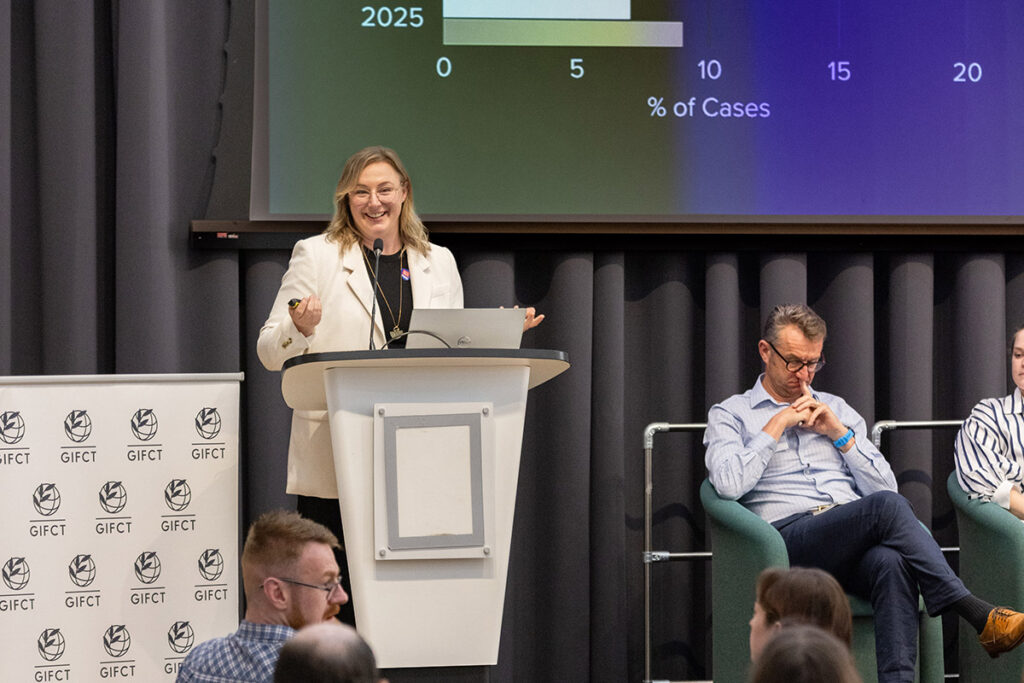
Davis grew up in a military family and went to Royal Military College for her undergraduate degree and a master’s focusing on terrorism and political violence.
Afterwords, she worked for the Department of National Defence, Global Affairs Canada, FINTRAC (Canada’s financial intelligence unit) and the Canadian Security Intelligence Service. But she has always loved school and learning and decided, encouraged by friend and former colleague Prof. Stephanie Carvin, to begin a PhD at NPSIA in 2019.
With her background in security and intelligence analysis, Davis’s research led deeper into the intricacies of terrorism financing. She wanted to bridge the gap between academic theory and policy application, and her efforts were recognized with the prestigious $50,000 SSHRC Talent Impact Award.
“Carleton was a great fit because I wanted to study qualitative and quantitative methods and I wanted a significant international relations focus,” she says, “but I also wanted a program that had a really practical element.”
“Jessica’s ability to engage in policy-relevant research while maintaining high standards of scholarly rigour make her stand out,” says Carvin. “Moreover, she does this while writing in accessible ways so that anyone with an interest in the topic can follow her key insights.”
A Shift to State Financing
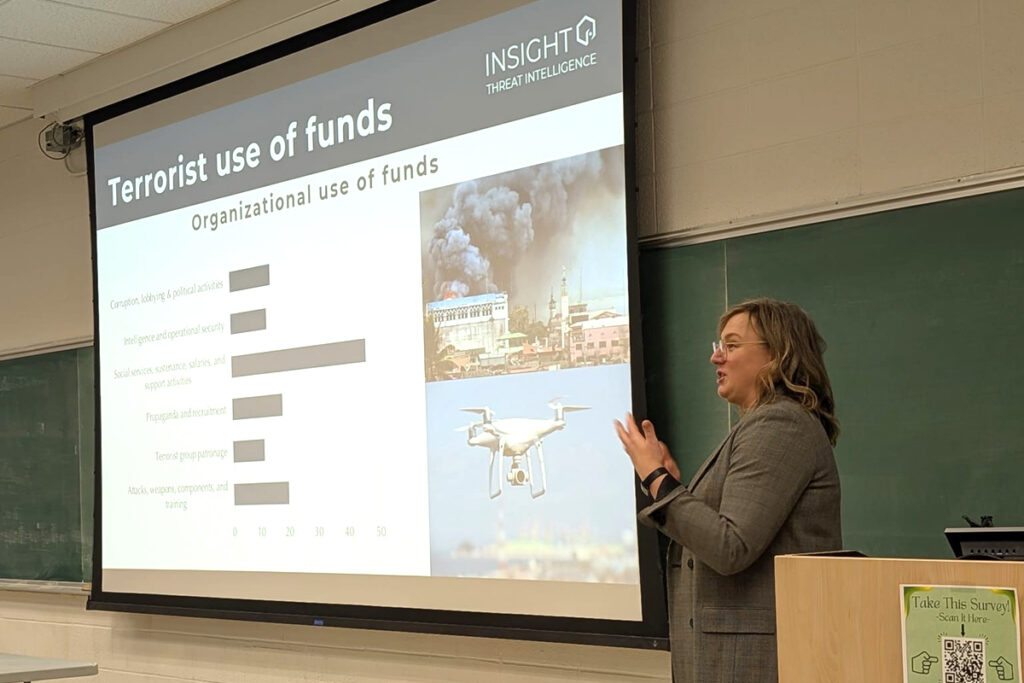
Davis was already running Insight Threat Intelligence during her PhD studies, consulting for a range of clients, from multinational organizations such as the United Nations and Council of Europe to national governments, non-profits and private sector companies in banking and technology.
Half a dozen years ago, much of her work involved ideologically motivated violent extremists like ISIS and small cell or lone actor attacks. Those are still a concern, but her priority has shifted to state financing of terrorism — for example, Iran’s support for Hezbollah and the Houthi movement in Yemen.
Davis is also increasingly looking at cryptocurrency, which is “a growth area,” she says, “because it’s such an easy way to move money.
“I started looking at cryptocurrency about a dozen years ago. At the time, it wasn’t that easy for people to use, and certainly not easy for illicit actors to use. They like to hide amidst a lot of transactions and there just weren’t a lot of transactions happening.
“But now cryptocurrency has become very mainstream, which means that illicit actors see it as a much more viable way to move money.”

Illicit Political Financing
Alongside cryptocurrency, Davis is spending more time working on what she calls “illicit political financing” these days.
Since Canada’s public inquiry into foreign interference in elections in 2023 — which she contributed to as part of a research panel — she has looked into issues such as transnational repression and state actors attempting to manipulate political outcomes. This work spans the globe, from Eastern Europe to allegations that Russian networks are actively trying to amplify separatism in Alberta.
As chaotic as this realm is, Canada has become a world leader in combatting illicit political financing, according to Davis, and is currently in the process of creating a new Financial Crimes Agency — a development that she has played a role in.
“It’s nice to see that some of the advice I provided and research I shared had led to this step,” says Davis, who, in addition to her consulting work, is doing a postdoc on cryptocurrency and sanctions evasion at the University of Calgary and is president of the board of the Canadian Association for Security and Intelligence Studies, a nonpartisan, voluntary organization focused on security and intelligence issues.
She’s also busy finishing up a book based on her 2024 PhD dissertation, Money for Mayhem, that’s scheduled to be published early next year.
“I’ve never really reflected on how difficult this work is,” she says.
“I just find it so engaging and so rewarding, because I know it can make a difference.”