Has it been established how the three phases of a butterflies life evolved. Many years ago I saw an article suggesting that it was due to an accidental merging of a caterpillar like animal with a flying insect and the flying insects DNA eventually emerged from the caterpillar via the pupa.
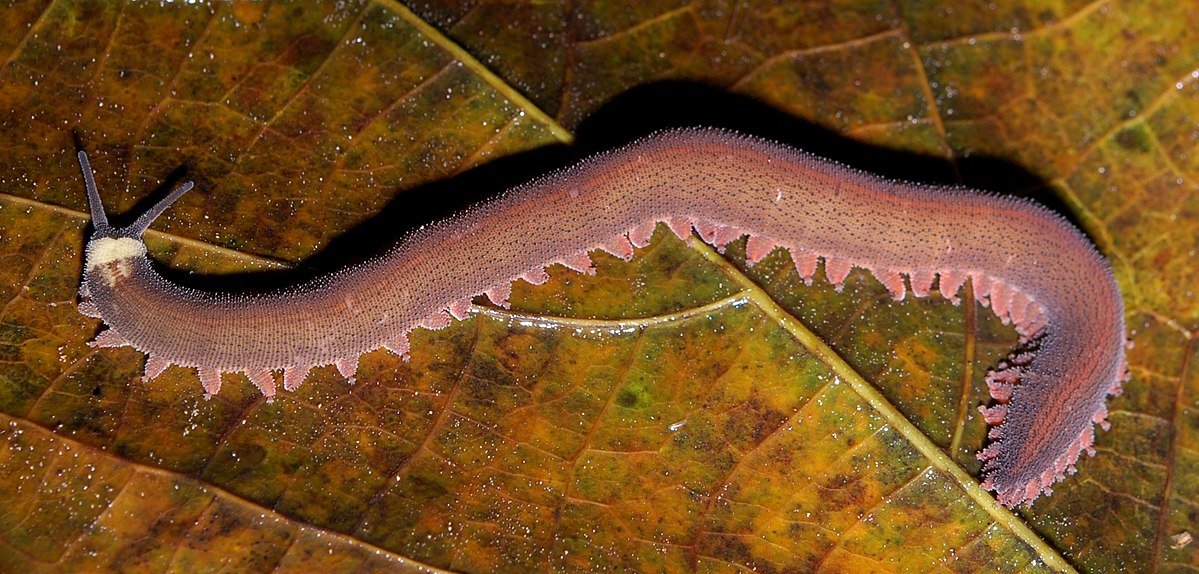
Thank you for this fascinating question. Let me first provide a little background for readers unaware of where this curious hypothesis came from. In 2009, a highly prestigious journal, the Proceedings of the National Academy of Sciences (PNAS), published a short communication written by Donald Williamson, a marine biologist at the University of Liverpool. Williamson proposed that a hybridization event between organisms very different in form—a velvet worm (see image below) and an unknown winged insect—gave rise to the Lepidoptera (butterflies and moths) and other insects that have caterpillar or grub-like larvae and a winged adult. Williamson did not provide any evidence that such an event might have happened, but he did propose that a look at the length of the lepidopteran genome might support his idea: the Lepidoptera would be expected to have an extra large genome, consisting of insect genes that determine adult form, as well as velvet worm genes that code for larval form. He also suggested that researchers with access to velvet worms try to inseminate a cockroach with velvet worm sperm.
As a “communication” in PNAS, Williamson’s paper did not have to go through the usual peer review process. Instead, it was accepted for publication by an editor, Lynn Margulis, who is renowned for her “endosymbiont theory”, in which early bacterial cells engulfing smaller cells gave rise to more complex organisms and ultimately led to the evolution of plants, fungi and animals. She endured years of criticism for her unorthodox idea before it was finally accepted by the scientific community, an experience that probably led her to be sympathetic to Williamson’s fringe idea. Nevertheless, peer review is an important part of weeding out ideas that can be easily debunked, as was the case for Williamson’s hypothesis. (PNAS has since eliminated the “communication” route to publication.)
At the time of publication, there were already enough studies on genome size in the literature to test Williamson’s hypothesis, as Michael Hart of Simon Fraser University and Richard Grosberg of U.C.Davis pointed out in a quick rebuttal. Insects with caterpillars or grubs do not have more genes than either insects without a larval stage or velvet worms. Moreover, butterflies do not have a set of genes that closely resemble those of velvet worms. In terms of genetic similarity, insects with larvae are most closely related to insects without larvae, and the insects as a whole are more closely related to the other arthropods (spiders, mites, crustaceans, etc.) than they are to velvet worms.
The difference between adult butterflies and their caterpillars is indeed astounding, as is the complete restructuring of the body plan during metamorphosis. However, the larval stage can be explained by natural selection acting upon the juveniles and shaping, through evolution, a form that best accomplishes quick growth and accumulation of the energy resources that the adult will need to disperse and reproduce. Soft bodies and cylindrical shape have been proposed as the best way to grow quickly when constrained by an external skeleton that needs to be periodically shed to allow growth. – Dr. Naomi Cappuccino
Sources:
Williamson, D. I. 2009. Williamson DI (2009) Caterpillars evolved from onychophorans by hybridogenesis. Proc Natl Acad Sci USA 106:15786–15790.
Hart, M. W. and Grosberg, R. K. 2009. Caterpillars did not evolve from onychophorans by hybridogenesis. PNAS 106: 19906–19909.
Maddrell, S. H. P. 2018. How the simple shape and soft body of the larvae might explain the success of endopterygote insects. J. Expt Biol 221
Velvet worm photo: Geoff Gallice on Wikimedia Commons