WHITE PAPER: Contested Pasts and Foreclosed Futures: Poland’s Mnemonic Landscape, the Juridification of History, and the Election of Karol Nawrocki
By Kim Nesbitt
In one of the most closely contested elections in Polish history, Karol Nawrocki narrowly defeated liberal Warsaw mayor, Rafał Trzaskowski, to secure the Polish presidency on May 18th, 2025, with 50.9 percent of the vote. The election saw a historic voter turnout of 71.0 percent, signalling a high level of civic engagement across the country. Nawrocki was politically backed by Poland’s Law and Justice party (PiS) – a right-wing populist party that is known to espouse conservative social values, emphasize the importance of national identity and sovereignty, and has overall been associated with ethnonationalist political rhetoric. Over the past two decades, PiS has promoted a vision of Polish identity rooted in traditional Catholic values and cultural norms while otherwise consolidating power through appeals to popular will and skepticism directed at liberal democratic institutions. This ethnonationalist push continues to unfold alongside the pro-European leadership of Prime Minister Donald Tusk, leader of the Polish Civic Platform party (PO), ultimately revealing stark ideological cracks and strategic revisionism taking place at the highest levels of Polish government.
In what ways will Nawrocki’s presidency influence Poland’s future domestic and foreign policy position and priorities? Could this political moment in time mark a turning point in Poland’s so-called backsliding democracy, or does this mark a possible juncture and deepening of political polarization?
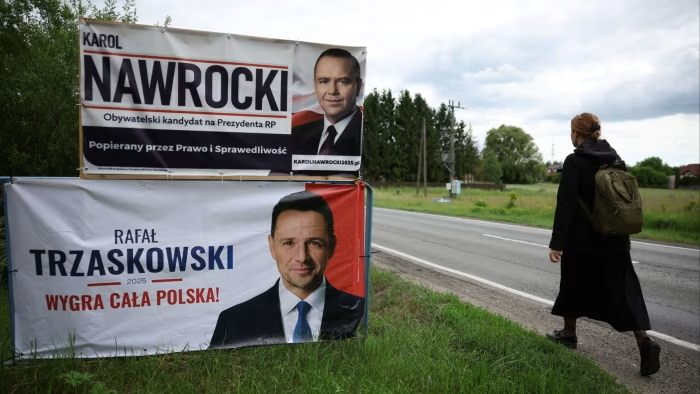
This white paper offers a theoretical examination of Poland’s evolving political and mnemonic landscape leading up to the election of Nawrocki, situating it within broader domestic and regional power shifts and politics. By mnemonic landscape, I am referring to the dynamic field of memory politics through which state and political narratives of the past are constructed, contested, institutionalized, and negotiated within particular political, cultural, and geographical contexts. Mnemonic landscapes encompass the discursive, legal, and affective structures – such as commemorations, memory laws, and judicial rulings – through which states, and civil societies, engage with historical memory within and between states. In hybrid regimes like Poland, the mnemonic landscape is a critical site of governance where national identity, moral authority, and political legitimacy are shaped by competing visions of history and responsibility. I take an interdisciplinary approach in considering the mnemonic and security landscape of Poland, bringing in considerations of critical geography, critical security studies (CSS), International Relations (IR), revisionist history, and transitional justice. In doing so, however, I argue out of the standpoint of a practitioner of care ethics: a feminist approach to morality and issues of justice that foregrounds our relational embeddedness and ethical responsibilities to particular others – near and far – within networks of interdependence and relationality. As Joan Tronto and Berenice Fisher have described, care is a “species of activity that includes everything we do to maintain, continue, and repair ‘our’ world so that we can live in it as well as possible” – a world that includes our bodies, environments, and relationships (Fisher and Tronto, 1990).
Situated within this care ethics standpoint, this white paper engages with an interdisciplinary array of research to ultimately suggest that current understandings of democratic backsliding, ethnonationalism, and mnemonic security can and should be re-evaluated through lenses of care. Specifically, it brings the feminist approach of care ethics – understood as a relational, responsibility-oriented approach to morality – into conversation with the study of hybrid regimes and the politics of memory. By emphasizing the ethics of care as a framework for action and practice, my approach aims to highlight how state-led mnemonic governance is not only a discursive construction or juridical phenomenon, but one that materially shapes the conditions of relationality, recognition and moral responsibility for the past, present, and future within and across national borders. In contexts like Poland and Ukraine, where historical memory is increasingly instrumentalized to consolidate political power and produce moralized national narratives, I believe care ethics offers an approach that is attentive to how narratives of the past shape present realities and common futures, while also offering more dialogical, reparative, and relational approaches to justice, recovery, and the building of democracy.
This white paper begins by tracing Poland’s post-Socialist trajectory, which, despite early democratic gains, has increasingly exhibited the characteristics of a hybrid regime – defined by the legal façade of democratic institutions and checks-and-balances while consolidating executive power and a moralized national identity. Central to this trajectory, I aim to show, is the rise of ethnonationalist governance, in which appeals to national memory and identity are politicized to legitimate reforms, rollback of human rights, marginalize dissent, and assert cultural homogeneity – particularly through what are often termed “memory laws” and the instrumentalization of institutions like the Constitutional Tribunal.
Section two narrows its focus upon the structure of the Polish judiciary to consider how it is not only a battleground of democratic backsliding but can be understood as a site where moralized authoritarianism is taking shape via affective governance and a narrowed jurisprudential and juridical horizon. As readers will see, ethnonationalist populists have leveraged affective appeals – rooted in moral symbolism, national identity, and historical memory – to cultivate civic trust in partisan institutions while redirecting trust outward toward supranational actors like the European Union (EU). Section three then shifts to also consider the ongoing war in Ukraine, examining how Russia’s invasion has affected mnemonic and geopolitical alliances, intensified nationalist sentiment and movements, and produced new pressures for regional solidarity, particularly within the EU and NATO. Finally, I conclude with a reflection on the evolving dynamics of Polish-Ukrainian memory politics in the shadow of Russia’s own. In reference to the Volyn tragedy, I suggest the epistemic tools and approaches of care ethics offer diplomatic audiences and broader global civil society the opportunity to transition away from rigid, juridical models of justice and moral responsibility towards those of a more dialogical and collaborative nature, including practices of mnemonic rapprochement.
Polish Party Politics: PiS, PO, and the Fractures within the Polish Electorate
Since the fall of socialist rule in 1989, Poland has undergone a multi-stage process of democratic transition. In studies of political science and IR, this is commonly referred to as a process of democratization – a political transformation in which a non-democratic state (oftentimes, authoritarian in character) regime transitions into a democratic one via the institutionalization of democratic norms and principles, including free and fair elections, separation of powers, the rule of law, and practices of political pluralism (Bunce, 2001).
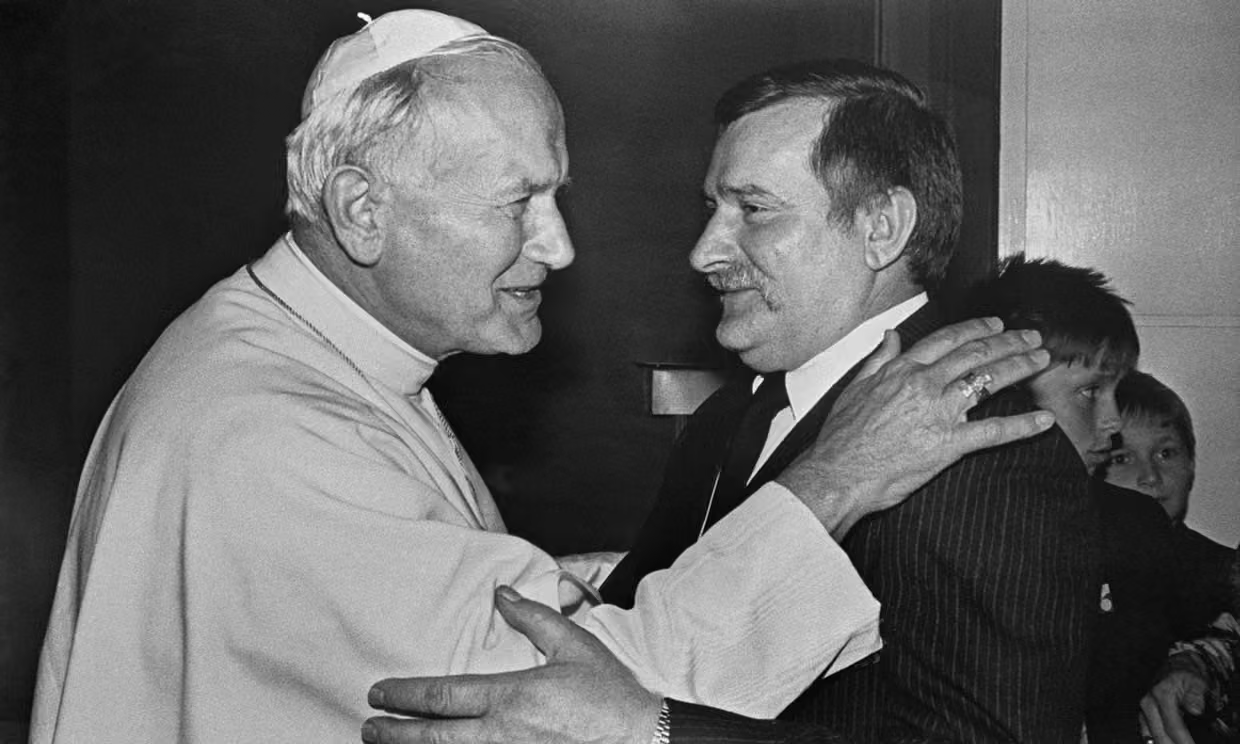
Soviet troops did not officially leave Polish soil until 1993, and though it is often understood as the end to a broader era of Soviet-style occupation (Mishtal, 2015), the process of democratization nonetheless took root in Polish society through a peaceful dismantling of the social system in favour of a nascent, pluralist democracy. The Solidarity Movement – a grassroots and intellectual movement facilitated largely by Polish labourers and intellectuals – played a foundational role in this transition, helping to contribute to the establishment of democratic norms and institutions in Polish civil society (Kubow, 2013). By the mid- to late-1990s, significant structural reforms had begun, including constitutional amendments, capitalist market liberalization, and institutionalization of free and fair elections, to “return” Poland to Europe. While political party fragmentation and political instability remained, these early years nonetheless laid an important foundation of democratic architecture.
Party politics continued to take shape into the early 2000s and the Polish Civic Platform (PO), along with the Law and Justice (PiS) party, emerged as influential parties in an otherwise pluralistic party system. As PO and PiS largely came to dominate the public discourse and party system, it became evident that social forces beyond democracy were beginning to shape the contours of governance in Poland. Poland’s accession to the European Union (EU) in 2004 consolidated its democratic transformation and was ultimately marked by broad public support, as 77.41% of Poles voted in favour of joining the EU during the referendum. A review of literature and public attitudes at the time, however, reveals how much of this enthusiasm stemmed from promises of economic growth and prosperity for everyday Poles by Polish elite (Cichowski 2000; Szczerbiak, 2002; Bielasiak and Blunk, 2002; Slomczynski and Shabad, 2003; Kurczewska, 2003; Hubner, 2004; Balcerowicz 2007; Sporek 2008; Kundera, 2014; Duch, 2017; Ambroziak, 2021; Michalek and Hagemejer, 2024; Wozbiak-Jechorek, 2024). Despite broad support, EU accession also brought to the surface bubbling tensions around issues of national identity, religion, the family, and the perception of Brussels’ influence over domestic law.
As skepticism of Brussels’ influence over Polish civil society deepened, nationalist and populist narratives gained traction, many of them rooted in the unresolved and unrecognized memory politics of the Soviet era following World War II. As political scientist Maria Malksoo highlights, Poland – like many other post-socialist Eastern European countries – has long navigated what has felt to be a contradictory position; since 1991, Poland and the Baltic states have taken up a curious post-Cold War foreign policy strategy consisting of a “combination of simultaneously seeking recognition from and exercising resistance to the hegemonic ‘core European’ narrative of what ‘Europe’ is all about” (Malksoo, 2009). This in-between position was mirrored in domestic politics, as fragmentation of the centre-right – itself a product of unresolved symbolic struggles inherited from the Solidarity era – created a political vacuum into which more hardline actors like PiS could consolidate power (Bill and Stanley, 2020). Fusing social conservatism with populist anti-elitism, PiS successfully recast national history as a tool of political legitimation and portrayed themselves as guardians of Polish sovereignty and identity against alleged liberal decadence and supranational control. The party pendulum would swing between PO and PiS from 2005 to 2015, before PiS eventually clinched a majority government in 2015, bringing with it a wave of political and institutional reforms that shook the democratic foundation of Poland.
Since 2005, every Polish President and Prime Minister who has assumed office has been a member of PiS or PO and since 2015, PiS has implemented a series of structural reforms that have significantly undermined Polish democratic institutions and norms. These include asserting political control over the judiciary by forcing judicial retirements, creating newfound disciplinary mechanisms for judges, and an overall weakening of judicial independence – prompting EU criticism for violating rule-of-law standards. PiS also expanded executive influence over media, curtailed human rights and civil liberties, and deepened ties with the Catholic Church, a relationship which some scholars have cited as responsible for Poland’s national abortion ban. Poles voiced their dissatisfaction through the parliamentary elections in 2023, wherein the newly elected PO government under Donald Tusk vowed to restore judicial independence, repair democratic institutions, and realign Poland with EU values. While Tusk’s pro-EU administration has made efforts to reverse PiS-era reforms, progress remains contested and slow, particularly as PiS continues to control the presidency and other key state institutions (Bill and Stanley, 2025; Markowski, 2024; Cadier and Szulecki, 2022). Nawrocki’s presidency, therefore, may mark a continuation of the broader institutional to-and-fro now largely characterizing Poland’s democratic landscape; as Polish media has reported, the 2025 presidential election “sharply divided” the Polish electorate. Although Nawrocki ran as an independent, his campaign was institutionally backed by PiS, due in large part to Nawrocki’s own alignment with the party’s brand of hyperconservative nationalism, populism, and strategic invocation of memory politics. On Friday, June 20, 2025, Prime Minister Donald Tusk called for an electoral recount, citing the narrow results: “[W]herever there is doubt, let’s count the votes again.” Just days later, Tusk faced leadership challenges of his own, narrowly surviving a vote of confidence by a margin of 239 to 210, and while the outcome of the vote reaffirms the Tusk government’s mandate, it also laid bare the deepening polarization now marking Poland’s institutions – possibly foreshadowing further political friction in the months and years ahead.
The Narrowing of Poland’s Jurisprudential and Juridical Horizon
In recent years, scholars reflecting upon Poland’s democratic backsliding have used a variety of terms to describe this transition; for the purpose of this article, it is easiest to understand Poland as a “hybrid regime.” Hybrid regimes, according to constitutional scholars Aleksandra Kubińska and Michiel Luining (2024), are largely characterized by the “skilful construction of a façade of democratic and rule-of-law standards.” This façade enables the consolidation of executive power while maintaining an effective veneer of constitutional legitimacy that satisfies minimal international obligations and rhetorical legitimacy at home (Kubińska and Luining, 2024). In Poland, this has been facilitated largely through the politicization of the Constitutional Tribunal (CT), along with the legal regulation of historical memory via what are commonly referred to as “memory laws” – both of which have been instrumental in constructing a hybrid regime under the guise of defending Polish identity, sovereignty, and “mnemonic security.”
In the simplest of terms, memory laws refer to the legislative acts and practices that institutionalize particular narratives of historical events, figures, and/or movements. Over the last ten to fifteen years, memory laws have proliferated throughout much of Eastern Europe, in large part a response to what scholars have called “mnemonic wars” – symbolic and increasingly, kinetic battles, over whose version of the past will shape present-day statehood, identity, and international status (Mälksoo 2015; Belavusau, Gliszcyńska-Grabias, and Mälksoo 2021; Ivangorodsky 2025). In the case of Poland, and its neighbour Ukraine, these confrontations evoke a sense of being caught between a rock and a hard place – trapped between conflicting, if not rivalrous, historical imaginations and political expectations of the past, present, and future world order.
The West and Russia each offer respective tales regarding the historical tenure of their state projects; in the West, the initial introduction of memory laws swept through Germany, France, and the rest of Western Europe in the 1990s, largely in an attempt to recognize the horrors of the Holocaust and to prevent such horrors from ever taking place again. While differentiating itself from the collapsed Soviet regime was not an explicitly stated goal by the West, such a result was nonetheless achieved. In contrast, Russia has demonstrated what has been described as “mnemonical positionalism”– that is, a strategy in which so-called “official” (state-based) memory is invoked to stabilize national identity, uphold power status, and justify overall international behaviour – be it benign or violent – under the guise of protecting historical truth (Mälksoo, 2021). In the Russian case, this most often takes place through the invocation of the so-called “Great Patriotic War,” (Великая Отечественная Война), delimiting the period of 1941-1945 (rather than 1939-1945) in order to divert attention away from the infamous Molotov-Ribbentrop Pact that resulted in the invasion and occupation of Poland.
It is thus in response to these competing memory orders that structure Europe’s broader socio-political fabric that Central and Eastern European (CEE) states, including Poland and Ukraine, invoke their own version of memory politics and mnemonic security narratives. As Mälksoo (2015) argues, memory orders are hierarchically structured regimes of historical representation that shape how state identities are recognized by others, evaluated bilaterally and multilaterally, and either recognized, validated, or marginalized within global civil society. Within this context, Poland and Ukraine seek to not only confront and challenge dominant mnemonic narratives – particularly those by Russia, who in many ways still perceives itself as the “continuator state” of the Soviet Union (USSR) (Malksoo, 2021) – but to also reassert themselves within the broader European memory order that continues to largely be shaped by (albeit, at times, reductive) narratives of historical justice and liberal-democratic identities. In Poland, a project of mnemonic revisionism has taken place in more recent years – particularly under PiS governance – where state actors have sought “to change elements of the current international memory order, including internal stratification” (Malksoo, 2021). In contrast, Ukraine’s own memory politics have largely been leveraged in support of a project of mnemonical self-emancipation – wherein an actor seeks to enter the global memory order “as a sovereign actor in the first instance in order to improve its international standing” (Malksoo, 2021). Since Russia’s invasion, this project of mnemonic self-emancipation has only accelerated and diversified (Malksoo, 2021).
Memory politics – and more specifically, modes of mnemonic security and governance – have a unique relationship with the law. Through a process of what Habermas (1981) originally identified as “juridification,” which refers to both “legal regulation of new areas, with conflicts and problems increasingly being framed as legal claims, and penetration of judicial ways of thinking and acting into new fields” (Magnussen and Banasiak, 2013), memory is institutionalized through top-down legal mechanisms that work to consolidate partial, situated historical interpretations into fixed, unalterable and uncontestable truths (Hartsock, 1998). As Nancy Hartsock and other critical epistemologists have argued, all truths are partial, emerging from the contextual, embodied standpoint one occupies; the juridification of historical memory, in this way, often disguises these contingent narratives as universal. Such an understanding of juridification opens the way for Bucholc’s (2022) critical account of commemorative lawmaking, which interrogates how political actors opportunistically assemble and manipulate a group or nation’s collective memory to consolidate power and authority.
Bucholc’s (2022) concept of commemorative lawmaking demonstrates how the process of juridification not only refers to the institutionalization of explicit memory laws but to the embedded, symbolic, and rhetorical dimensions of legal practices. Informed by Claude Levi-Strauss’s concept of ‘bricolage,’ Bucholc (2022) suggests that political actors engaging in commemorative lawmaking should be understood as bricoleurs, that is, as actors who are charged with selectively assembling fragments of collective memory into new legal and narrative configurations that serve present political needs and interests. Legal codes are crafted in pursuit of a coherent and universal truth; they are not, Bucholc highlights, engaged and reached through a process of dialogic collaboration: “A bricoleur does not act in compliance with any preconceived set of rules: she puts pre-existing items – things, signs, symbols, thoughts, ideas, and thinking patterns – together in new ways, putting them to any use as the current need dictates. A bricoleur is, by definition, an opportunist” (Bucholc, 2022). In this way, memory laws work in tandem with commemorative lawmaking, as laws are transformed into “means of memory politics by relating them to a certain memory apart from the normative content of the law and references to memory in the lawmaking process.” Bricolage is only one strategy through which commemorative lawmaking takes place; Bucholc suggests that strategies of “retouching,” which endow a particular person, event, idea, or institution with a confluence of meaning in order to “retouch” the figure or event in an “act of fairness and restoration of historical justice,” and “restylization,” which lends credibility and an “impression of communality” to bricolage and retouch, also support the practices of commemorative lawmaking. Together, these strategies have been increasingly employed by bricoleurs of a populist and ethnonationalist sentiment in both the Polish and Russian contexts; indeed, research in recent years has begun to take note of the intersubjective nature of Ukraine’s, Poland’s, and Russia’s mnemonic governance in the CEE region (Koposov, 2022;).
In Poland, the invocation of memory politics and practices of commemorative governance have been utilized by PiS since the early 2000s. In the case of PiS, such practices have not only served to protect against so-called external influence or manipulation of the EU but have also been effectively mobilized as a tool for internal consolidation of power via the intersubjective cultivation of civic trust. As Kubinska and Luining (2024) highlight, trust in hybrid regimes is incredibly malleable and contingent in the hands of populist state officials, who in many ways re-mould democratic institutions and norms to sustain a partisan, moral narrative that suits its project. This is especially evident, I argue, through the PiS’s transformation of its Constitutional Tribunal (CT) and broader attack on judicial independence.
Rather than treating trust as a shared, institutional responsibility, PiS is similar to other populist parties in its adoption of a political strategy of affective governance – by affective, I am referring to the strategies that target emotion, identity, and moral symbolism among a populace or community and simultaneously mobilized to cultivate a particular, often narrowed form of civic trust that ultimately upholds the moral and political order such a party desires to create. In cultivating this civic trust, PiS constructs a vision of the CT not as a neutral arbiter, but as a guardian of national Polish values. This framing taps into the affective reservoir of Poland’s collective political memory, wherein the CT was historically regarded as a crucial safeguard against Soviet influence and a pillar of Poland’s democratic transition from socialist rule after 1989 (Mishtal, 2015).
At the same time, civic trust is cultivated, distrust is strategically redirected outward, particularly toward supranational institutions like the EU and European Court of Justice. In “early-forming-hybrid regimes,” this intersubjective construction of trust and distrust is meant to capitalize on citizens’ discontent with democracy and channel pre-existing skepticism of rule-of-law institutions (Kabinska and Luining 2024) into a relation that enables the capture of democratic institutions, all while maintaining a façade of democratic legitimacy.
Interestingly, Kubinska and Luining are also among a growing collective of scholars who have recognized Poland’s 2020 abortion ruling – which effectively rendered abortion illegal in cases of fetal abnormality or life-threatening illness – as the critical point at which constitutional capture of the CT had succeeded. By signalling successful constitutional capture, the Tribunal can now be understood to operate within what Bucholc has described as a “narrowed jurisprudential horizon” – that is, a shrinking of the spaces in which law is interpreted, debated, and trusted as the legitimate sphere of democratic dialogue. According to Bucholc, a nation’s jurisprudential horizon structures the expectations and symbolic limits of what the law is to do and not to do; while a narrowing of the horizon does not necessarily equate a rollback of rights, in the case of Poland, it suggests that constitutionalism has been reoriented away from democracy’s pluralist foundations and towards what I describe as “moralized authoritarianism,” wherein a single moral worldview is privileged and institutionalized through top-down legal and political mechanisms that shape civil society and consequently, subject identities, foreclosing the space for democratic dialogue and pluralist legal reasoning. Under a regime or structure of moralized authoritarianism, memory laws can be understood to operate as disciplinary technologies that attempt to regulate public discourse and historical consciousness (Foucault, 1977). In a Foucauldian sense, they function not only to prohibit or punish, but to produce – authorizing a singular moral “truth” or narrative while otherwise rendering alternative or competing narratives “unintelligible” (Butler, 1989; 605) within the bounds of legal reason. In doing so, they shape not only what can be said about the past, but also who can be recognized as a legitimate subject of history and politics, aligning individual and collective identities within the state’s moral order.
It is against this legal, political, and mnemonic backdrop that Karol Nawrocki’s 2025 presidential victory ushers in a new phase of uncertainty for Poland’s democratic future and its broader role within the EU and the rules-based international order. While formally running as an independent, Nawrocki’s support and subsequent alignment with PiS – along with his previous leadership role at the Institute of National Remembrance (IPN) – signals, I suggest, a likely continuation, if not intensification, of memory-based governance. Nawrocki’s presidency also arrives at a critical geopolitical juncture: Russia’s full-scale invasion of Ukraine has not only destabilized the broader European security landscape by returning war to Europe, but also exposed the cracks forming in the transatlantic alliance – particularly amid wavering American commitments to Ukraine and growing fears over the future of NATO under the current Trump administration. In this context, the narratives Poland chooses to advance through law and public discourse – especially in relation to Ukraine and broader European security – carry heightened significance and worry. Central among these mnemonic tensions is the enduring legacy of the Volyn tragedy, a case of historical memory that continues to strain Polish-Ukrainian relations. Nawrocki’s presidency thus raises further questions about whether Poland will advance efforts towards historical reconciliation or return to a more ethnonationalist mnemonic posture – one that treats history as a moral battleground rather than a space for pluralistic dialogue aimed at reaching intersubjective truths.
The Moral Relationship between Poland, Ukraine, and Russia
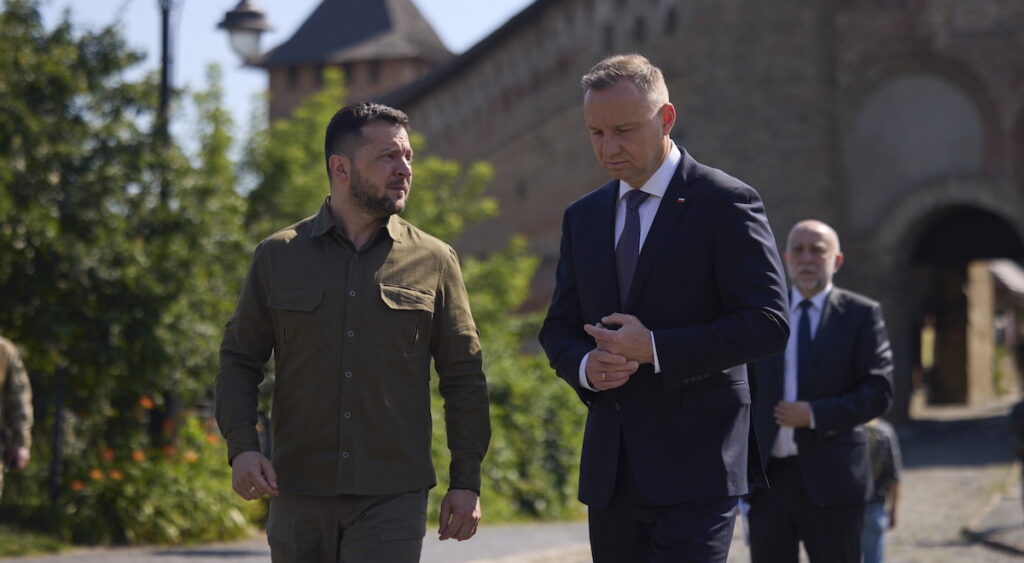
Despite the concerted efforts of democratic peace theorists (eg. Bruce Russett; John O’Neal; Michael Doyle), empirical evidence linking war and democracy remains both contested and limited (Holesch and Zagorski 2023). Despite this contested relationship, it can nonetheless be argued that war acts as an exogenous shock to a nation, often marking a “turning point” within the broader international security arena (Holesch and Zagorski 2023). Keeping in mind that democratic backsliding is not so much a radical departure from democratic norms, but rather the “irregular series of incremental actions resulting in a diminished form of democracy,” it is pertinent to consider how both the fatigue and fog of war may deepen or exacerbate issues of moral reasoning, civic trust, and mnemonic security.
At the time of writing, Poland currently stands as the second-largest recipient of Ukrainian refugees since Russia’s full-scale invasion began in 2022, second only to Germany. And while an approximate 994,180 Ukrainians currently reside in Poland as the war wages on, it is estimated that over 26 million border crossings have been formally registered from Ukraine to Poland (and 24 million from Poland to Ukraine) since 2022 (Kocyba et al., 2025). Many refugees temporarily return to Ukraine for medical treatment, property maintenance, to maintain family ties, or to collect essential paperwork necessary for their stay in Poland. Additionally, sustaining essential cross-border travel has become increasingly difficult for many Ukrainian refugees in Poland: according to recent UNHCR findings, the number of individuals encountering difficulties after returning from short visits home to Ukraine has risen sharply – nearly tripling over the past year. From losing legal protection and access to social support, to facing increasing uncertainty when attempting to re-enter, the UNHCR highlights Poland as an especially difficult context where these burdens are felt most acutely – underscoring how prolonged displacement is straining not only those forced from their homes, but on the systems and networks meant to sustain them.
Since 2005, Ukrainians have been officially recognized as a national minority in Poland. Following Russia’s annexation of Crimea in 2014, migration from Ukraine to Poland increased significantly, though most arrivals during this period were labourers and their families seeking improved living and working conditions. By 2021, census data recorded just over 80,000 Ukrainians residing in Poland. When Russia first launched its full-scale invasion of Ukraine in 2022, the Polish public quickly mobilized as they became a primary entry point for those fleeing Russian aggression (Kocyba et al., 2025). Official public statements were offered quickly by Polish officials; Prime Minister Donald Tusk, in his latter ascension to power, was similarly clear in his support of Ukraine: “I am not ashamed to use these big words: it is here, in Ukraine, that the world front between good and evil runs.”
On the ground, the practical burden of refugee assistance and support was largely shouldered by everyday Poles. As documented in After the Solidarity Wave, the Polish state had “no policies, strategies, capacities or resources to meet the rapidly unfolding situation,” leaving volunteers and grassroots networks to fill the void (Kocyba et al., 2025). Despite early February 2022 intelligence reports confirming the presence of nearly two hundred thousand Russian troops amassing along Ukraine’s borders, the shock expressed by global leaders and institutions underscores a broader failure of foresight and strategic judgment by both Russia and the West: the latter had underestimated Putin’s willingness to escalate in the name of mnemonic security, while the former had largely overdetermined its military capacity to subdue Ukrainian resistance. In the wake of this aggression, Polish civil society emerged as a de facto hub for displaced Ukrainians, offering critical support including medical services, housing, transportation, childcare, and other vital forms of humanitarian aid.
This surge of civic solidarity, however, is not without its limits. As the war grinds into its fourth year, so too has a growing sense of collective exhaustion for Poles and Ukrainians alike – a phenomenon that can be understood as the fatigue of war. Combined with increasing economic pressures and policy inaction, this fatigue is at risk of being exploited by ethno-populist nationalists in both states, wherein some political figures “whitewash the history of their countries persistently, forming a new type of memory laws that primarily shifts the blame for historical injustice to other states, [while also trying] to promote their own national narratives into the mnemonic space of the EU” (Ivangorodsky, 2025). In this climate, Nawrocki’s presidential win may not only be a product of this growing war fatigue, but also the simultaneous enactment of what can be described as ethnopopulist mnemonic governance. And while his “Poland first, Poles first” rhetoric may appear to echo the familiar tropes of some Western populists, it nonetheless draws from a distinct and historically-charged well of Polish and Ukrainian collective memory – one steeped in entangled pasts, wartime trauma, and contested narratives of gratitude and grievance, of falsity and truth.
The Volyn Tragedy (ie. The Volyn Massacre; the Volhynia Massacre; the Volyn genocide) functions today as one such space of mnemonic contestation and construction – a flashpoint where the politics of memory, security, and national identity collide. Nawrocki is one of several Polish politicians who regard Volyn as a case of ethnic cleansing and clear moral injury against the Polish people; indeed, as current-President Andrzej Duda affirmed in a letter marking the 75th anniversary of the tragedy: “No such crime can be silenced or omitted. It should not remain without moral judgment and condemnation, which I why we observe the National Day of Remembrance of Victims of Genocide by Ukrainian nationalists against Poles during World War II.”
In contrast, Ukrainian recollections of the violence of Volyn are marked by fragmentation, ambivalence, and deep entanglements with legacies of imperial and colonial violence. Between 1939 and 1941, following the infamous Molotov-Ribbentrop Pact, Eastern Galicia and Volhynia – territories that had been a part of the Second Polish Republic – were forcibly annexed by the Soviet Union. Initial reflections offered by Volodymyr Kubijovyč[1] suggested that the Red Army was “greeted sometimes with genuine joy” upon entering Poland by Western Ukrainian villagers (Kubijovyč 1963), but revisionist history highlights a broader sentiment of skepticism met their arrival, largely fueled by their own historical experience with imperial and great power violence:
Ukraine’s modern inhabitants are fiercely attached to their land… However, since the plain has always been the playground of power politics, the Ukrainians have rarely been allowed to control their destiny. In the twentieth century, they were repeatedly suppressed. Their short-lived Republic, which in 1918-20 served as one of the main battlegrounds for Russia’s Reds and Whites, was crushed by the victorious Red Army. They were victims of some of the Continent’s most terrible man-made disasters, and of wholesale genocide. Their casualties during the wars of 1918-2, the collectivization campaign of the 1930s, the terror-famine of 1932-3, and the devastations of the Second World War must have approached 20 million. Some among them, frustrated by their impotence in face of Russians, Poles, and Germans, and unable to reach the source of their oppression, stuck out in desperate violence against their neighbours (Davies 1996).
The annexation of eastern Galicia and Volhynia was accompanied by a subsequent dissolution of local institutions, widespread arrest and execution of Polish elite and intelligentsia, and the forced deportation of over a million people from the region by the Red Army, including Poles, Jews, and Ukrainians, largely to Siberia and Central Asia. In this way, the Nazi and Soviet occupations of Poland introduced increasingly violent regimes of social engineering, wherein the existing socio-political order and state structure was dismantled, interethnic distrust was sowed, and suppression of Polish and Ukrainian resistance carried out.
The cumulative disintegration of political and social order in Eastern Galicia and Volhynia – brought on by successive occupations, mass deportations, and competing imperial ambitions – laid the groundwork for the further interethnic violence that followed. From roughly 1943 to 1945, the Organization of Ukrainian Nationalists (OUN) and its armed wing, the Ukrainian Insurgent Army (UPA), carried out a coordinated campaign of ethnic cleansing against the Polish population of Volhynia and Eastern Galicia. Attacks were described as especially brutal, with entire villages razed and civilians – including women, children, and the elderly – killed en masse. It is estimated that between 40,000 to 60,000 Poles were killed in Volhynia alone (Scott, 2009; 6); an additional 20,000 are estimated to have been killed in Eastern Galicia (Motyka, 2006).
Though the OUN-UPA initially formed to resist both the Nazi and Soviet domination of the WW2 era, their campaign against the Polish population was nonetheless guided by an ethnonationalist vision of an independent Ukraine in the future – one free from perceived foreign interference and occupation. This vision was tied to a deeply held cultural attachment and historical belief that Eastern Galicia and Volhynia were Ukrainian land, of which had been subsequently subjected to policies of ‘Polonization’ under the Second Polish Republic. Thus, many Ukrainian nationalists at the time perceived the interwar (1918-1939) Polish state as a colonial power suppressing Ukrainian ways of life and knowing, further fueling intergroup dynamics of dispossession, grievance, and discord. In this context, territorial reclamation through violent means was not only perceived as strategic, but as a moral and historical righting of wrongs. As the Polish underground responded with retaliatory violence, including through later so-called “reprisal raids,” the region descended into a contained conflict spiral that has left permanent scars on the Polish-Ukrainian consciousness. Such a spiral did not reach its formal end until 1947, following the end of World War II, the Yalta and Potsdam agreements, and Operation Vistula (1947).
Internal UPA documents and subsequent historical accounts have pointed to an explicit strategy to “remove the Polish element from Ukrainian lands,” a pursuit that, while perceived by some as rectification of colonial subjugation, raises critical questions about how moral reasoning and justification is constructed, understood, and operationalized as it relates to conflict. Traditionally, such justifications have often relied upon what Margaret Urban Walker has termed a “theoretical-juridical model” of moral reasoning – a mode or framework that treats morality as a universally applicable, abstract system of codified principles that can be applied to issues or conflicts of morality as they emerge (Walker 2007). In such a framework, moral knowledge is imagined as separate from the lived realities of social life, accessible without empirical inquiry or mutualistic dialogue, and enforceable through juridical institutions that claim impartiality and moral clarity. As Walker notes, this model “typically universalizes and homogenizes ‘the’ moral point of view or position of ‘the’ moral agent, and traffics in claims of ‘our’ concept of responsibility, sense of justice, institutions, or obligations” (Walker 2007).
In the cases of Poland and Ukraine, ethnonationalist and populist narratives of mnemonic security in each respective hybrid regime have relied on a theoretical-juridical model of morality that ultimately “shrinks morality down to a kind of purified core of purely moral knowledge” (Walker 2007). This is felt most acutely in continued negotiations surrounding Volyn, where moral claims of historical injustice – be it assignments of responsibility, blame, or victimhood – are approached not in terms of mutual engagement and dialogue, but as fixed positions in a zero-sum moral quest. Yet, in light of renewed geopolitical urgency – marked by Russia’s full-scale invasion and Ukraine’s ascension to the EU – there is a growing imperative for both states to engage in strategic forms of mnemonic rapprochement. Such a shift will require more than the usual practices of diplomacy; it calls for a reorientation away from the familiar theoretical-juridical pursuit of moral closure toward approaches and practices more attuned to the intersubjective and dialogical nature of memory and responsibility.
Conclusion and a Path Forward
The memory of Volyn resists easy moral categorization; as Walker’s critique reminds, however, narratives as it relates to issues of morality and moral conflict are rarely, if ever, neutral. On the contrary, “our” sense of justice and responsibility is always embedded in the institutions, contexts, and power structures from which we arise, speak, and resonate within. Poland and Ukraine’s future navigation of the Volyn tragedy under a new Nawrocki presidency is likely to encounter serious challenges, as it stands to not only be a question of historical (in)justice and truth, but of resisting the overall flattening effects of mnemonic governance,[2] which recasts remembrance as a contest of moral dominance and certainty rather than a shared pursuit of pluralistic dialogue and ethical negotiation.
Flattening of mnemonic space works in favour of those wishing to benefit off the fog of war, which in this case, refers not only to the uncertainties and fatigue endured on the frontlines and battlefield, but the dizzying and obscuring effects of prolonged conflict and occupation on mnemonic processes and diplomatic negotiation themselves. Under these conditions, history becomes increasingly difficult to interpret in good faith: complexity risks giving way to urgency, nuance risks being eclipsed by desires for nationalist clarity, and pluralistic moral reckonings are exchanged in favour of singular, homogeneous state narratives. Political actors – may they be Nawrocki, or other foreign revisionist elite from Russia – can exploit such a political climate by engaging in ethnonationalist narratives of mnemonic security based out of the reductive theoretical-juridical model, which works in their favour by suppressing dissenting histories, voices, and foreclosing opportunities for reconciliation. Such an approach also aids in further entrenching division, recasting of victimhood, or absolving responsibility. In doing so, a discursive passing of the buck takes place, one which ultimately benefits aggressors, revisionists, or rising powers.
The theoretical-juridical model serves to reinforce mnemonic practices and processes of ethnonationalist governance by attempting to guarantee “uniformity in judgment and action both across cases and across agents, and [give] priority to the sameness and repeatability by regimenting moral consideration into fixed paths” (Walker 2007). In hybrid regimes such as Poland, the window through which these mnemonic practices and processes of governance are adjudicated has narrowed; on the other hand, at the time of this writing, President Zelenskyy’s move to sign a bill that effectively erodes the independence of Ukraine’s National Anti-Corruption Bureau (NABU) and the Specialized Anti-Corruption Prosecutor’s Office (SAPO) stands to construct a similarly reductive horizon as it relates to the jurisprudential and juridical practices within the country’s anti-corruption infrastructure. Such a narrowing, Bucholc reminds us, is a reflection of a state’s retreat from international legal interdependence – a rejection or circumvention of the shared foundations of the rule of law in favour of sovereign self-containment and self-referential legalism. In these cases, jurisprudence becomes a flattened and narrowed space, and when entangled with mnemonic processes and practices of governance (ethnonationalist or otherwise), works to consolidate state narratives that ultimately foreclose the space and opportunities for mutual intelligibility and pluralistic dialogue. And it is precisely here where Walker’s critique of the theoretical-juridical model comes to be especially relevant: by institutionalizing rigid paths of moral judgment and attempting to enforce epistemic (ideological) sameness across agents, it not only obscures the moral complexity of nuanced tragedies like Volyn, but when applied in such social-political and institutional settings, risk becoming bureaucratic and authoritarian (Walker 2007).
In light of Russia’s continued invasion of Ukraine and Ukraine’s wishes to join the EU, I have argued that a strategy of mnemonic rapprochement may need to take place between Poland and Ukraine. By mnemonic rapprochement, I am referring to the formation of a deliberate, dialogic process through which states work to reconcile conflicting narratives of shared and intersecting pasts – not by imposing a moral consensus from the top-down, but through the creation of a space where mutual recognition and intelligibility, differentiated memory, and pluralistic dialogue may take place. Such a process not only resists the flattening impulses of ethnonationalist memory politics but aligns well with what Walker has termed an “expressive-collaborative” framework for morality and moral thinking.
According to Walker, an expressive-collaborative framework of moral navigation reframes ethical judgment in the pursuit of justice as something grounded not in abstract moral principles and rules, but in lived, ongoing relationships that are negotiated, in constant flow, and transcend borders (Walker 2007). In this way, such a model captures the socio-political, interpersonal, and intersubjective features of morality that are left obscured by theoretical-juridical approaches. As Walker writes,
It permits us to know for what and to whom we will have to account when we have done or failed to do something, and what makes sense as a moral reason or excuse. It equips us to reckon failures and derelictions, to understand what can be repaired and what compensated, to assess the costs of choices in morality’s own currencies of integrity and appropriate trust… In doing so it makes us responsible to ourselves and others for the moral sense our lives make (Walker 2007).
Practically speaking, this approach is one that entails attending to relationships of accountability, responsibility, and trust as they are embedded in particular histories and institutions. Rather than codifying universal judgments, this model embraces dialogic processes where responsibilities are distributed, acknowledged, and negotiated across time, space, and agents. It asks critical questions: Who has been wronged? Who must respond? What does repair look like in this given context? In the mnemonic sphere, this may involve commemorations, recognition of differentiated memory, and cooperative truth-telling and truth-seeking processes that resist singular state narratives and instead foster mutual intelligibility. Ultimately, the goal is to work towards a shared future in which the historical past is not only recognized but actively engaged with as a site of mutual reckoning, ethical dialogue, and collective responsibility.
This brief has provided a modest overview of Poland’s democratic trajectory following the relatively peaceful collapse of the Soviet Union and broader socialist system. It highlights how in the Polish case, a democratic to-and-fro has taken place, largely between the PO and PiS parties. Under the PiS-led government, ethnonationalist governance has resulted in a narrowing of the juridical and jurisprudential horizon – a phenomenon which has not only contributed to the fallback of human rights and reproductive justice, but pushed the national needle towards moralized authoritarianism, in which a single worldview is privileged and institutionalized through top-down legal and political mechanisms, foreclosing the space for legalistic and democratic dialogue with others.
The foreclosing of the jurisprudential and juridical horizon is best understood as the result of a larger process of ethnonationalist and populist mnemonic governance; by leveraging a particularly reductive, top-down view of collective memory, PiS has sought to institutionalize a homogeneous and moralized narrative of history that legitimizes current political authority and control, restricts legal pluralism, and otherwise attempt to exclude those who do not wish to conform to the national script. Ukraine, on the other hand, encounters different but relational challenges of mnemonic governance within its own territory; while it strives to maintain political alliance with Poland and join the EU, it must also balance national politics of memory in such a way that reinforces its ontological security in the face of Russian aggression without alienating key allies like Poland – an increasingly complex task that may require strategic mnemonic rapprochement.
I have suggested that the Volyn tragedy stands as one such historic case wherein collaborative and strategic mnemonic rapprochement between Poland and Ukraine may need to take place. However, I have also argued that the dominant framework often used to approach such moments of moral and historical reckoning – what Walker refers to as the theoretical-juridical approach – is ill-suited to the complex context of Polish-Ukrainian dialogue over Volyn. This model, grounded in abstract universalism and codified moral principles and rules, imposes a top-down vision of justice that seeks uniformity and closure. As such, it continues to struggle to accommodate the moral complexity, historical asymmetry, and affective weight that mark the years and events of Volyn for Poles and Ukrainians alike. Rather than aiming to foster understanding, it risks entrenching binary narratives of guilt and innocence, flattening memory into state-based narratives that obscure the plural and relational nature of historical and political experiences – especially during conflict.
In contrast, Walker’s expressive-collaborative model of moral reasoning and practices offers a contextually sensitive and dialogically grounded framework. It repositions morality as something lived and negotiated through relationships – wherein responsibility is not fixed in solely legal statuses, but also traced through the histories of trust, betrayal, silence, and repair that mark historic conflicts. Applied to the politics of memory, such a model does not demand a singular historical account but instead remains an open space where differentiated memory and plural perspectives coexist. It encourages practices of attentive listening, recognition, trust-building, and negotiated accountability that can overall support the work of mnemonic rapprochement – especially in a time when regional security and democratic integrity are under attack.
Footnotes
[1] Importantly, Kubijovyč was a documented Nazi sympathizer and collaborator; he headed the Ukrainian Central Committee, a quasi-political organization under the Nazi occupation of Poland.
[2] I use ‘flattening’ in this context in a manner similar to Anna Carastathis – to speak to the discursive and political reduction of complex, intersecting histories and power relations into a singular narrative that erases contradiction, suppresses interstitial voices, and forecloses the possibility of plural, relational understandings of harm and resistance. For further reading, please see her work Anna Carastathis, “Basements and Intersections,” Hypatia 28, no. 4 (2013): 698-715.