Relationships. Mycelium. Human Connection.
Discussing Trans Resistence with Author and Storyteller Ivan Coyote: 2025-2026 Munro-Beattie Lecturer
By Sophie Drache and Erica Raley
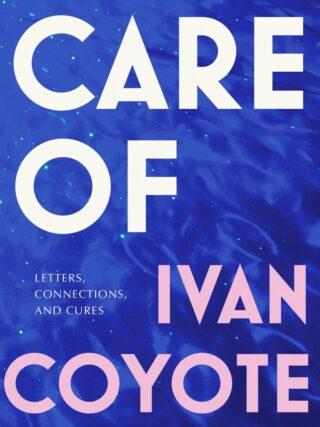
In preparation for the 2025-2026 Munro-Beattie Lecture on October 15th, students Sophie Drache and Erica Raley spoke with lecturer Ivan Coyote over the phone about trans relationships, censorship, and the power of storytelling in creating networks of resistance. Ivan Coyote is a writer, storyteller and performer. They have created four films, seven stage shows, three albums, and authored 13 books. Their most recent book published in 2021, Care Of, is a collection of correspondences between Ivan, fans, readers and audience members, co-authoring a story of relationality that Ivan says is essential in our modern political moment.
Interview
Sophie: So we know that you did your first writer-in-residence here at Carleton in 2007.
Ivan: I did, yeah.
Sophie: How do you think your path has led you back here to do this event?
Ivan: Oh, easy. Relationships. Mycelium. Human connection.
You’d have to ask Jodie [Jodie Medd, Professor in the English Department] how I first got on her radar, I think it was teaching English and I’d write short stories that are accessible. In 2007 … I get this email asking if I want to come [to Carleton] and it was like.. A paycheck for a self employed artist. I had left my job in the film industry in 2003, so I was still really having to hustle and it was just kind of like a paycheck. It was for, I wanna say, two semesters. Like 8 months. It was a paycheck for eight months and a chance to work at a university for a blue collar kid from the Yukon, whose mom wanted nothing more than me to be an academic. My mom’s side of the family lauded university education, that would be the ticket to not having to bust your back and knees and wrists and your shoulders.
My mom was like, “You have a chance to go work at a university? How amazing.” That was twenty years ago. Before the residency, Jodie asked me to come in and do a queer literary gig [Referring to “Wilde About Sappho” at the National Archives, through work with the Lambda Foundation].
…That’s how I started. Me and Jodie– I love her work, I love her approach, she’s passionate, she’s got skin in the game.
I walked into the English department and one of the things they kept saying [was] about my CV, my academic credentials, and I sent them my CV which is impressive, I’ve done a lot of stuff, even back then, I had a lot of books out. They were like, “Oh, we’re missing a page of your CV. Your education? Your academic credentials?” And I was like, “Um. I’ve got my grade 12 and my electricians ticket. I can write that down on a piece of paper and send it to you.”
Yeah, so it’s mycelium, it’s friendship, it’s relationship. It’s common working together for a principled cause and aligned moral values. And respect. Mutual respect, I think. Crazy artists need Jodies. There’s Jodies somewhere buried, usually underpaid, underappreciated, being micro-aggressed against, queer academics all across this country. We need each other right now. Look what’s going on, look what we said was going to happen all along if we allowed the continued march of facism… Ask any trans person, especially someone who has been trans their whole life, and knows what we’ve always been up against. I just didn’t think we were going to be strapped right to the front of the tanks. I didn’t realize how far under the bus trans people were going to get thrown.
Erica: Absolutely… Sophie and I are taking a graduate seminar right now with Jodie Medd about book banning, with a particular focus on LGBTQIA+ literature being targeted in North America, particularly in the States, but in Alberta recently as well.
Ivan: It’s endemic, we can’t just blame it on Alberta, it’s everywhere. We’re all Alberta right now. Make no mistake, vigilance is required. Carry on.
Erica: We’re curious about your particular experience with targeted censorship, have you experienced this over the course of your career and has it exacerbated in recent years?
Ivan: Oh yeah, of course. I don’t know if I’ve existed on a book ban list, but of course. Yes, since the beginning. It’s endemic, it’s homophobia.
Erica: My particular research interest is about creative ways of resisting modern censorship. How do you see means of resistance to this censorship developing? What does this mean for you?
Ivan: Way back in the day, librarians and teachers were photocopying a couple of pages of my books and handing it to kids. Because my books weren’t in the libraries at school. […] And then basically librarians and teachers came to me and said, […] “Could you please put together a collection of short stories and include this one, this one, this one, and this one, and try not to put any in that contain anal sex or marijuana use or underage drinking.” Not for the kids who are reading all of that, but for the parents who are going to be vetting probably only the queer book.
They’re not vetting anything that their kids are reading or consuming or living— but they will vet the queer book. I wasn’t being censored to make it accessible to youth, it was their parents who would be vetting it. It’s always been that way. This has always been happening. [In Nazi Germany] they destroyed an immense amount of data, our data, […] it was us writing ourselves down ‘cause nobody was interested.
But really, we’ve always [resisted] this, we’ve always done this and we’re going to continue to do it. Queer people and trans people will make and distribute.
We need to prepare for the apocalypse and make sure that there’s still a physical book when everything has crashed. We need to plan for a time when we need to go back to handing a piece of paper from one to another. We need mycelium, we need to create cultural mycelium. And we need to make it so that it is unburnable. And if we don’t we’ll just make new stuff and find each other again. We have always done this. Always.
Sophie: The [Munro Beattie Lecture] was in part founded to invite writers/thinkers who can really speak on current issues that will resonate with the public, so what does it mean for you to be invited this year and what do you hope guests at the lecture can leave with?
Ivan: Well hopefully they leave with a book.
I’m quite f–in’ old, and I have to crawl into my crawlspace and I got to go get books which are heavy and I have to put them in a pelican case so they don’t get damaged, which is heavy, and then I gotta get on a plane and I gotta hop across the country, because of mycelium. Because of this. Because I want to, not just speak to you, but I want to hear from and meet other queer and trans people and I want to pass them something and I want them to pass me something back.
People pass me letters and I collect them, that’s what Care Of is. And this is us, back and forth, this is us handing each other a piece of paper. Our story. This is my story, what’s your story? ‘cause that’s what we have to do right now.
So what does it mean to be asked? I get to come back to Ottawa, and guess who’s going to be there? A bunch of doctors, mostly young(er) than me, mostly immigrants from immigrant families, mostly brown, women of colour, doctors, who I met and did a keynote for and they’re bringing all their doctor friends to come and listen to trans stories because they’re trying to give better gender affirming care, while we still have it.
Erica: To end on a lighter note, what are you looking forward to in the next couple of months in terms of your career?
Ivan: My career? I hope in December to not get in an airplane. I’m hoping in December to have time to play guitar, sit in front of a wood stove, read. I really need to generate. I’ve been on a travel-travel-go-go-talk-talk-meet-meet-greet-greet-travel-travel-drive-drive. I can’t say where I’m going to be in two months; December I’m going to stay home. I am writing a memoir called This Won’t End Well about caring for my father with Korsakoff… but hopefully over the next months I’m not going to be thinking about my career, hopefully I’ll be thinking about my family and my life.
This interview has been lightly edited for length and clarity.
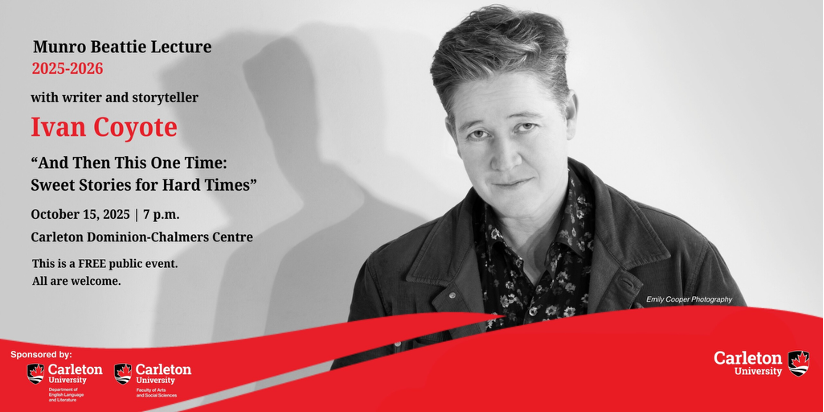
The Faculty of Arts and Social Sciences and the Department of English language and Literature invite you to the 2025-2026 Munro-Beattie Lecture at Carleton Dominion-Chalmers Centre on October 15th at 7 pm to see Ivan Coyote’s talk, “And Then This One Time: Sweet Stories for Hard Times.”