African Cinema, Memory, and the Work of Preservation
This story was originally published in the 2026 Faculty of Arts and Social Sciences Research Review.
For Dr. Aboubakar Sanogo, cinema is an archive of humanity that shapes how people, cultures, and nations understand themselves.
His research interests include African and Afro-diasporic cinemas, documentary film theory, history and form, transnational and world cinemas, film preservation and restoration, colonial cinema, early and silent cinema, and film festival studies.
Much of African cinema’s history remains unknown or undocumented, and the films most often studied today are
those screened at festivals, distributed internationally, or circulated beyond their countries of origin.
“There’s an immense ocean of films that never circulated and never left their own country, that were never seen beyond maybe one or two screenings. Some were never screened at all.”
“That must be accounted for properly in order to be able to really have a grasp of the further longevity of African
film history, the complexity of African history, and the interrelationship between different national contexts,” says
Sanogo.
Recovering and preserving this unseen history has become the driving force of Sanogo’s work over the past decade.
That commitment led to the African Film Heritage Project (AFHP), the initiative for which he is now internationally
known.
He says the AFHP was created in large part for African filmmakers and the larger African film community. Sanogo says many legacy creators in African cinema are insufficiently known in Africa itself. His hope is that African
filmmakers can be inspired by creative projects in their own neighbourhood.
“In other words,” Sanogo describes, “we have not yet succeeded in vanquishing the coloniality of film distribution
and exhibition.”
Across Africa, the preservation of cinematic heritage is undermined by a convergence of structural, financial, and political obstacles. Many countries lack dedicated film archives, stable funding for cinema, and adequate restoration facilities, placing existing collections at constant risk.
“Our projection is thus one of repatriating the African cinematic heritage in view of its reappropriation toward the creation of other African new waves, new movements, and bold cinematic and audiovisual experiments,” says Sanogo.
The AFHP also strives to expand the domain of cinema to include newsreels, documentaries, experimental and avant-garde works, short films, and even raw footage, so long as the material in question embodies important historical, cultural, and artistic elements.
Sanogo says the AFHP grew out of his role as North American Regional Secretary of the Pan-African Federation of Filmmakers (FEPACI), Africa’s leading filmmakers’ organization that was founded in 1970.
Through this, he launched the FEPACI Archival Project, an initiative devoted to the memory, preservation, and historiography of African cinema from each of the six regions of Africa: West Africa, North Africa, Central Africa, East Africa, Southern Africa, and the African diaspora.
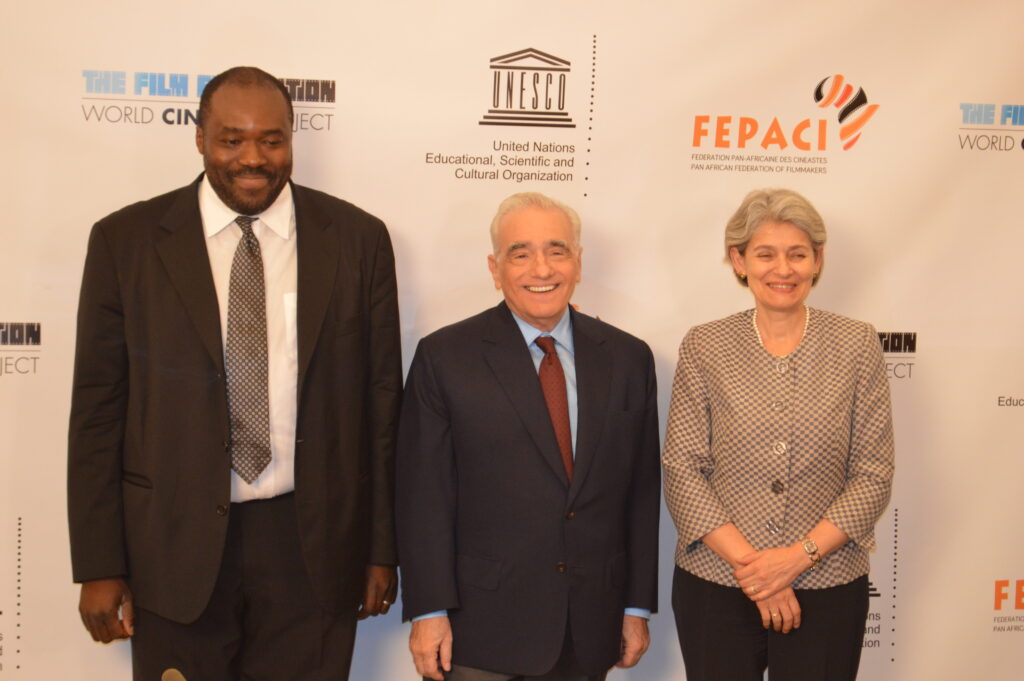
That work laid the foundation for a historic partnership between FEPACI, Martin Scorsese’s The Film Foundation, and the United Nations Educational, Scientific and Cultural Organization (UNESCO).
“It was important that within UNESCO the conversations were spearheaded by a branch devoted to the General History of Africa, a project which started in 1962 at the behest of African historians, who, in the wake of independence, sought to write a decolonized history of the continent,” Sanogo explains.
The General History of Africa (GHA) project emerged as a landmark counter-history initiative, bringing together founding figures of decolonial African historiography. Today, the project has reached its ninth volume, each spanning roughly a thousand pages.
Through this work, specifically the African Film Heritage Project, Sanogo was invited to contribute the cinema entry
to Volume 9, marking the first time the arts were formally included in the GHA.
This led to a formal partnership among three major institutions.
Meeting in Bologna, Italy, at Il Cinema Ritrovato, the world’s leading festival dedicated to restored and archival films, the group recognized a shared goal.
“We said, instead of you choosing what films count because you like them, we, as an African institution, should choose.” He says this partnership made way for an autonomy not previously held.
“This film preservation and restoration project is in part a historiographic project for us to acquaint ourselves with that history, and in the process to let Africans know about and be aware of that history, and beyond them, the entire planet.”
The collaboration was first launched at the 2017 edition of the Pan-African Film and Television Festival of Ouagadougou in Burkina Faso, and later in New York City, where the partnership agreement was officially signed at the Directors Guild of America in the presence of Scorsese and Irina Bokova, the Director General of UNESCO at the time.
Beyond UNESCO, Sanogo says cinema enshrines African cultural, political, social, and economic histories in film.
“It is an indispensable part of life as lived by Africans since they got involved with moving image technology, over 130 years of African cultural history and memory.”
Since launching in 2017, the AFHP has set out to restore and preserve set out to restore and preserve 50 African films of historical, cultural, and artistic significance from 1889 to 1989.
To date, they have restored 19 films from West, North, Central, and Southern Africa, and are working their way toward East Africa.
Sanogo describes the project as “a big alchemy and an important balancing act” with a particular focus on issues of
fragility in both human and technological aspects.
“We want to celebrate some of the pioneers that are still with us—some are in their 90s now, for example. Other times it is the fragility of the film itself that requires more immediate intervention.”
“Likewise, many significant films never received enough recognition when they were released, or some completely
went below the radar. We see it as our duty to bring attention,” says Sanogo.
He says this work continues to shape change and open space for forgotten histories.
“We are still locked in a kind of colonial epistemology, and this is part of what we are doing as well, to push backward colonial ways of misremembering world history,” Sanago explains.
“Film is one of the best messengers of peace in the world, of dialogue between cultures, regardless of political
dispensations and power differential. It is an indispensable cement of conviviality in the world, of shared emotions and memories; it should be, in fact, one of the most important instruments to unite humans as opposed to dividing them. That to me is the ultimate horizon.”
The AFHP recently restored a film by Haitian director Raoul Peck, and is currently working on restoring one of Afro-
Brazilian director Zozimo Bulbul’s works.
“The very existence of an African film preservation project is a decolonizing act, in the sense that it refuses to cede
the terrain of discourse projection, film historiography, theorizations, and aesthetics to a hegemonic regime still
largely informed by a colonial episteme,” says Sanogo.