Black Feminist Praxis and Engaged Anthropology
This story was originally published in the 2026 Faculty of Arts and Social Sciences Research Review.
“My work is the result of this ancestral legacy of love and struggle.”
This is Dr. Beatriz Juárez-Rodríguez’s origin story and the grounding principle of her scholarship. A political anthropologist in the Department of Sociology and Anthropology, her work grows from the relationships, histories, and embodied knowledge of the communities she is part of. It traces her commitment to Black and Afro-Latin feminisms, analyses of the racial state, historical memory, and collaborative methodologies to the people whose experiences and political creativity have shaped her understanding of justice.
When she reflects on what first guided her toward this field, she returns to the women who made that foundation possible.
“I would say that both I and my research are the result of the influence of Black women in my life,” she explains. “My aunts, grandmothers, teachers, activists and friends opened paths for me and believed that Black women have something to say that not only matters, but can bring about justice.”
That inheritance continues to guide her research, linking her early formation to the political struggles she studies across Latin America and beyond.
Juárez-Rodríguez’s work has long centred on Black women’s movements and the political demands they make in the face of state violence.
“Since my PhD, my research has centered on Black women’s organizations,” she says, although her academic engagement with social movements began earlier. During her master’s research in Venezuela, she worked with Afro-Indigenous communities resisting displacement caused by a dam construction project. In that context, state classifications as campesinos (rural agricultural workers) erased their identities as Black or Indigenous, sharpening her awareness of how racialized state policies shape everyday life for racially marginalized communities.
Her connection to these questions is also deeply personal. Her family is from the Barlovento region in Venezuela, an area shaped by its history of slavery and the hacienda system (large plantation-style estates established during the colonial period), and known for its strong Afro-descendant population and long traditions of resistance.
“I grew up surrounded by strong Black women who fought for their rights in everyday life, often outside of formal organizations.”
That early education in political struggle informed the ethnographic work she later conducted with Black women’s organizations in northern Ecuador, where women continue to challenge exclusionary state practices. Her research examines how they theorize their past, confront their present, and imagine their futures through anti-racist and feminist pedagogies.
For Juárez-Rodríguez, relationships are at the core of how she practices anthropology.
“For me, collaboration is not about balancing scholarly work with community needs, but about centering my teaching, research, and service on the voices and priorities of the communities I work with.”
Her scholarship moves in step with the questions and concerns of her collaborators, whether she is teaching, writing, or working across borders.
What this looks like in practice varies widely.
“It can mean mapping ideas together for a local political meeting, listening carefully to everyday experiences, or engaging in long-distance conversations about co-authoring a paper.”
These conversations often include the harsh realities of how the racial state continues to harm Black and Indigenous people, or the pain of losing friends and family members to state violence or treatable medical conditions. Collaboration can also mean responding to urgent needs, such as working with partners to design research and seek funding for projects related to sickle cell anemia, a condition that disproportionately affects Afro-descendant populations in Ecuador and reveals structural racism within the public health system.
The relationships Juárez-Rodríguez cultivates continue through the co-presentation and co-dissemination of knowledge, ensuring that her academic work supports, rather than extracts from, collective struggles. In her teaching, she asks students to scrutinize ethnocentric and technocratic notions of community engagement that reduce participation to a checklist. The question she poses is both simple and difficult: how can scholars support communities in their struggles, and when can they not?
Central to this approach is the notion of soberanía epistémica, or epistemic sovereignty. The concept affirms the legitimacy of knowledge rooted in lived experience, ancestral memory, and collective ways of understanding the world. It recognizes that communities hold intellectual traditions that do not rely on academic validation, shaping how Juárez-Rodríguez collaborates and how she understands the production of knowledge itself. It also provides the foundation for her work on memory, which she approaches not only as an object of study, but as a political practice.
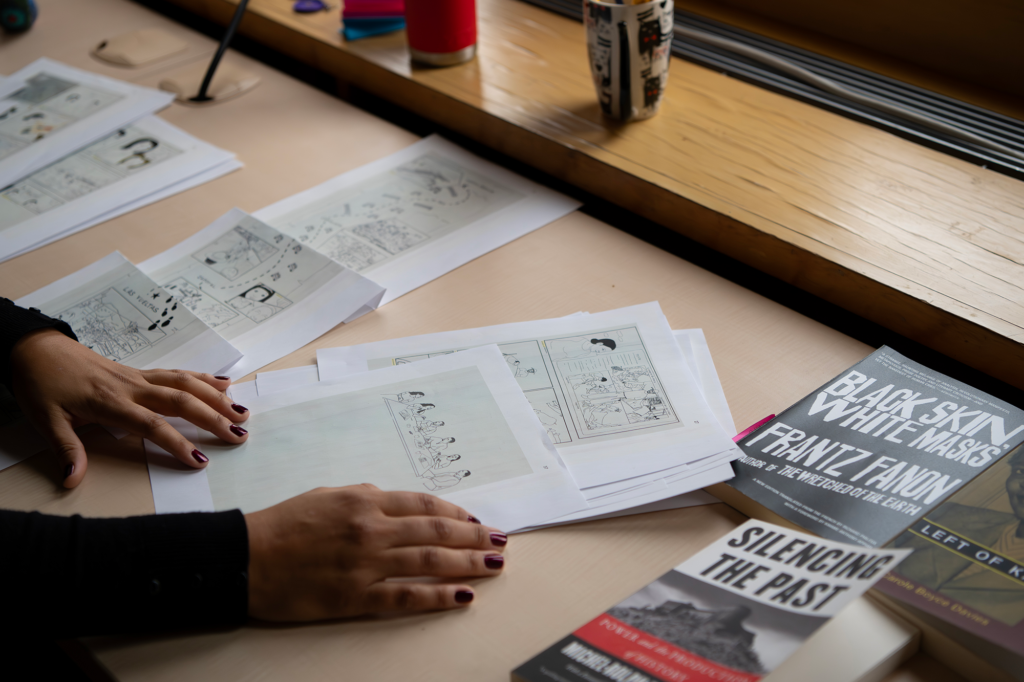
Memory threads through her work as both subject and strategy. Juárez-Rodríguez is a co-researcher on Surviving Memory in Postwar El Salvador, a SSHRC-funded partnership committed to documenting the Salvadoran Civil War through survivor perspectives. In collaboration with the community of Las Vueltas in Chalatenango, the project is producing a historical memory book that aims to revitalize, mobilize, and amplify local narratives, cultural practices, and collective actions silenced by official histories.
Her exhibition project, Voices in Ink, similarly explores how community-created comics carry memory across generations. Developed in partnership with Salvadoran collaborators, social leaders, and a Salvadoran-Canadian illustrator, the exhibition traces the creative process behind a community-created comic depicting Padre Bernardo’s role in the resettlement movement during the civil war in Las Vueltas.
“My hope is that students, broader audiences, and the Salvadoran diaspora can see themselves reflected in these stories,” she says, “and ask how art allows us to rethink the past, problematize the present, and imagine new futures.”
She is candid about her concerns with how community engagement is often treated as a technocratic requirement, but hopes the exhibition encourages a different conversation.
Across countries and political contexts, Juárez-Rodríguez sees resonant strategies of resistance.
“My answer may sound a bit romantic,” she says, “but I think it is important to highlight the beauty and love that are embedded in the madness of the world we live in.”
Whether speaking with survivors in El Salvador, Black women in Ecuador, or campesinos in Venezuela, she encounters strength, hope, and a radical belief that new futures are possible. Historical memory, she notes, remains a constant strategy in resisting interlocking systems of oppression.
“I also see a politics of joy and solidarity that transcends borders, alongside a radical understanding of the limitations of liberal democratic systems. These resonances remind me that resistance is not only about survival, but also about imagining and enacting alternative futures grounded in dignity, justice, and collective care.”
Much of Juárez-Rodríguez’s future work builds on her current research in El Salvador. She plans to extend this work to Ecuador and Venezuela, deepening her exploration of the intersections between comics, memory, and resistance. She is also developing new courses in political anthropology focused on Latin America and preparing a book on Black women and the racial state in Ecuador, with particular emphasis on ethno education.
Whatever direction her work takes, the guiding principle remains constant.
“My work continues to be inspired and guided by what my collaborators want and need,” she says. “That will always remain at the centre.”