Making Music More Inclusive
Music professor Jesse Stewart is the co-founder of “We Are All Musicians,” an organization dedicated to helping anyone make music, regardless of ability or experience.
This story was originally published in the 2026 Faculty of Arts and Social Sciences Research Review.
Dr. Jesse Stewart is an award-winning composer, percussionist, visual artist, researcher, and educator. He is also the founder of “We Are All Musicians” (WAAM), an organization launched in 2012 dedicated to providing opportunities for individuals and groups to make music regardless of ability or experience.
Through WAAM, Stewart has collaborated with diverse communities including people with disabilities, seniors with Alzheimer’s, and children and adults from low-income backgrounds.
He says the creation of We Are All Musicians sparked from a request made by the National Capital Commission in 2009 to create an interactive sound installation for Canada Day celebrations in Ottawa.
The result was something he called the “Junk Funk Sound Cube,” an open eight-foot cube made of aluminum scaffolding that supported various recycled items as makeshift percussion instruments.
“People would come to the cube, pick up mallets, and join in improvised music making. Literally thousands of people of diverse cultural, gender, linguistic, and age backgrounds participated, some for two minutes, some for two hours.”
“No one ever told anyone else what to play, and yet the music always felt cohesive and inclusive. Until I realized it wasn’t.”
He set up the sound cube for the third and final time in 2011. At one point, a group of people in wheelchairs approached.
“It was not until that moment that I realized that by designing the cube to be played by people standing up, I had excluded a whole segment of society. I felt quite bad about that, and it got me thinking about ways of making music more broadly accessible.”
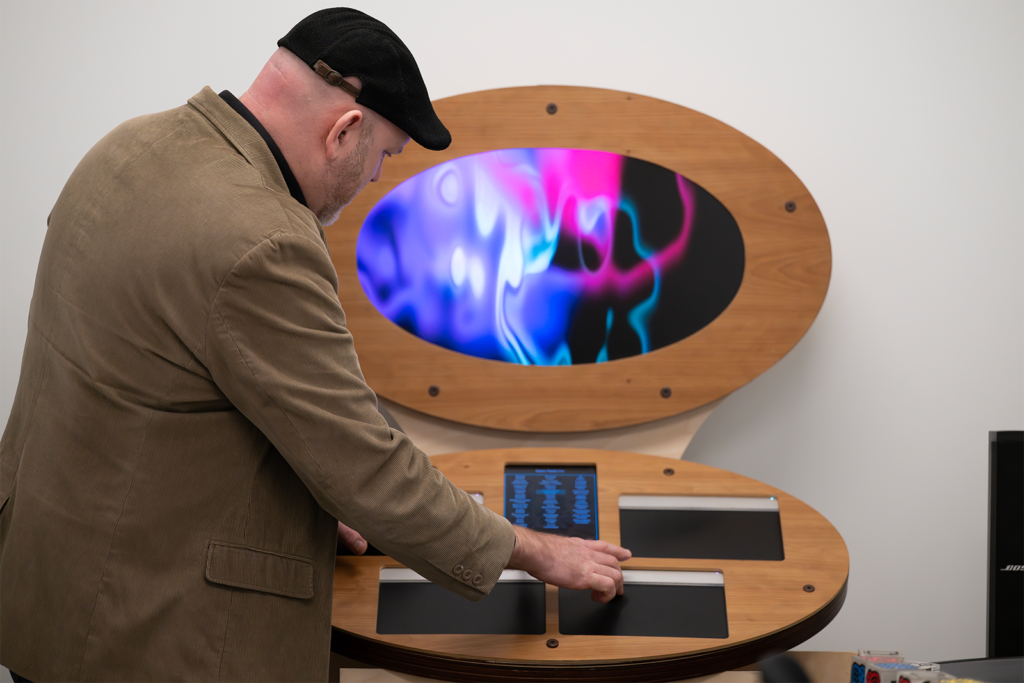
WAAM uses a variety of adaptive musical instruments that are modified or custom-designed to accommodate different abilities and needs. Some of these are movement-to-music technologies that translate movements — even very slight movements — into sound.
One such technology is the Adaptive Use Musical Instrument or AUMI, a project with which Stewart has been involved for almost two decades.
Using a built-in webcam on an iPad or iPhone to track movement and trigger different sounds, the AUMI has been a useful tool in the WAAM toolbox because it can adapt to any range of motion. It has a zoom function that allows it to track movements ranging in size from eye blinks to a room full of people.
Usually, AUMI triggers digital samples drawn from a wide range of sample libraries. However, in recent years, Stewart has been using it in a new way: instead of triggering digital samples, it detects motion and sends corresponding electronic impulses to mechanical strikers attached to acoustic percussion instruments, often gongs of various sizes.
Stewart uses this system in a variety of contexts, including a complex care hospital and a children’s hospice where many of the patients have very limited motor control.
“My sense is that for people with extremely limited mobility (in some cases, just the movement of their eyes), it is exciting to use that movement to play an acoustic instrument and participate in group music making. I think there is a sense of agency and accomplishment that goes along with that.”
Stewart, who has given talks and published writing on the subject of music as a fundamental human right, often cites Articles 19 and 27 of the UN Declaration of Human Rights: “Everyone has the right to freedom of opinion and expression” and “everyone has the right freely to participate in the cultural life of the community. “It’s even more important that we put those ideals into practice, which is what I try to do through the WAAM project,” says Stewart.
Along with a new project involving online group music making for adults with dementia and their caregivers, WAAM has partnered with the Community Music Schools of Toronto to develop a sample pack of recordings of “ludophones,” brightly coloured percussion instruments from France.
The sample pack is slated to be released early in 2026.