Spotlighting FASS Researchers in Trans and Queer Studies
By Emily Putnam
At Carleton’s Faculty of Arts and Social Sciences (FASS), student researchers are reshaping how we understand representation and relationships through work that is grounded both in scholarship and lived experience.
Through projects that examine topics on queer retellings of classical texts and the ethics of empathy within alternative kinship networks, students like Matthias (Matty) Grosser and Simon Turner are challenging long-held assumptions in literature, film, and culture.
Their work highlights the power and consequences of the stories we tell, offering new ways to think about identity, community, and solidarity in a rapidly shifting social landscape.
Rethinking Representation
Matthias (Matty) Grosser completed his BA in English at Carleton and has started an MA in English where he’s completed an essay on The Song of Achilles.
“I’ve always been particularly interested in the way that literature affects the lives of the people that read them, and the ways that their creators channel their own lives into these fictional spaces,” says Grosser.
He says he found his focus while writing an essay in his first-year course on Sexuality Studies.
“The essay dealt with representation, which I think set the stage for my research interests going forward. I was fascinated by the realization of how much life influences representation, and how representation in turn influences life in a never-ending cycle that can, in certain cases, have pretty disastrous effects.”
Grosser says he was drawn to this type of research because of his own self-discovery of his gender identity and sexuality.
“Fiction helped me deal with those things long before I even became consciously aware of them, and when I did come to the eventual realization of my transness, reading helped me learn how I wanted to present myself to the world in that capacity.”
“Even to this day, books help me refine my thinking and understand new ways of thinking about a myriad of things, including my identity (because identities are never static, and always have the potential to change),” says Grosser.
He says he chose to analyze The Song of Achilles because of its reputation as one of the most popular queer texts of our contemporary period.
“I wanted to know if there was anything to be found in the comparison of these texts that could hint at modern conceptions of sexuality/relationships. I guess you could say that I went into it completely blind—none of my prior education had touched on anything to do with Ancient Greek sexuality, nor had I ever actually read The Song of Achilles before.”
Published in 2011, “The Song of Achilles” is a modern retelling of the ancient Greek myth surrounding the Trojan War, primarily narrated by Patroclus, the companion and lover of Achilles. The novel explores themes of love, honour, and the complexities of fate against the backdrop of war.
“It became clear to me that this book was an incredibly heteronormative version of the original work. While the novel is good when read in isolation, I am quite surprised that it seems to be touted as a great work of queer literature when there is, arguably, nothing all that queer about it in the first place.”
Grosser says the most important reason to question these frameworks when reading classical texts is the ability to grasp how social constructs can change across time and place.
“By taking a step back when analyzing differing social formations of desire/identity, it allows us to see how our own systems are created through the observed differences, as well as similarities, that our own social systems have with those of the ancient world.”
He says he’s looking forward to more research being done in this field.
“I think literature is one of the most important ways in which lives, especially the lives of those who are different from us, can be communicated, understood, and absorbed.”
“It’s my hope that by working through the sociocultural understandings of gender diversity as they are expressed in fiction, both by other trans people and not, we can slowly start to raise the limits that force trans people, fictional and real, into easily-digestible boxes.”
How Stories Shape Identity
PhD student Simon Turner’s research scrutinizes the ethics of empathy by analysing narratives depicting kinship outside normative, nuclear family structures.
It centers on narratives concerning queer, trans, Black diasporic, and/or disabled people and combines a variety of American, British, and Canadian literary and film texts that span the past century.
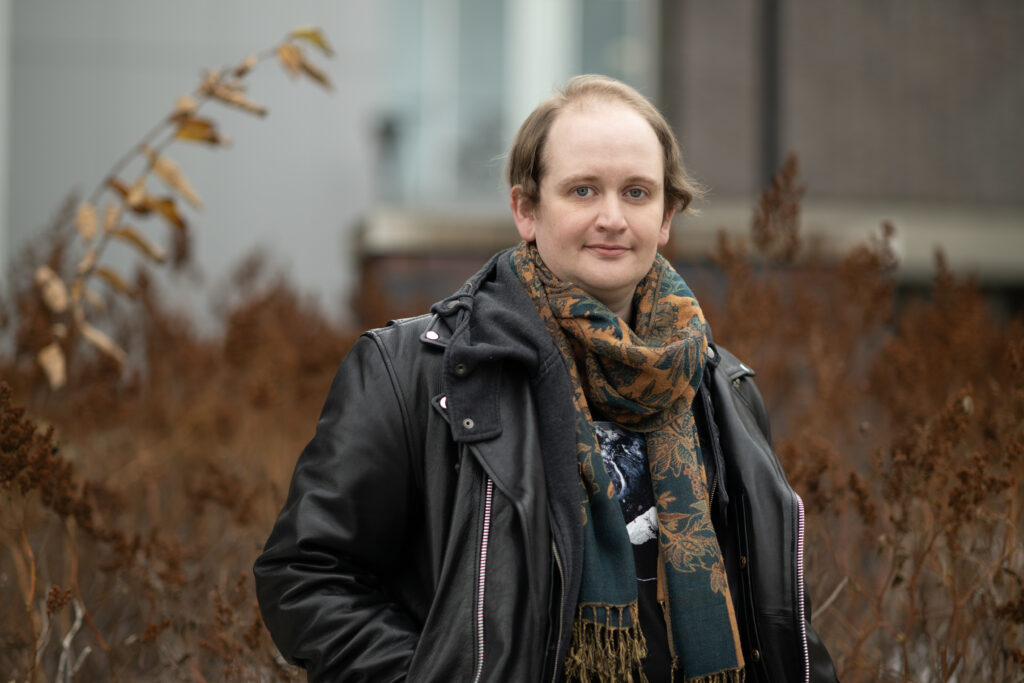
“I use these as case studies to parse the potentials and pitfalls of empathetic engagement, driving towards a particular interest in how empathy can ground political solidarity versus us marginalized folks ensconcing ourselves in identitarian bubbles,” says Turner.
Turner’s forthcoming publication discusses 1991 film The Silence of the Lambs and its relationship to determining transgender (non)identity.
Directed by Jonathan Demme and based on the novel by Thomas Harris, the American suspense film features Clarice Starling, a young FBI trainee recruited to interview Dr. Hannibal Lecter, a cannibalistic psychiatrist imprisoned at a hospital for the criminally insane.
Turner’s argument concerns the way both Jonathan Demme’s movie and Thomas Harris’ original novel disavow the trans identity of Jame Gumb (Buffalo Bill).
Turner says characters Hannibal Lecter and Clarice Starling assert that “Billy’s not a real transsexual” and that “transsexuals are passive types”, or in other words, not prone to violence.
“What I find fascinating about this is that Harris and subsequently Demme are working against the grain of the trans killer trope in the horror or mystery genres. Yet, in circumventing a kind of pop-culture transphobia, they instead lean on the transphobia of medical and legal institutions that gatekeep trans identity,” says Turner.
“The FBI literally tracks Gumb down by relying on John Hopkins Hospital’s list of rejected gender-affirming surgery applicants!”
He says medicolegal gatekeeping during this period was extreme.
“If a woman couldn’t ‘pass’ – and I’m talking before she had access to any prescribed hormone therapy – then she was barred from care. Diagnoses of mental illness and violent criminal histories also meant that a person couldn’t possibly be trans,” says Turner.
“And this is the discourse, these are the criteria, that The Silence of the Lambs uses as the basis for invalidating Gumb’s self-identification. Lambs sidesteps one type of transphobia only to reinforce another.”
They explain the connection between the film and the evolution of trans discourse, drawing attention to the broader ways narratives can shape identity, such as the normalization of the “wrong-body” narrative for trans identity.
“I think that today, not only does that history matter, but how Lambs illuminates discourses on who is and who isn’t really trans, or really a woman, provides a case study from which to reflect on how those discourses have evolved, and how we continue to struggle with an impulse to define who is ‘legitimately’ trans.”
“We all need to reflect on our own preconceptions and biases about gender. Even if the thrust of my argument is in one direction, the forthcoming chapter is also about the urge to define an identity in general and the harm this can cause,” says Turner.