History Students Create a Living Archive
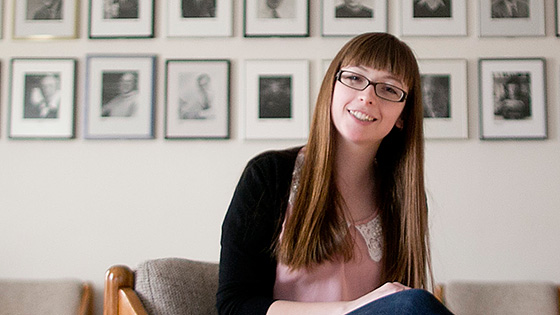
A group of 17 Carleton history students are gearing up to document the memories of local residents who grew up in neighbourhoods near the university.
Led by history professor John Walsh, students will be conducting “life course interviews” focusing on the childhood, youth and early adulthood of the participants, ideally people who grew up in the Glebe or Old Ottawa South, between 1945 and 1990.
Along with the interviews, the students will be collecting visual culture such as photographs and asking the subjects to draw maps of their neighbourhood from memory, including places they remember being important to them.
“One of the things that’s been interesting to us already in talking to people during the pre-interviews, is where they think their neighbourhoods are. It’s not as simple as what’s on a map,” says Walsh. “Those senses of place have their own sense of boundaries and edges.”
Once the research is collected, the students will use it for a variety of projects, with one student already planning to collaborate with songwriters on a musical endeavor. The research will then be organized into a digital database that will be archived, curated and built upon by future public history students.
“We don’t want to conduct interviews for papers that will just sit around and collect dust,” explains Walsh. “We want these things to have a real life.”
Kathryn Boschmann, a graduate student working on the project, says that oral history is important because it gives a voice to people who may not always be represented in traditional approaches to research.
“Oral history has introduced all sorts of really interesting challenges to history, in terms of memory and how memory plays a role,” she says. “I love it because it gets to everyday people’s stories. There’s something so fascinating about how people think about the past and how they tell their stories, and how those stories are so important to people and relationships.”
One of the ideas Boschmann might explore during her research is how children go from place to place in their neighbourhoods.
“We’re talking a lot about mobility as a child – how you get from one place to another, whether you can run down a street and knock on your friend’s door to go and play, where you go without your parents, biking, and that sort of thing,” says Boschmann. “That’s getting to be really interesting to me and will also play into when we’re doing the maps with them.”
Meanwhile, Walsh hopes the experience will open up new ways of approaching research and thinking about the past to his students.
“One of the things I’m hoping students will take away is the possibility for historical work that doesn’t just involve sitting and looking at text or even looking at images,” he says. “It also involves talking to people and working with what we call ‘living archives,’ that is, with people very much in our own present.”
“You hope a course like this shows them the possibilities for their own storytelling, for their own senses of place and where they’re from, and to tell how important those stories and memories are,” he adds.
Students will begin work on their projects in March, and they will become available online at the end of the school year in April.
Story by Kayla Wemp, for Carleton Now, Carleton’s monthly community newsletter.