Shawn Graham
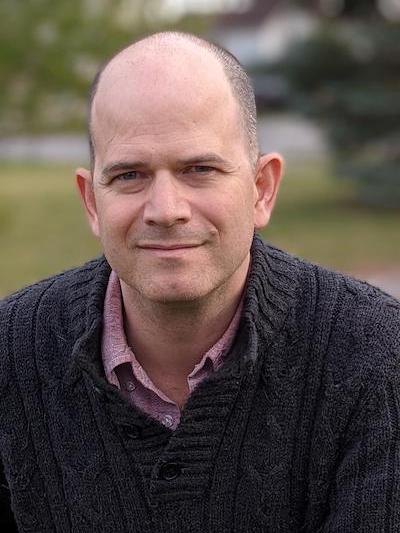
Professor – Digital Humanities methods; Digital media for exploring & representing Archaeology and History; Computational Creativity
- BA Hons (Wilfrid Laurier University); MA, PhD (University of Reading, UK)
- Email Shawn Graham
Shawn Graham trained in Roman archaeology but has become over the years a digital archaeologist and digital humanist. In 2016 he won a Provost’s Fellowship in Teaching Award and was designated a Carleton University Teaching Fellow. His most recent SSHRC Insight Grant project was called ‘The Bone Trade: Studying the Online Trade in Human Remains with Machine Learning and Neural Networks’, which culminated in a major study with his collaborator Damien Huffer, These Were People Once: The Online Trade in Human Remains and Why It Matters. He was part of the multi-institution SSHRC Partnership Grant funded project, ‘CRANE: Computational Research in the Ancient Near East’ led by Tim Harrison of the University of Toronto. Graham’s sub-project involved using neural networks to complete archival photographs for photogrammetric reconstructions. Most recently, he and his collaborator at the University of Maastricht, Dr. Donna Yates, won a SSHRC Insight Development Grant to explore knowledge graphs and the antiquities trade (which have enabled them to spot hitherto unknown episodes in the trade). Graham also recently launched the XLab: Cultural Heritage Informatics Collaboratory.
He keeps an open lab notebook of his research and experiments in digital history and archaeology at his research blog, www.electricarchaeology.ca. He was on sabbatical 2023-24, and used some of that time to contribute to the International Space Station Archaeological Project (ISSAP) . His MA Student Chantal Brousseau contributed to that project by overhauling an open source image annotation platform to serve as a collaborative archaeology recording system. ISSAP won the New Directions Award from the AAA and the Award for Outstanding Work in Digital Archaeology from the AIA. Graham was second author on the ISSAP project’s report on the first archaeological field work ever done in space, and devised many of the analytical methods used in that landmark study.
He is founder and editor of the open access journal, Epoiesen: A Journal for Creative Engagement in History and Archaeology. He abandoned Twitter for Mastodon-powered Scholar Social; follow his feed here. He awaits the inevitable enshittification of BlueSky.
Books
An Enchantment of Digital Archaeology
An Enchantment of Digital Archaeology: Raising the Dead with Agent-Based Models, Archaeogaming, and Artificial Intelligence is an exploration of the use of computation in archaeology as a kind of magic, a way of heightening the archaeological imagination. Agent-based modelling allows archaeologists to test the ‘just-so’ stories they tell about the past. It requires a formalization of the story so that it can be represented as a simulation; researchers are then able to explore the unintended consequences or emergent outcomes of stories about the past. Agent-based models are one end of a spectrum that, at the opposite side, ends with video games. This volume explores this spectrum in the context of Roman archaeology, addressing the strengths, weaknesses, and opportunities of a formalized approach to computation and archaeogaming.
Failing Gloriously
Failing Gloriously (open access) documents Graham’s work ”… through the digital humanities and digital archaeology against the backdrop of the 21st-century university. At turns hilarious, depressing, and inspiring, Graham’s book presents a contemporary take on the academic memoir, but rather than celebrating the victories, he reflects on the failures and considers their impact on his intellectual and professional development. These aren’t heroic tales of overcoming odds or paeans to failure as evidence for a macho willingness to take risks. They’re honest lessons laced with a genuine humility that encourages us to think about making it safer for ourselves and others to fail.”
His teaching explores historical methods and digital history at all levels, including seminars in the collaborative MA Digital Humanities program, as well as in the MA Public History program.
The Historian’s Macroscope
Graham co-wrote ‘The Historian’s Macroscope‘, a handbook to big data in digital history, for undergraduates with Ian Milligian (Waterloo) and Scott Weingart (Carnegie Mellon). The Second Edition was published in 2022 with Kim Martin (Guelph) as a new author.
The open access version of the first edition, along with supplementary materials, may be viewed at http://themacroscope.org. The volume has been translated into standard Chinese.
Dr. Graham’s github code repository is here.
Course Trailers
Undergraduate Critical Making in Digital History Course HIST 3812
Graduate Seminar in Digital History
FORVM, a board game about Ancient Rome
Research & Supervision Interests
- Computational Creativity for History & Archaeology
- Machine Learning and Neural Networks
- Open Access Pedagogies
- Digital Public History & Archaeology (especially landscape)
Current Graduate Students
- Scott Coleman. Ph.D. Byzantine History
- Kavita Mistry. Ph.D. AI ethics in Archaeology/Public History
- Corey Safinuk, Ph.D. Video games and Public History
- Jihad Baayoun, Ph.D. Ubisoft and Public History
- Sadie Cann, MA
- Madeline Dejonge, MA
- Sophie Miliner, MA
Dr. Graham would be pleased to consult with graduate students of any stripe concerning the digital aspects of their work.
Past Graduate Supervisions
- Katherine Davidson, Ph.D. Anthropology. “Long, Long Time Ago”: Collaborative Engagement with Indigenous Descendant Communities in Ontario through Object Elicitation Davidson won the Senate Medal for Outstanding Academic Achievement
- Michael Carrier. M.A. History with Digital Humanities ‘The Greco-Roman Historians & Their Geographic Mentalité : Word Embeddings to Investigate the Imagination of Space in Representations of the Early Roman Republic‘.
- Liran Assaf. M.A. History with Digital Humanities ‘Computational Approaches To Art Crime Resarch: Network Analysis And The Case Of Ante Topić Mimara’
- Chantal Brousseau. M.A. History with Data Science. ‘Metadata in the Margins‘. Brousseau won the University Medal for Outstanding Graduate Work – Master’s Level
- Noah Chapman. M.A. History with Digital Humanities ‘Engines of Agency and Affect: A Model for Interactive Histories’.
- Callum McDermott. M.A. Public History with Digital Humanities
- Jaime Simons. M.A. Public History with Digital Humanities ‘Remixing The Ottawa’
- Cassandra Crane. M.A. Public History with Digital Humanities ‘Remembering Dianna Boileau: Towards A Trans Ethos Of Care In Canadian Public History’
- Cristina Wood. M.A. Public History with Collaborative MA in Digital Humanities “Songs of the Ottawa: A Sonified Environmental History of the Changing Riverscape from the Chaudière Falls to Kettle and Duck Islands, 1880 to 1980”. Co-supervisor with Joanna Dean. Wood won the University Medal for Outstanding Graduate Work – Master’s Level
- Hollis Peirce, History MA with Collaborative MA in Digital Humanities Academic Accessibility: A Case Study of Carleton University, 1942 – 2019
- Matt Dodds, History MA, on data mining the Old Bailey Online.
- Danny Guay-Bélanger, Public History MA, on video game preservation.
- Rob Blades, Public History MA, on soundscapes and memory in Pembroke Ontario.
- Peter Holdsworth, Public History MA, on social networks analysis, public memory, and commemoration.
Undergraduate Thesis Supervisions
- Ryan Pickering 2015/16 The Historical Consciousness of Dwarf Fortress
- Hollis Peirce, Entangled with Books:Two Moments In the Evolution of Accessibility and the Notion of Universal Design blog. 2014/15
- Allison Smith, Digital history and Black History in Canada 2013/14
- Zack Battist, Feasting in the Bronze Age & Social Networks Analysis 2012/2013
Honours and Awards
- 2025 Teaching Achievement Award: The DHPrimer Project
- 2019 Archaeological Institute of America, Award for Outstanding Work in Digital Archaeology for the Open Digital Archaeology Textbook Environment
- 2016 Provost’s Fellowship in Teaching Award
- 2013 Desire2Learn Innovation Award in Teaching and Learning, Society for Teaching and Learning in Higher Education
- 2012 Educational Development Centre Carleton University Excellence in Teaching with Technology Award
- 2010 Leadership Award, Grand Canyon University
- 2006 1st Digital Humanities Workshop Awardee, University Nebraska Lincoln
- 2005-6 1st Postdoctoral Research Fellow in Roman Archaeology, University of Manitoba
- 2004-9: Member of the Institute of Field Archaeologists, UK
- 2003-11: Register of Professional Archaeologists, North America
Current Digital Projects
- The XLab The Cultural Heritage Informatics Colaboratory – Funded via a 2023 Canadian Foundation for Innovation John R. Evans Leaders Fund award and a 2021 Carleton Multidisciplinary Research Catalyst Fund Award.
- The New Organigram Project: A Macroscopic View of the Illicit Antiquities Trade – SSHRC Insight Development Grant
- The Bone Trade: Studying the Online Trade in Human Remains with Machine Learning and Neural Networks – SSHRC Insight Grant
- Computational Creativity and Archaeological Data – SSHRC Partnership Grant
Select Publications
2024. Walsh, J., S. Graham, A.C. Gorman, C. Brousseau, and S. Abdullah. Archaeology in space: The sampling quadrangle assemblages research experiment (square) on the international space station. report 1: Squares 03 and 05 PloS one 19 (8), e0304229
2024. Davidson, K., S. Graham, and D. Huffer. A Protocol for When Social Media Goes Private: Studying
archaeological or heritage discourses in closed Facebook groups, Internet Archaeology 67. https://doi.org/10.11141/ia.67.11
2024. Yates, D., and S. Graham. ‘Reputation laundering and museum collections: patterns, priorities, provenance, and hidden crime’ International Journal of Heritage Studies, 30:2, 145-164, DOI: 10.1080/13527258.2023.2284740
2023. Huffer, D., and S. Graham. These Were People Once: The Online Trade in Human Remains and Why It Matters. New York: Berghahn Books
2023. Graham, S., D. Yates, A. El-Roby, C. Brousseau, J. Ellens, C. McDermott. ‘Relationship Prediction in a Knowledge Graph Embedding Model of the Illicit Antiquities Trade’ Advances in Archaeological Practice 11.2: 126-138
2022. Graham, S. An Enchantment of Digital Archaeology: Raising the Dead with Agent-Based Models, Archaeogaming and Artificial Intelligence. New York: Berghahn Books.
2022 Graham, S., D. Huffer, and J. Simons. ‘When TikTok Discovered the Human Remains Trade: A Case Study’ Open Archaeology 8.1: 196-219.
2021 Graham, S., and J. Simons Listening to Dura Europos: An Experiment in Archaeological Image Sonification Internet Archaeology 56. https://doi.org/10.11141/ia.56.8
2021 Huffer, D., Guerreiro, A., Graham, S. Osteological Assessment of a Seized Shipment of Modified Human Crania: Implications for Dayak Cultural Heritage Preservation and the Global Human Remains Trade Journal of Borneo-Kalimantan 7.1: 67-92.
2020 Graham, S. An Enchantment of Digital Archaeology: Raising the Dead with Agent-Based Models, Archaeogaming, and Artificial Intelligence. New York: Berghahn Books.
2020 Graham, S., Huffer, D., Blackadar, J. Towards a Digital Sensorial Archaeology as an Experiment in Distant Viewing of the Trade in Human Remains on Instagram. Heritage 3, 208-227.
2019 Failing Gloriously and Other Essays Grand Forks: The Digital Press at the University of North Dakota
2019 Al-Azm, A, K. Paul with contributions by S. Graham. ‘Facebook’s Black Market In Antiquities. Trafficking, Terrorism, and War Crimes’. Athar Project. http://atharproject.org/wp-content/uploads/sites/37/2019/06/ATHAR-FB-Report- June-2019-final.pdf
2019 Huffer, D., C. Wood, S. Graham. “What the Machine Saw: Some Questions on the Ethics of Computer Vision and Machine Learning to Investigate Human Re- mains Trafficking”. Internet Archaeology 52.5 DOI: https://doi.org/10.11141/ia52.5
2019 Graham S., S. Eve, C. Morgan, A. Pantos. “Hearing the Past” in K. Kee and T. Compeau (eds). Seeing the Past. Ann Arbor: University of Michigan Press. Pp. 318-331.
2018 Lawall, M. and S. Graham. “From Sherds on the Ground to Dots and Lines on a Screen: Moving from the archaeological record of Aegean amphoras to simulations of networks,” in J. Leidwanger and C. Knappett (eds.), Networks of maritime connectivity in the ancient Mediterranean: Structure, continuity, and change over the longue durée, Cambridge. Pp 163-183
2018 Huffer, D. and S. Graham. Fleshing out the Bones: Studying the Human Remains Trade with Tensorflow and Inception, Journal of Computer Applications in Archaeology 1(1). DOI 10.5334/jcaa.8.
2017 Huffer, D., and S. Graham. The Insta-Dead: The rhetoric of the human remains trade on Instagram Internet Archaeology 45.5 https://doi.org/10.11141/ia.45.5.
2016 The Sound of Data. The Programming Historian.
2015 Graham, Milligan, and Weingart. Exploring Big Historical Data: The Historian’s Macroscope London: Imperial College Press.
2015 ‘The Equifinality of Archaeological Networks: an Agent-Based Exploratory Lab Approach‘ Journal of Archaeological Method and Theory 22.1 248-274.
2014 ‘Rolling Your Own: On Modding Commercial Games for Educational Goals’ in K. Kee (ed.) Pastplay: Teaching and Learning History with Technology. (Ann Arbor: University of Michigan Press). 214-254.
2014 K. Kee and S. Graham, ‘Teaching history in an age of pervasive computing: the case for games in the high school and undergraduate classroom’ in Kevin Kee (ed) Pastplay: Teaching and Learning History with Technology. (Ann Arbor: University of Michigan Press). 337-366.
2013 Graham, S. and I. Milligan. ‘Review of MALLET, produced by Andrew Kachites McCallum‘ Journal of Digital Humanities 2.1.
2013 Graham, S., G. Massie, Nadine Feuerherm. ‘The HeritageCrowd Project: A Case Study in Crowdsourcing Public History’ in Jack Dougherty and Kristen Nawrotzki (eds.) Writing History in the Digital Age. (Ann Arbor, MI: University of Michigan Press). 222-232.
2013 ‘The Wikiblitz: A Wikipedia Editing Assignment in a First Year Undergraduate Class’ in Jack Dougherty and Kristen Nawrotzki (eds.) Writing History in the Digital Age. (Ann Arbor, MI: University of Michigan Press). 75-85.
2012 Arya, A., P. Hartwick, S. Graham, N. Nowlan. “Collaborating through Space and Time in Educational Virtual Environments: 3 Case Studies.” Journal of Interactive Technology and Pedagogy 2.
2012 Graham, S., S. Weingart, I. Milligan. ‘Getting started with Topic Modeling’ in W. Turkel and A. Crymble (eds) The Programming Historian 2.