Former Irish president Mary Robinson joins young climate leaders for conversation at Carleton
As climate change competes with economic, political and global pressures for public attention, former Irish president and UN climate justice leader Mary Robinson joined students, faculty, senators and environmental leaders at Carleton University on Nov. 4 to discuss climate justice, political action and the role young people can play in shaping the future.
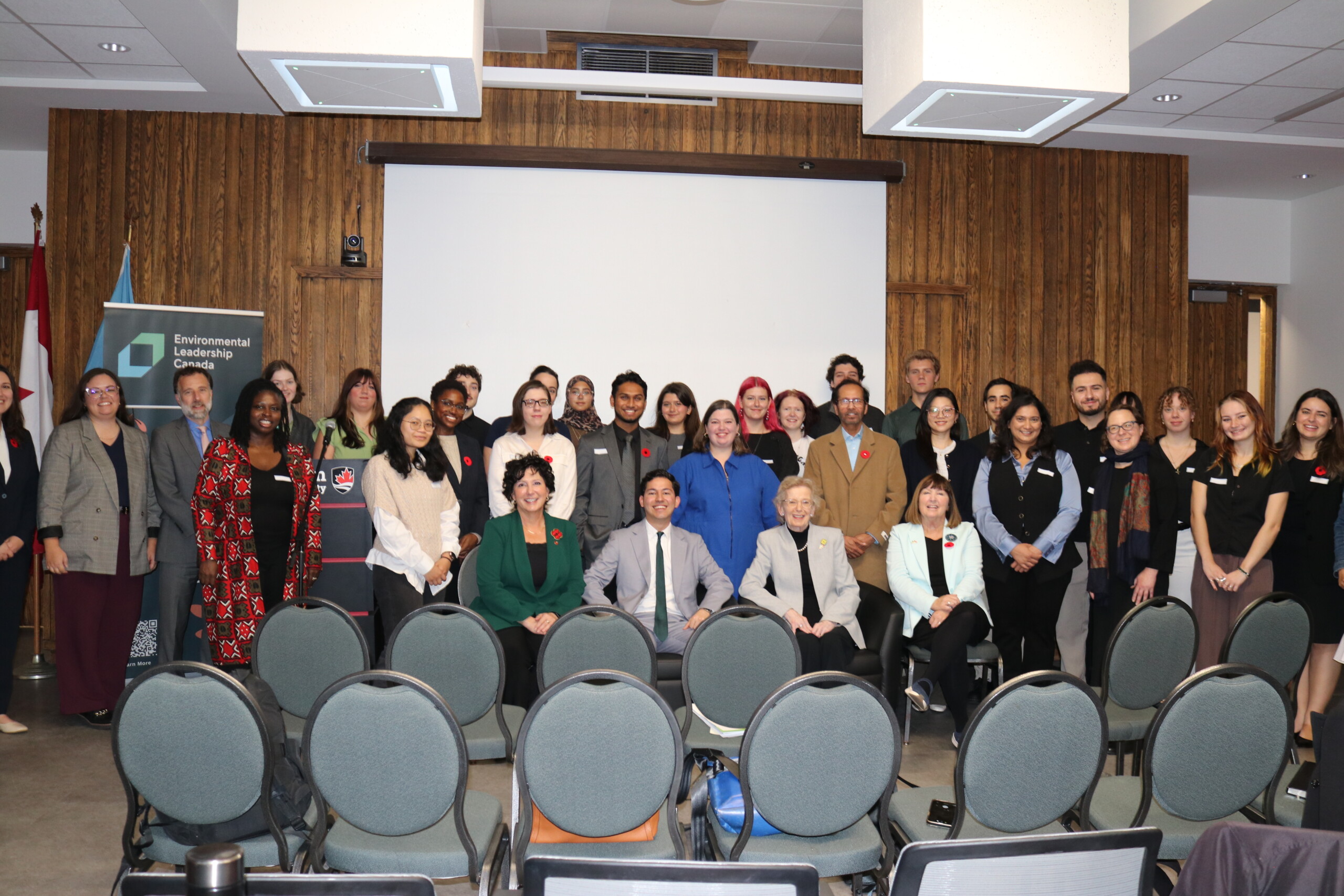
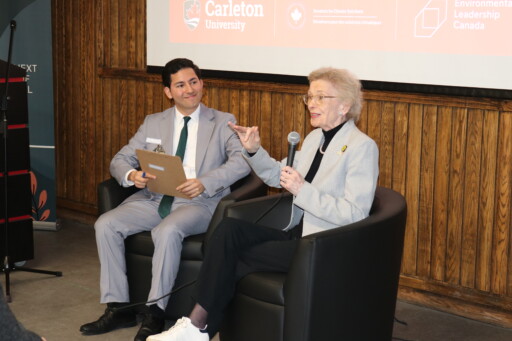
Through Youth in Conversation with Mary Robinson, students and youth from Carleton, Environmental Leadership Canada, the University of Ottawa and the Ottawa Centre Environmental Youth Council were able to ask Robinson directly about the climate challenges their generation will inherit. In a conversation led by Diego Arreola Fernández, a parliamentary intern with Environmental Leadership Canada, Robinson made clear she had come to hear from them.
“I want to listen to people whose lives are ahead of them,” Robinson said. “My generation failed to deal with climate change and the generation after mine also failed.”
Robinson, the first woman elected as president of Ireland, later served as UN high commissioner for human rights and the UN secretary-general’s special envoy on climate change. She told participants that her understanding of climate justice developed while working on economic and social rights in African countries, where she saw communities already experiencing severe droughts and flash floods.
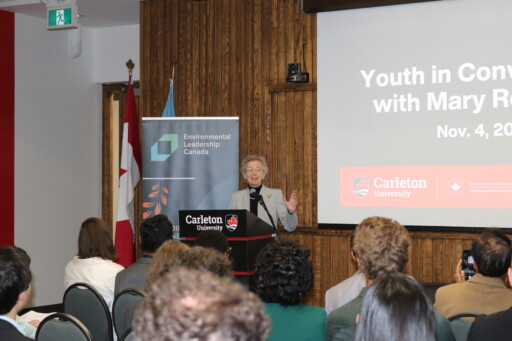
Climate injustice, she said, has several dimensions, including the disproportionate impact on poorer countries and communities, the unequal burden on women and Indigenous Peoples and the long-term consequences for younger generations.
Young people put their questions forward
Participants asked Robinson who should help countries experiencing some of the worst effects of climate change, how governments can keep climate high on the political agenda and how those working for climate action can sustain their efforts over decades. They also asked what young people’s voices can accomplish in climate policy and where those voices are most needed.
Robinson called for greater international support to help vulnerable countries adapt to climate change. She emphasized that adaptation funding is essential to helping communities withstand impacts they are already facing.
“The global system is not providing support that reflects the injustice,” Robinson said. “Countries that contributed very little to climate change face some of its worst impacts.”
She also challenged governments to move beyond international commitments and develop concrete plans for reducing dependence on fossil fuels. For young people, she said, that means continuing to press political leaders for action and demanding a place in the decisions that affect their future.
Senators Mary Coyle of Nova Scotia and Tracy Muggli of Saskatchewan, co-chairs of Senators for Climate Solutions, joined the session. Coyle spoke to the opportunities and the need for youth voices through last year’s Canadian Youth Climate Assembly, which brought 33 young Canadians to Ottawa to develop climate recommendations for Parliament.
Referring to this Assembly, Robinson said, “Your youth citizens’ assembly was an important step. It produced a collective voice and strong recommendations. The next step is to continue the dialogue and ensure that young people are present on panels and in decision-making spaces.”
For students at Carleton, the conversation with Robinson brought those broader questions of representation and responsibility into sharper focus.
“What stood out was the disconnect between those making decisions and those living with the consequences,” said Nicole Lee, a student in Carleton’s Norman Paterson School of International Affairs (NPSIA). “Climate action should be measured by the commitments governments make and by whose lives and experiences those commitments protect.”
Keeping climate change on the agenda
Robinson’s visit built on an ongoing partnership among Carleton through the efforts of Elisabeth Gilmore, Associate Professor at NPSIA and Environmental Engineering and Expert Advisor to the Provost on Climate Change and Sustainability, Senators for Climate Solutions and Environmental Leadership Canada to engage young Canadians in climate policy and broaden public discussion about climate action.
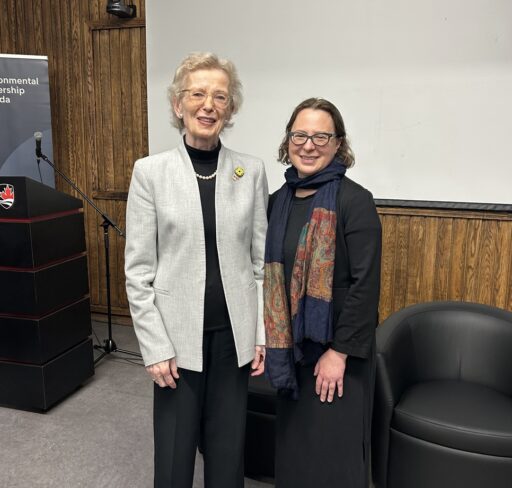
Robinson emphasized that keeping climate change on the political agenda means making it part of everyday conversation, while focusing on collective solutions rather than fear.
“Climate should be an everyday conversation, not so that people constantly worry, but because solutions exist,” she said. “The central question is what we are going to do together.”
In Robinson’s view, universities can contribute by developing credible research and information, building partnerships with communities and creating opportunities for students to help shape decisions that will affect their futures.
Turning concern into action
Acting on climate change can take many forms, from participating in decision-making to making everyday choices and working collectively.
“Students can seek out opportunities to make their voices heard in decision-making but change also comes from the choices we make every day and from working with others toward a common goal,” said Jaee Nikam, a Carleton civil and environmental engineering student. “By getting involved in climate initiatives, we can help amplify our own voices and those of others.”
Robinson ended the conversation with a lesson she learned from Archbishop Desmond Tutu, who described himself not as an optimist but as a “prisoner of hope.”
“As young people, work in community, work with us prisoners of hope and make the change we need,” Robinson said.