StoryMap: Access to Obstetrical Care Across Canada
Carlee Ridley, Tomoko McGaughey, Paul Peters
What do we know? Rural obstetrical care in Canada has limited local access, meaning many women must travel, sometimes over two hours, to give birth. Care is often provided by fewer specialists and more family physicians, and services vary widely between communities. These gaps can affect outcomes and reflect that rurality is a key social determinant of health. There are fewer obstetrical specialists in rural areas, so care depends heavily on family physicians and limited staff, which affects consistency of care.
What do we want to know? We want to know whether access to rural maternity care has improved since 2011, how to reduce travel and service gaps, and whether some maternal health risks and deaths are preventable with better access and resources.
How does it affect people? Limited access to rural OB care can lead to worse birth outcomes, increased stress, and financial strain due to travel. It also impacts overall health because rurality acts as a social determinant of health, affecting both mothers and newborns. Long travel times can lead to delayed care, emergency deliveries, and higher stress, which can affect outcomes.
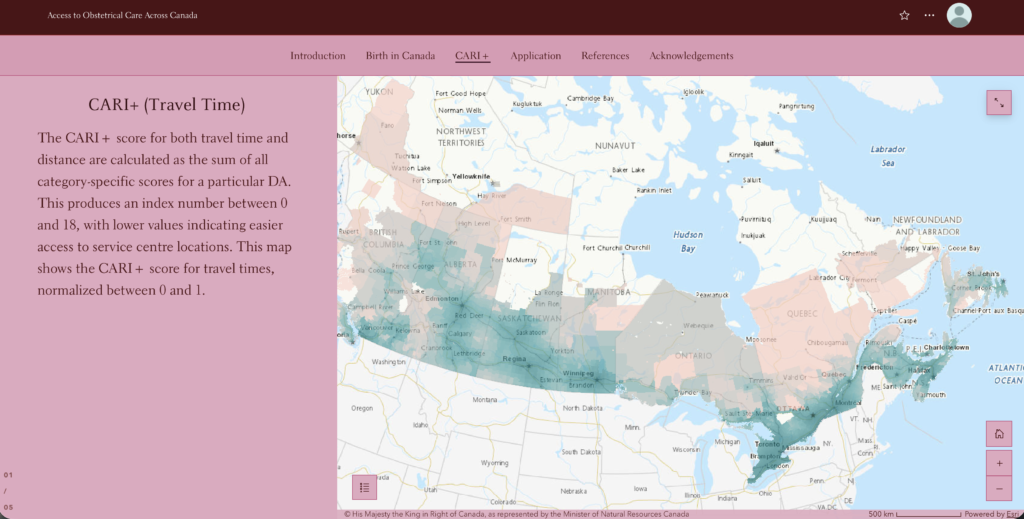
ArcGIS StoryMap
An ArcGIS StoryMap is a web-based digital storytelling tool created by Esri that combines interactive maps and 3D scenes with multimedia content—like text, photos, audio, and video. It allows anyone to build immersive, visual narratives without needing prior GIS (Geographic Information System) experience.
View the complete ArcGIS StoryMap at: https://storymaps.arcgis.com/stories/be39cea7b75d4b6ca6287ed3f63e6c49.