Carleton English Student Shares Her Co-op Journey
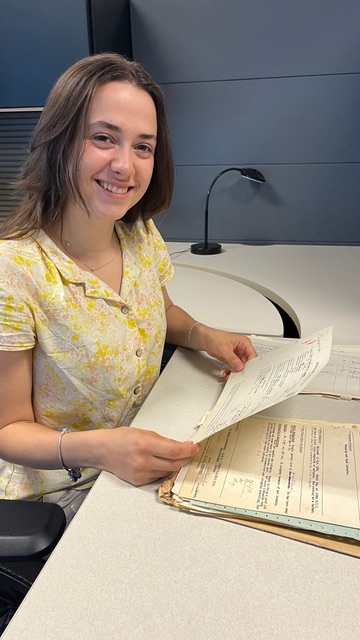
My name is Ayla, I’m an undergraduate English student at Carleton University, and I’m currently finishing up my three-term Co-op experience. When I first began, I thought I would be working ‘English-specific’ jobs like technical editing or working as an intern at a publishing house. Now, towards the end, I’ve learned that the skills I’ve built during my degree have allowed me to contribute meaningfully in a variety of professional environments: the Kanata North Business Association, Library and Archives Canada and Hydro Ottawa.
Kanata North Business Association (KNBA)
It comes as a surprise to some that as an English major, I spent the first of my three Co-op work terms immersed in technology.
My first placement was with the Kanata North Business Association (KNBA). The KNBA represents the 540+ member companies which are in Kanata North Tech Park—a designated business improvement area.
One of the major events that I helped to plan was the Annual Technata Hackathon. The event focused on sustainability and invited students from Carleton, the University of Ottawa and Algonquin College to participate in group mentorship and problem solving. Planning the event was a test to my time management skills, which were luckily already quite strong from balancing assignments in university. From organizing the catering to organizing the participants and mentors, I learned how to juggle not only my own time and expectations, but others’ as well.
One of the highlights from this event was interviewing the participants, mentors and sponsors, whose responses I used to write an article on the event. In my degree, the lectures and materials have always invited discussion. The interpersonal skills acquired through these discussions allowed me to interview confidently and effectively. This article led to my favourite project of the work term, which was organizing and editing the KNBA’s annual publication TechTalk. This magazine was printed and distributed at the annual partner’s summit, and it included my article on the Hackathon.
For a few of my written deliverables, I was asked to write on topics which I was not familiar with, featuring ‘up-and-coming’ technology. One such instance was when I was asked to write a blog post on semiconductors, which was meant to kick-start Chip Month (October). I didn’t have a clue what a semiconductor was, and up until this point, would have guessed it was some kind of semi-truck. However, my degree has helped hone my research abilities. After asking a friend in engineering to explain the concept, reading through various articles and publications and asking AI to help simplify the topic, I was able to write a blog post explaining the ‘what’ and ‘why’ of a semiconductor.
Working in the Kanata North Tech Park, I learned how versatile my degree was, and how many opportunities there were for an English major that no one thinks or talks about.
Library and Archives Canada
My second work term was spent at the Access to Information and Privacy (ATIP) branch of Library and Archives Canada (LAC). While it is difficult to picture an English major in a Tech Park, LAC is exactly where you would picture one.
I worked largely on one project throughout the summer term, which I will first contextualize. Under the Privacy Act, there are exceptions for when LAC can release information which would normally be redacted. One of these exceptions is 8(2)(m)(i), which allows government institutions to release information in the ‘public interest.’ However, ‘public interest’ is interpretive, and it is therefore difficult to determine when an invasion of privacy is warranted. LAC is investigating how this section could be applied to Indigenous information. Like the rest of ATIP’s teams, the Indigenous records team is backlogged. Normally, information is released through an informal processing of requests under 8(2)(k) of the Privacy Act, however, this too is time-consuming. Unlike a non-Indigenous citizen requesting information, these requests often pertain to land claims, historical grievances, etc. which are often urgent in nature. Additionally, under OCAP (ownership, control, access, and privacy) which are the governing principles of Indigenous Data Sovereignty, First Nation, Inuit and Métis governments require access to their own information to properly practice self-governance. Canada has committed to reconciliation, and data sovereignty is a part of that.
While a Library and Archives might be an expected workplace for an English major, policy work is not necessarily included in that association. However, once again, my research skills were advantageous in this role. My work involved researching various Indigenous, First Nation and Métis organizations and reading through the reports that they had published concerning the Privacy and Access to Information Acts. Additionally, it involved reading through suggested policy changes and familiarizing myself with the concept on Indigenous Data Sovereignty.
This research accumulated into a 25-page report wherein I made the case for why LAC needed a policy for releasing Indigenous information under 8(2)(m)(i) (‘public interest’), as the current structures were an obstacle to Indigenous Data Sovereignty—an incredibly important issue.
This work term was incredibly fulfilling, as it allowed me to work on a real-world issue, and broaden my understanding of information, data and ownership. Bringing this knowledge back to my degree, I have a greater appreciation for information accessible to me in my studies.
Hydro Ottawa
My third, and current, work term is with Hydro Ottawa. Again, this is a position not expected for an English major, and I often receive confused looks when I tell people that I work for an energy corporation. Despite this, I believe this placement to be the most related to my degree.
I work on the Corporate Planning team responsible for internal reporting. Internal reporting includes deliverables such as the Annual Reports, Quarterly Reports, the CEO’s communications, the Board’s presentations to Hydro Ottawa’s shareholder (the City of Ottawa), and the 5-year Strategic Direction.
Thus far in my placement, I have worked on confidential presentations for my supervisor and for the board and am currently assisting in authoring the new 5-year Strategic Direction. I am incredibly excited to be working on this document, as it details the company’s plans for the next five years. Additionally, both through working on the presentations and now on the Strategic Direction, I am learning to write in a completely new way. Corporate writing is incredibly concise and should be accessible for most people. This means breaking down syntax, and asking myself “What am I trying to say? Can I say it in fewer words?” While building on my written communication skills from my degree, I am also adding new ones.
Another learning curve has been the operational pace of the team. Because we have so many deadlines, it is an incredibly fast-paced working environment. It has pushed me to be even more efficient in my time-management, and to work under tight deadlines. This has been incredibly rewarding as I am able to directly see where my work is going and the impact it is having. And… I am writing and reading… All day, every day (an English major’s dream).
I am learning an incredible amount in this work term—about energy, my own writing and the corporate setting in general. It is demanding, but it is rewarding, and it has pushed and challenged me in ways that, I believe, will best prepare me for any work environment that I might enter after graduation.