On Storytelling in the Age of Technology
By Hannah Wanamaker
About Hannah
Hannah Wanamaker is a fourth-year Journalism and Humanities student. She is interested in tracing how people have mobilized media throughout history to achieve individual goals.
We repurpose stories to suit our agenda and situation. Metaphor and rhetoric are invaluable tools to convey the subjective from one to another – to help ourselves and each other understand the world. And in some cases, vastly reimagine frameworks and older ideas.
I’ve seen this time and again, reading through the Great Books program, and also in my journalism studies. As I conclude my degree, my mind is flooded with images of pamphlets and newspapers, hieroglyphs, art, and oral traditions – some of the media people have used to tell stories since the ancient world. When I started this degree four years ago, I wanted to know: Of all that has changed and evolved since the start of time, what has stayed the same? Ultimately, the media we use to tell stories has changed, but the reasons for telling them, and even the stories in and of themselves, have not.
This semester, I had the pleasure of reading Meghan O’Gieblyn’s 2021 book, God Human Animal Machine, for a small book club organized by the College of Humanities (O’Gieblyn was recently invited to Carleton by the College to deliver the 2026 Edgar and Dorothy Davidson Lecture). Paging through was a walk down memory lane, revisiting old friends like Augustine, Hannah Arendt, Mary Shelley, and Job. Through a series of personal essays, O’Gieblyn attempts to uncoil our relationships to technology, drawing on her background in religion, philosophy, journalism, and physics.
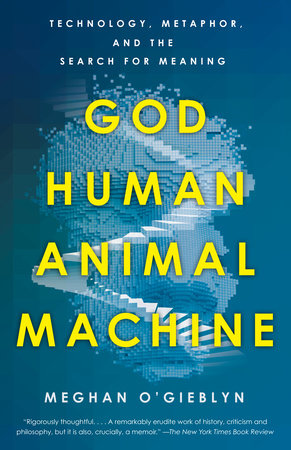
As someone who fervently enjoys contemplating a multitude of perspectives, I found O’Gieblyn’s multidisciplinary approach, as well as the ensuing conversations in our group, fascinating. We poked holes in O’Gieblyn’s account and each other’s interpretations. My peers also offered up passionate remarks, connecting her ideas to counter culture, biology, environmental humanities, and, of course, our dependence on technology.
Today, vast storehouses of knowledge live at the tips of our fingers. Misinformation runs rampant; meanwhile, entire populations are subsumed by digital fatigue. From here, many point to weakened attention spans, but O’Gieblyn offers a different take.
We hold technology today to similar standards that people held gods and religion throughout time. In consumerist North America, we have deified technology as an all-knowing means to fix our issues. We’ve crowned it an authority figure.
But, I would argue it runs deeper than that.
Buried deep in her treatise, O’Gieblyn notes:
“I suppose I came to see language the way that machines regard information, as a purely formal structure of symbols without meaning.”

I don’t think she’s alone in that. Language is imperfect and ever-changing. We rely on devices – metaphor, rhetoric, juxtaposition – because of how unreliable language is. Or, rather, because of subjectivity. We cannot trust that everyone will interpret messages the same. The “right” words to tell a story will differ based on your audience and the experience you contribute as its author.
Up until the modern world, the greater storytelling framework revolved around the divine. As one of my Humanities profs puts it, people understood the world as being of God, by God, and for God. Modernity, on the other hand, flips that script: today, our stories operate around the individual. How does one relate to the world? What do they create? How does every action serve the individual? In her discussion about paradox, O’Gieblyn says something to a similar extent that fundamentally changed my reading of the book:
“In each instance, the only way out of the impasse was to put the ‘I’ back into the story… the ‘I’ was not an expression of hubris, but a necessary limitation… a way to narrow my frame of reference and acknowledge that I was speaking from a particular location, from that modest and grounded place we call ‘point of view.’”
In my first reading of this, I felt like a deer in headlights. Throughout my degree, I’ve grappled with ethical storytelling and the notion of authority. Who can have it? How does it define relationships?
In the group, my peers interrogated why O’Gieblyn approached questions of physics, attention, and religion the way she did. Did she consider environmentalism? Did she consider individual abilities? The questions posed were intriguing, but they speak to the limitations of authority that O’Gieblyn mentions when considering the ‘I.’
The best I can offer is that authority of any kind is fallible. Inserting ourselves into a story can make it more cohesive for the reader, but it also asserts that there are limitations to what any one person can speak to. This holds true for storytelling today, and throughout history.
In an era of AI overviews, clickbait headlines, and partial truths, we must be skeptics. Most importantly, as consumers, I believe that we must question why we accept someone as an authority figure, as well as who benefits and whose voices are ignored when a particular angle is taken.