By Emily Putnam
Behind the scenes at the Senate of Canada, Carleton-trained curators are shaping how the nation’s history is told on Parliament Hill.
Alumni Mike Steinhauer, Meghan Paterson, and Natalie Whidden are three of the four members of the Senate team responsible for preserving Canada’s heritage, curating exhibitions, and stewarding the Senate’s collection. The fourth member, Kaitlin Shimotakahara, ensures the proper care and long-term preservation of the collection.
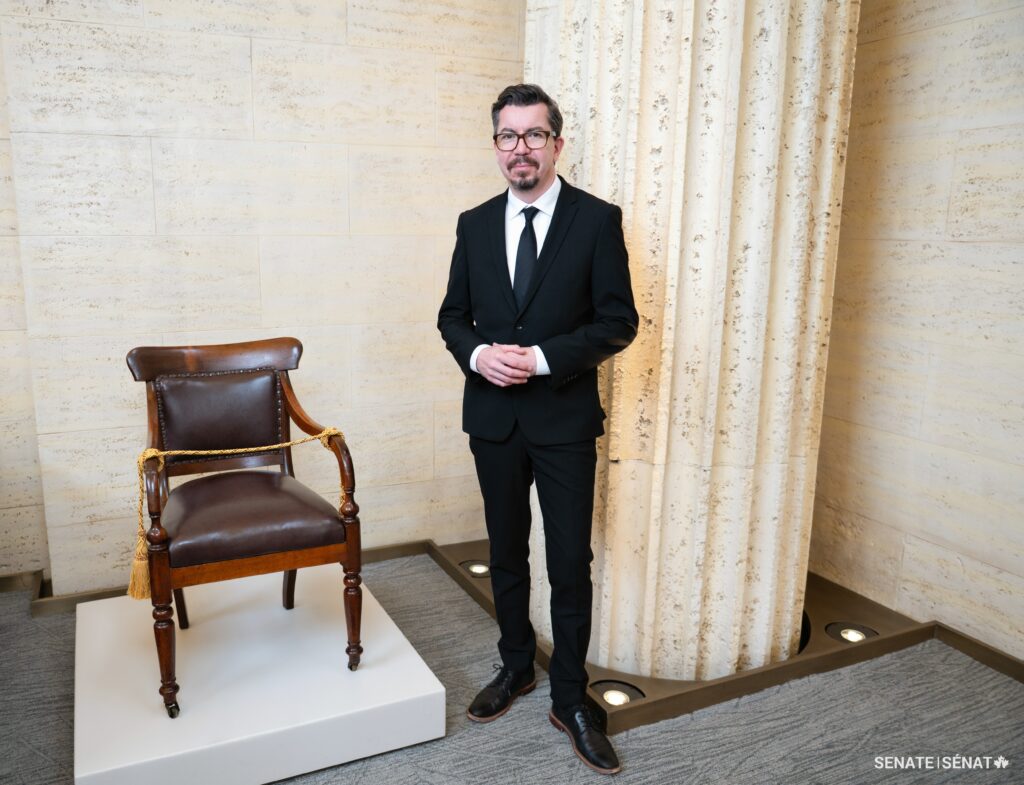
Mike Steinhauer, the Chief Curator of the Senate, completed his master’s degree in the History of Art from the School for Studies in Art and Culture at Carleton in 2016.
His current role includes managing acquisitions, exhibitions and research while ensuring that heritage assets are preserved and made accessible to both Parliamentarians and the public.
“I support the institution’s broader function by overseeing the stewardship of a significant national collection — one that predates Confederation and reflects the evolving history and identity of Canada. Much of the collection remains in active use, integrated into the daily work and ceremonial life of the Senate.”
“It’s a privilege to serve the Senate and help ensure that Canada’s parliamentary heritage is preserved and interpreted today, and safeguarded for future generations.. The collection not only embodies this heritage but also supports the daily functions of the Senate.”
Over the last 155 years, the Upper Chamber’s important collection has grown to include more than 4,600 works of art, ceremonial objects and heritage furniture that are significant to the responsibilities and material culture of the Senate and that celebrate Canadian history, events, ideas and identities.
Many of the items in the artwork and heritage collection can be found displayed in the Senate of Canada Building (former Union Station) in downtown Ottawa or used in routine parliamentary functions, such as the opening of Parliament and Senate sittings.
While at Carleton, Mike Steinhauer’s research focused on architecture—specifically the 19th-century revival styles of Parliament Hill.
“I appreciated the flexibility of the program. Since I was already working in the heritage field here in Ottawa, I needed the ability to spread out my studies over three years—which was entirely manageable.”
Steinhauer says he was immediately drawn to the work of Peter Coffman, Associate Professor, History and Theory of Architecture, whose keen eye and thoughtful writing significantly influenced his research and writing. Coffman also served as his thesis supervisor, further shaping the rigour and direction of his research.
He says Ming Tiampo, Professor; Graduate Supervisor, Art and Architectural History, was also pivotal to shaping his success at Carleton.
“Ming challenged us to think critically while remaining supportive throughout the process. Beyond the classroom, she introduced us to professionals at key national cultural institutions across Ottawa—such as Library and Archives Canada and the National Gallery of Canada—relationships that I continue to draw upon.”
Steinhauer also nods to Carol Payne’s, Full Professor; Associate Dean, Research and International, course on cultural memory and historical discourse as a highlight of his studies.
“The theoretical frameworks we explored around memory continue to inform my current research and curatorial practice. The readings were not only thought-provoking but also quite beautiful; they helped me recognize my own blind spots and gaps. They prompted a deeper reflection on how memory is framed and represented in curatorial work—insights that I carry forward in my practice today.”
He says Carleton helped inform his perspective on curation as both an act of interpretation and self-reflection.
“Carleton helped shape not only what I know about art and art history, but how I see and engage with it. I learned to look at objects and pre-existing narratives with fresh eyes — to ask questions, to be intrigued rather than assume, and to recognize that curation is not just about displaying objects, but about interpreting meaning and situating works within their broader historical, cultural, and social contexts.”
“Importantly, the program also taught me to be aware of my own biases and perspectives as a viewer and curator. I came to understand that every act of selection, interpretation, or display reflects a particular point of view—including my own. That critical, self-reflective mindset continues to guide my work in heritage and curatorial practice today.”
Meghan Paterson, an Assistant Curator at the Senate, says some of her daily responsibilities include planning and coordinating temporary exhibitions, coordinating copyright, collections management tasks like database work and cataloguing, and working with their communications department on products related to the Senate’s Artwork and Heritage Collection.
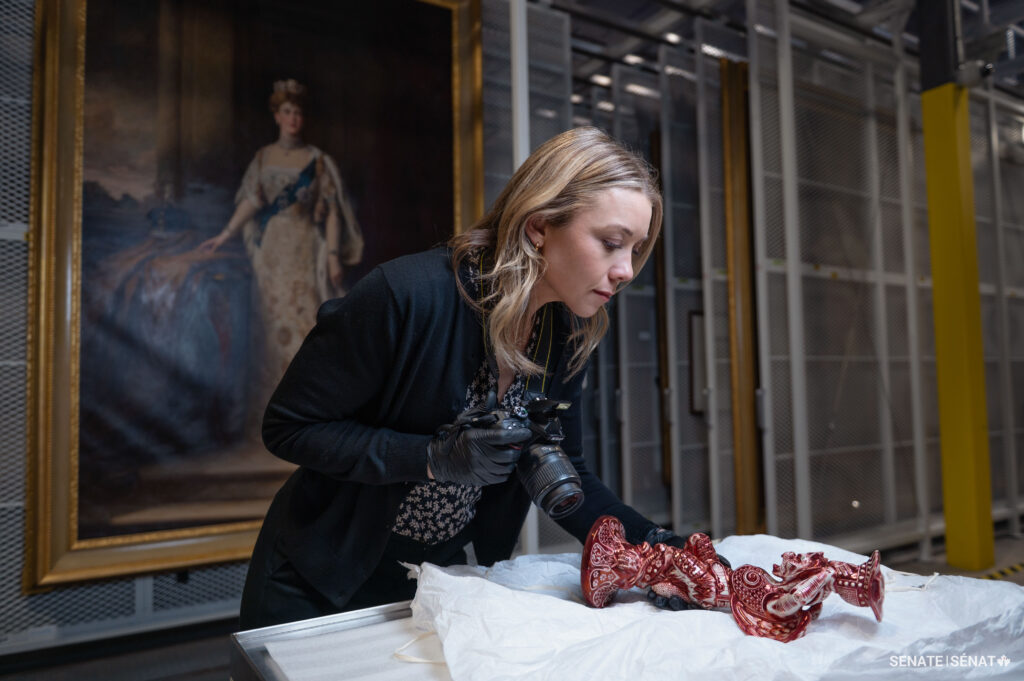
Paterson completed her master’s in Art History at Carleton and specialized in Medieval Art History, specifically architecture.
Like Steinhauer, Paterson studied under Associate Professor Coffman, whose academic influence was a significant factor in her decision to attend Carleton.
She says her placement with the City of Ottawa’s Public Art Program for co-op during her studies helped her gain important experience in her field.
“The practicum was helpful for my career by giving me industry experience for my resume when I was applying to jobs after graduation. I helped with installations, de-installations, worked with artists, cataloguing, and research. It was fantastic.”
She says her time at Carleton broadened her understanding of art history in unique ways.
“My master’s really showed me how to embrace the grey area and bring different art periods into dialogue with each other.”
Her advice to current students is to consider which of their skills or interests are transferable and expand their idea of what working in the museum/curatorial industry could mean.
“There are places other than traditional galleries and museums where they can use their curatorial and museum skills and find meaning in their work.”
Natalie Whidden did her master’s in Canadian Studies (Heritage Conservation) at Carleton and graduated in 2012.
Having known Peter Coffman from her time at Queen’s as an undergraduate, she reached out to him to pursue a directed study focusing on the unique architecture of the Parliament buildings.
She says it was a great starting point to her career on the Hill.
“My time at Carleton ended up being a course in Ottawa’s history. My directed study with Professor Coffman introduced me to the architectural history of the Hill, while coursework in Canadian Studies lead me to a modernist neighbourhood in Ottawa’s east end (which my classmates and I worked to have designated and protected).”
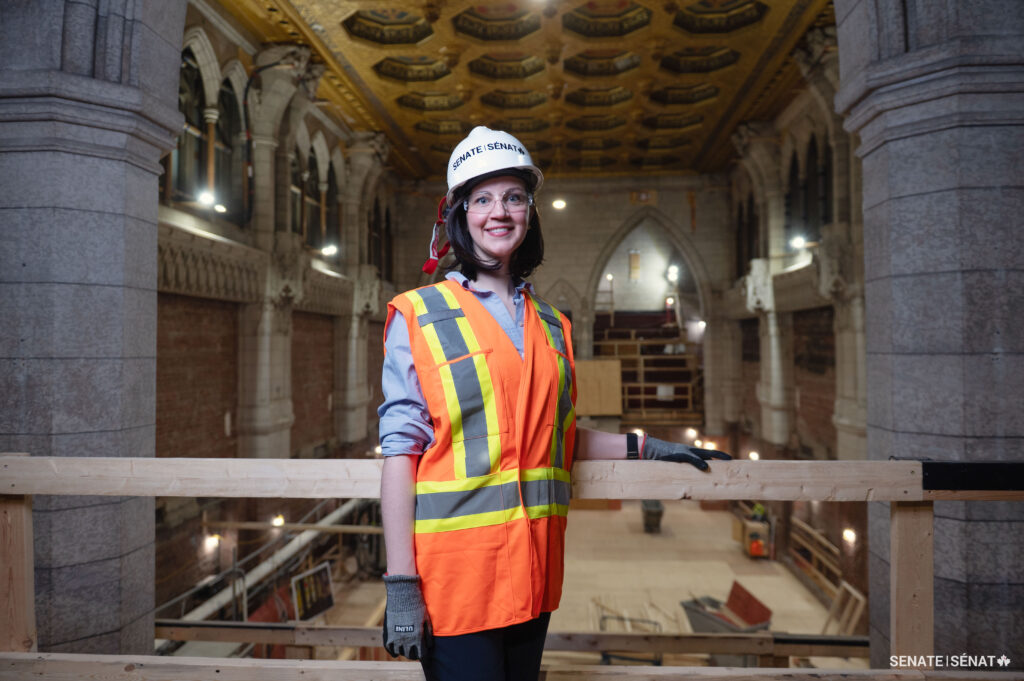
Whidden also worked for the Carleton Archives and Special Collections on projects relating to Carleton’s own history and a separate project on the construction of the Rideau Canal.
As an Assistant Curator, her days are split between internal projects displaying and caring for the Senate’s Artwork and Heritage Collection and external tasks related to the Centre Block Rehabilitation Project.
“Some days I’m planning artwork and decorative schemes for Senate-occupied areas, while others revolve around our working collection of antique furniture. I also attend meetings to ensure heritage considerations are incorporated into the Centre Block’s rehabilitation plans. My position is a great mix of desk work and hands-on tasks, which keeps things interesting.”
For Professor Coffman, the lasting reward for teaching is knowing his graduates are shaping how history and culture are understood today.
“It’s fantastic to see our grads – people I’ve taught – succeed like this. As a teacher, my greatest aspiration isn’t a good lecture, or a successful course, or good year-end evaluations. It’s to see my students out in the world making a difference – not just thriving themselves, but contributing to the community. And to imagine that I played a part, however small, in their trajectory is immensely satisfying and humbling at the same time. In my dotage, that will be the memory I carry with me as proof that it was all worth it.”
He says a degree like HTA (or their sister disciplines of Art History and Canadian Studies) provides graduates with more than just expertise.
“It also equips them intellectually to grasp the big picture through the small details, to analyze complex problems and find creative solutions, and to communicate those problems and solutions to stakeholders. That’s what these three are doing, as custodians of our heritage whose job is to interpret it for the present and leave a legacy for the future.”