Malini Guha Awarded Ruth and Mark Phillips Professorship, Launches Project on Geographical Thinking
By Emily Putnam
Malini Guha, Associate Professor of Film Studies, has been awarded the Ruth and Mark Phillips Professorship (RMPP) for the 2025/27 term.
Guha says she was thrilled to receive the news.
“It is such a joy to be able to think with others — a feat that is difficult to accomplish in the absence of the kind of structures and supports provided by the [RMPP] Professorship. I’m grateful and excited about all the opportunities for collaborative thinking and research that this Professorship will bring.”
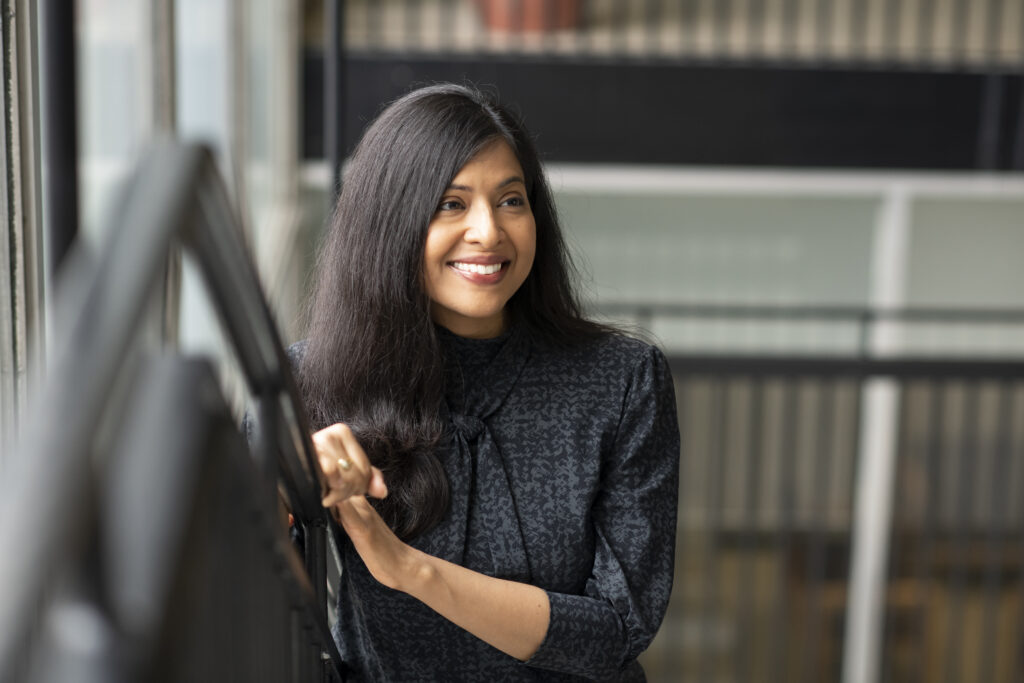
Over the next two years, Guha’s Professorship will help facilitate collective thinking and practice with students and faculty, bringing others into the orbit of her research.
Her focus is to activate ‘geographical thinking’ amongst students and faculty working across different disciplinary contexts. This is what scholars Fred Moten and Stefano Harney describe as ‘a common intellectual practice’ of study, or a form of collaborative thinking undertaken with others.
She approaches the project with two main aims.
“The first is to stimulate geographical thinking amongst scholars and students in ways that resonate with their own existing research practices. The second is to facilitate geographical thinking about the university itself.”
Through this lens, Guha hopes the project informs broader conversations about the institution as a place where colonial and carceral logics are often reproduced.
“Thinking like a geographer means to ask the question of how places came to be and just as crucially, how they can be transformed, re-made, dismantled, and (re)built.”
While her own research focuses on representations of space and place in moving images, the prompt to “think like a geographer” originates from abolitionist geographer Ruth Wilson Gilmore. Guha is especially inspired by how organizers Mariame Kaba and Kelly Hayes extend this concept in Let This Radicalize You: Organizing and the Revolution of Reciprocal Care.
“This insight is difficult to hold onto in a culture that tells us there are no alternatives and that large-scale social transformation isn’t possible. We can, in fact, remake aspects of the worlds we inhabit if we begin to understand exactly how they work and if we embark on such projects with and for others.”
Guha hopes her project helps inform broader political or activist conversations around space, mobility, and resistance.
“Geographers have so much to teach the rest of us about what it means to do this work, but geographical thinking is not simply confined to any one discipline or specialization.”
“As Gilmore teaches us, geographical thinking is key to world-building, which is something that many of us study in the humanities but do not necessarily put into practice at our institutions.”
“I believe that pedagogy is one ‘site’ where the university can be reimagined, where we can begin to think about more praxis-oriented and equitable means of teaching and learning.”
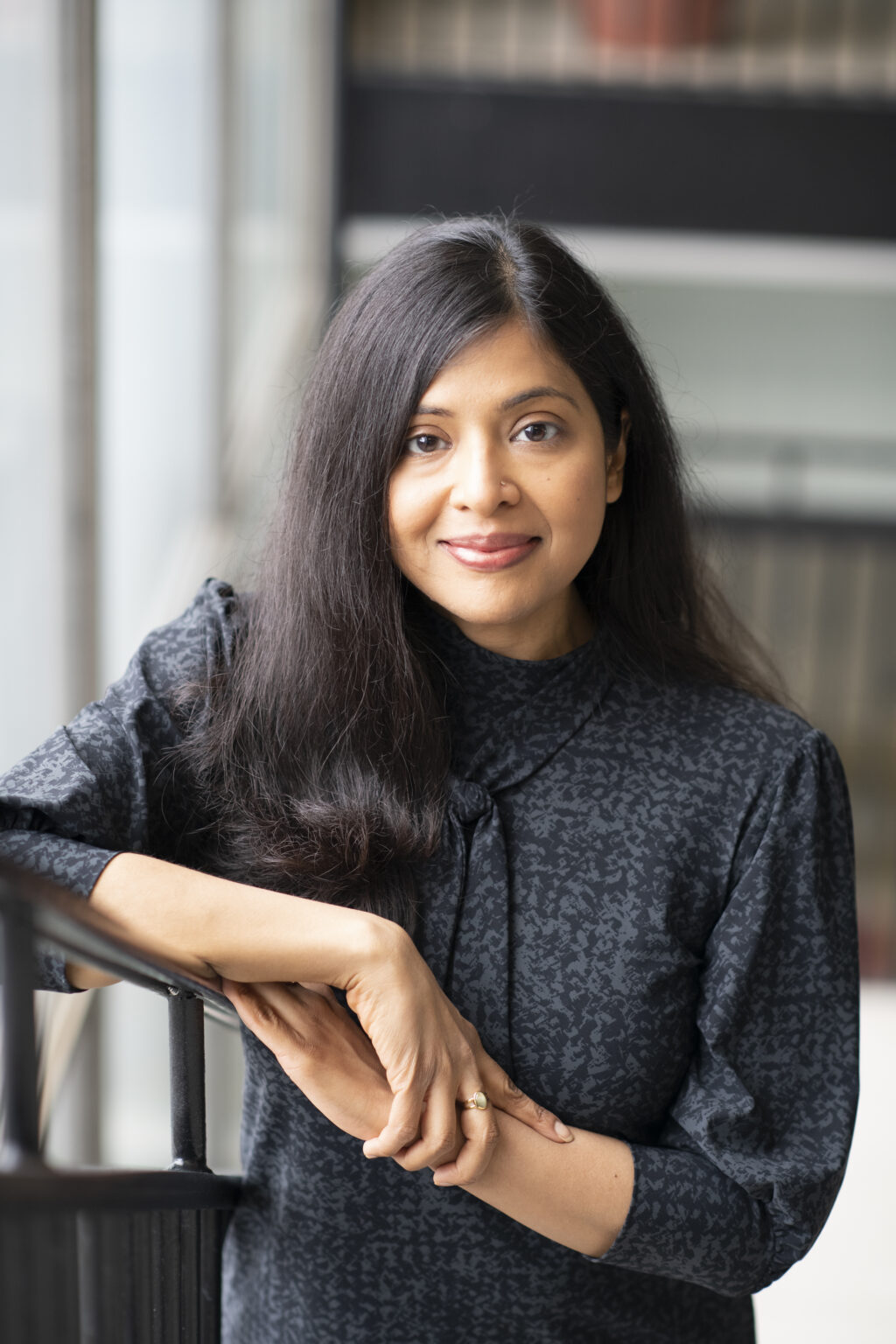
At the heart of her Professorship lies the question of whether geographical thinking can inspire new approaches to curriculum, design pedagogy and assessment. Ones that push through traditional academic frameworks.
As part of the RMPP, she will establish a working group where participants will collectively complete an open educational resource (OER) co-designed by Guha and artist, curator, and scholar Neven Lochhead.
She is also developing a series of talks and workshops designed to support participants in beginning the monumental work of ‘remaking’ the University as a place where community can flourish.
One of the key frameworks informing her project is ciné-geography, a concept that explores how films, particularly militant cinema, are inherently geographical in the ways they move through the world, not just in moving image form, but through manifestos, essays, and pedagogical methods.
“I’m especially interested in artists who pursue geographical thinking via the moving image, in militant film practices and otherwise. But I am also interested in, how someone like me, who analyzes spaces and place in cinema, might begin to think of themselves as a ciné-geographer.”
This shift in self-understanding began as Guha participated in Something Happened, which is a produced intensive designed, curated and organized by Lochhead as part of her SSHRC Insight Development Grant project, On traction: moving images and their realities (2023-2025).
“This new framing of myself not as a scholar, but as a ciné-geographer, yielded a series of insights that has reinvigorated my scholarly approach to cinema and geography. That’s what ultimately led to this Professorship proposal.”
She piloted this concept further in a fourth-year undergraduate seminar on cinema and mobility, where students were encouraged to think like ‘ciné-geographers’ through a range of films and readings.
“Ciné-geography can also be understood as both a positioning and a practice. One that places us in a more active relationship with moving images, their spatial orientations and the methods we use to study them.”
Now she’s especially excited to teach a new doctoral seminar that integrates aspects of the open educational resource (OER) and invites students and faculty from the Institute of Comparative Studies in Literature, Art, and Culture (ICSLAC) to experiment with it.
“I love teaching, and the doctoral seminar and OER offer two different models for stimulating geographical thinking. I’m curious about these two teaching approaches might overlap and influence each other over the course of the Professorship.”
Guha’s Professorship invites students and colleagues to think differently about our university as a place of study and as a place that can be challenged and reimagined together.
Held on a rotating basis by an ICSLAC faculty member entrusted with making a leading contribution to the program, the RMPP is named in honour of Ruth and Mark Phillips, two emeritus ICSLAC faculty members whose lasting contributions helped shape the Cultural Mediations program and the Institute as a thriving academic environment for interdisciplinary doctoral research.