Resource Wars and the Search for Peace
Drawing on 450 interviews, Carleton researcher Evelyn Namakula challenges conventional understandings of conflict in the Democratic Republic of Congo.
For more than two decades, the international community has poured its resources, expertise and peacekeepers into the Democratic Republic of Congo (DRC). And yet, lasting peace has remained painfully out of reach.
For Dr. Evelyn Namakula, a human rights professor and researcher in the School of Interdisciplinary Studies at Carleton University, that persistent failure points to a more fundamental problem — that the people in power are looking for solutions in the wrong places. The powerful neglect local people’s agency, cultures and knowledge systems.
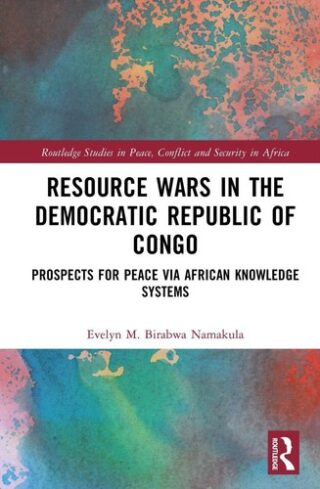
This is a foundational tenet of Namakula’s new book, Resource Wars in the Democratic Republic of Congo: Prospects for Peace via African Knowledge Systems, the culmination of years spent trying to understand not only why conflict in the DRC persists, but why so many attempts to end it have been unsuccessful.
Namakula grounds her analysis in the experiences of those living with the consequences. The book draws on more than 450 interviews, many conducted with people in communities that endure the armed conflicts and resource plunder especially since 1996. However, their experiences and knowledges have too often been absent from conversations about the DRC’s present and future.
“Without engaging the Congolese at the grassroots, their cultures and their values, peace and security will continue to remain in limbo.”
Listening, however, carries a tremendous weight.
Over years of research in the DRC, Namakula has spoken with families displaced by violence and mining from their homes, former and current child soldiers, politicians, military personnel, NGOs, civil societies, militia members, people living alongside unfathomable mineral wealth while desperately struggling in poverty, and survivors of violence that she sometimes still finds difficult to comprehend.
There are times, she says, when the experiences of these people follow her.
“Sometimes I close my office/room door when their stories come and what I have seen,” Namakula says. “And I find that tears are flowing from my eyes.”
Namakula explains that the emotional weight of those encounters shaped the way she researched and wrote Resource Wars. Drawing on her work across political economy, colonial history, human rights, natural resource governance, peace and security, and African Indigenous philosophy, she grounds the book in the knowledge and lived experience of Congolese people. Their voices, in turn, have shaped her understanding of what a lasting peace might actually look like.
Tracing the conflict through history and first-hand accounts
Namakula has spent much of her career studying resource-based conflict, peacebuilding and the political economy of extraction. Her work fits naturally within the interdisciplinary terrain of Carleton’s Human Rights and Social Justice program, where questions about rights — who defines them, who protects them and, often, who gets left outside their protection — are inseparable from questions about power.
Few places bring those questions into sharper relief than the DRC.
Rich in cobalt, copper, gold, coltan, cassiterite, tungsten and other minerals increasingly central to the digital transition, renewable energy and the global economy, the country has endured decades of armed conflict, foreign intervention, political instability and resource exploitation. The United Nations has maintained a peacekeeping presence there since 1999, with little lasting peace and security to show for it.
“There is no peace and security,” she says. Over time, she describes in the book, many Congolese have lost trust not only in their own political leadership, but in the international institutions, governments, corporations and non-governmental organizations that have arrived promising assistance.
Rather than locating the conflict within a single failed institution or political moment, Namakula approaches it simultaneously at three interconnected levels: national, regional and international. Congolese political leadership matters. So do the regional politics of neighbouring states. But so, too, do multinational corporations, foreign governments and international institutions operating in a country whose resources have long been coveted far beyond its borders.
“You cannot have peace without bringing these three together,” she says. “They are so interconnected.”
It is an argument rooted in history and Resource Wars reaches back through the DRC’s brutal experience of European colonialism and follows its legacy through post-independence politics, regional conflict and the contemporary greed driven global scramble for minerals.
That history provides the book’s broader framework, while Namakula’s years of field research brought another dimension to her understanding of the conflict. At times, what she heard challenged her own assumptions. Before undertaking the research, for instance, she says she tended to think of militia leaders as simply perpetrators of violence. Then she met “James,” a pseudonym she gives to one of the men she interviewed.
He described a life in the forest, separated from his wife and children, and asked Namakula a question: did she think this was the life he would have chosen?
“I would have loved to be in a decent home with my family,” she recalls him telling her. “Circumstances force me to be here (in a forest).”
Other encounters contested her assumptions about child soldiers and armed groups. She met educated people, including university graduates, whose lives had been overtaken by tragedy. Again and again, she heard about hunger, lost parents, absent employment, insecurity and governments unable or unwilling to protect their communities.
“Circumstances force people into these behaviours, this violence,” Namakula says.

“Walking on gold”
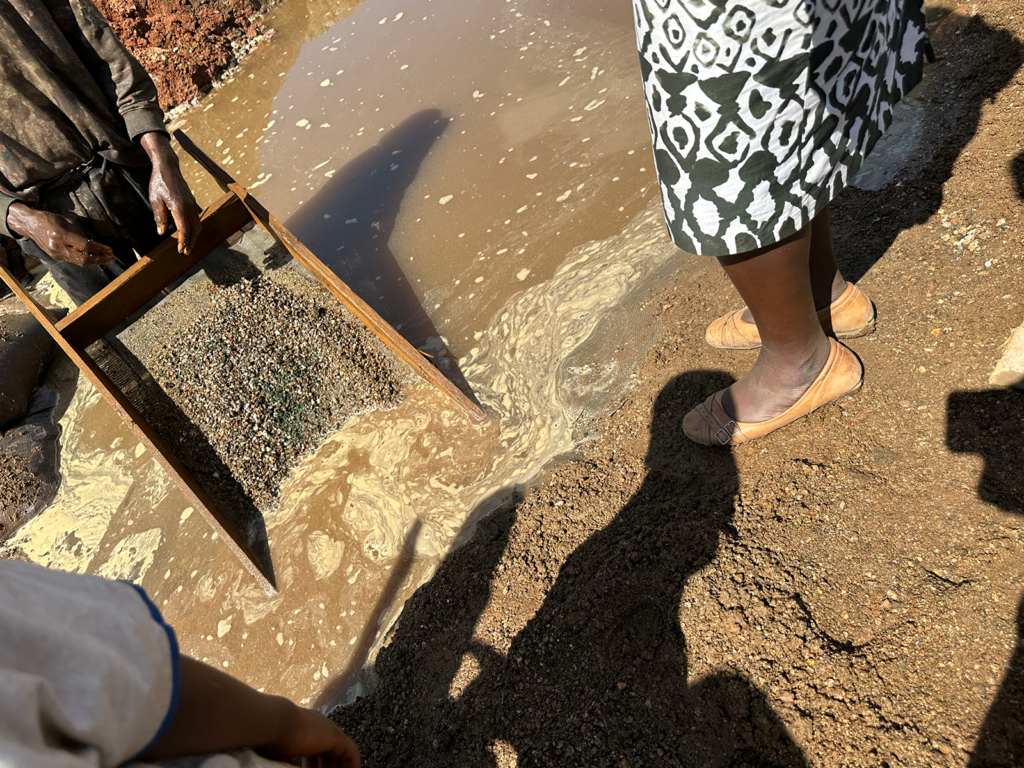
The DRC’s extraordinary natural wealth has done remarkably little to enrich or protect many of the people who live there — a contradiction that runs throughout Resource Wars. “You can walk along the banks of rivers, and you literally see gold,” Namakula says. “People say, ‘We are walking on gold, but we are always languishing in poverty.’” This cruel paradox has become even harder to ignore in an era of electric vehicles, smartphones, renewable energy technologies and growing competition for critical minerals.
“Today, I think none of us can claim that we don’t have any metals or minerals from Congo. The gadgets that we use, that we have made part of our lifeblood, contain Congo’s minerals and metals.”
At the same time, the language surrounding the green transition is overwhelmingly optimistic: electrification, decarbonization, green energy, modernization. Namakula asks what that transition looks like from the places where the materials enabling it are actually removed from the earth.
In the mineral-rich Katanga region, she describes a landscape where mining concessions can be heavily protected even while surrounding communities remain vulnerable. Homes and community infrastructure can give way to extraction. Elsewhere, particularly in eastern Congo, competition for resources intersects with armed conflict and regional geopolitics.
The forms of violence may look different, Namakula says, but they are connected by the same systems of extraction. The distance between “there” and “here (Canada),” she argues, is much smaller than we often imagine. That places some responsibility on the consumer societies benefiting from the DRC’s resources.
Namakula’s critique also extends beyond individual purchasing choices and interrogates the systems that make them possible: corporations doing the extracting, governments pursuing access to critical minerals, international institutions overseeing peace and development, and an economic order capable of turning instability itself into an opportunity for profit.
“We have created a world I think, where politics lies to us and tells us that we are separate from what’s happening in the DRC because of the national borders and categorization such as developed and developing world, core and peripheral states,” she says. “But in reality, we are deeply interconnected. Climate change is teaching us that lesson”
Human rights for who?
For Namakula, that interconnectedness also makes what’s happening in the DRC a Canadian story.
Before coming to Carleton University, Canada’s international reputation for peacekeeping and multilateralism was part of what made the country appealing to her as a place to live and work.
Today, she is less certain.
Canadian mining interests are among those operating in and connected to the region, and Namakula worries that Canada’s growing focus on critical minerals and economic interests risks reproducing some of the same top-down thinking where core states exploiting peripheral states, which her book challenges.
Economic considerations are real, she acknowledges. Governments cannot simply ignore them. “But I think we need to think deeply.”
If human rights are universal, Namakula asks, what happens when protecting them conflicts with economic interests? And if the technologies powering wealthier countries’ transition toward a greener future depend upon extraction elsewhere, what obligations travel with the minerals?
Resource Wars is not purely an indictment of failed approaches. Namakula also looks toward Afro-centric peacebuilding and African indigenous knowledge systems, including expressions of Ubuntu rooted in human interdependence. Her proposal is not to reject international cooperation. Instead, she imagines local, national, regional and international actors working together, but with Congolese people participating as protagonists rather than recipients of solutions devised elsewhere.
“I don’t want people also to retreat into too much nationalism, this mentality of that we have to fight for ourselves,” she says. “I dream of a global society, where we genuinely care for each other regardless of national and racial differences.”
Despite everything she has encountered through her research, Namakula remains hopeful.
Not because the systems she studies have given her much reason to be. Her hope comes from the people themselves.
“When you go to the grassroots,” she says, “you find that people have not lost hope, who want peaceful change.”
One such person who Namakula met in the DRC stays with her.
The woman knew Namakula lived in Canada, a country she had never visited and imagined as belonging to people very different from herself. But she wanted Namakula to carry a message back.
“When you cut me, the same blood will flow,” Namakula remembers her saying. “Tell them that we are also human beings here.”
For Namakula, it comes back to this.
“We survive in the measure that we treat each other as human beings,” she says, “and care for each other.”